
Blog
Who Offers the Best Florida After-the-Fact Permit Help?
Discover how Florida's best after-the-fact permit help works, what building departments require, and how to legalize unpermitted work fast.
Key Takeaways
-
Identify the correct jurisdiction first — each of Florida's 67 counties and hundreds of municipalities has its own after-the-fact procedure, fee schedule, and requirements, so confirming local rules early saves significant time and avoids costly rework.
-
Hire a Florida permitting specialist for complex or structural work rather than attempting it yourself; specialists know local playbooks across all counties, coordinate licensed design professionals, and handle plan review responses — preventing delays and stop-work orders.
-
Professional certification by a licensed design professional can often eliminate the need to open walls and ceilings for inspection, making the process faster and less invasive than visual verification alone.
-
Unpermitted work must be disclosed before selling or refinancing; lenders and title companies flag open permits during due diligence, so resolving it proactively prevents closing delays and deal derailment.
-
Prepare complete as-built documentation including drawings, photos, site plans, and sealed engineer letters before submitting; missing paperwork triggers rejections and extended review cycles that a permitting team can assemble efficiently.
-
If concealed work fails code inspection, the building department may require corrections or demolition; catching noncompliance early through after-the-fact permitting is far better than discovering violations post-sale or during insurance claims.
So, your home inspector just found a lanai enclosure, a converted garage, or a swapped-out electrical panel that never got a permit. Take a breath — you are not alone, and this is fixable. Every week, Florida homeowners, real estate agents, and contractors discover unpermitted work hiding behind drywall, and every week, good people work through the process and come out the other side with a clean file. The trick is knowing who to call and what the local building department with jurisdiction over the property actually expects from you.
This guide walks you through what "after-the-fact" really means in Florida, how the process works county by county, and how to find the best help for your specific situation — whether you are a homeowner trying to sell your house, a general contractor cleaning up a subcontractor's mess, or a solar company documenting a system that got installed a little too fast. Let's make this simple and a lot less scary.

What Does "After-the-Fact" Permit Help Actually Mean in Florida?
In plain English, after-the-fact permitting means applying for a permit after construction has already started or finished. It is not a magic statewide form or a one-size-fits-all penalty system. Instead, it is handled locally, by the specific building department that has jurisdiction over your property, under Florida Statutes §553.79 and the local code enforcement procedures that department has adopted.
That statute generally requires a permit before covered construction, alteration, repair, or demolition begins. When that step gets skipped — often because a homeowner didn't know better, or a contractor cut corners — the enforcing agency still gets to review the work, ask for documentation, and decide whether it meets code. A good building department lookup tool can help you confirm exactly which office you're dealing with, since jurisdiction lines don't always match city limits.
Why There Is No "One Size Fits All" Fix
Every county and city in Florida runs its own after-the-fact procedure. Some departments want four copies of specific forms. Others require a licensed design professional to physically inspect and certify concealed work before anything moves forward. This is exactly why working with a team that understands Florida's permitting landscape across all 67 counties saves so much frustration — you get someone who already knows the local playbook instead of learning it from scratch.
How the After-the-Fact Permit Process Works
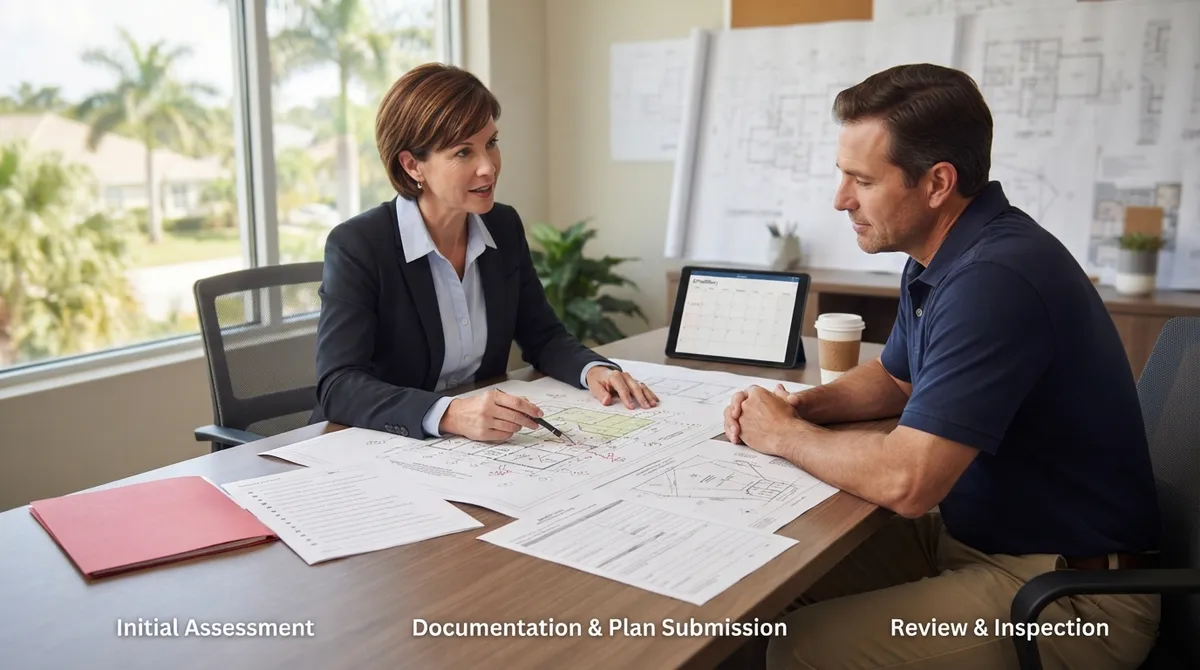
While details vary, most Florida jurisdictions follow a similar rhythm. Here is the general sequence you can expect:
- Identify the correct jurisdiction. Confirm which building department has authority over the property — county, city, or a special district.
- Document existing conditions. This usually means as-built drawings, photos, and sometimes a full survey of what was actually built versus what code requires.
- Submit the application package. This includes the after-the-fact permit application, supporting plans, and any required affidavits.
- Coordinate professional certification. If structural or MEP work is concealed and can't be visually inspected, a Florida-licensed design professional may need to certify it meets code.
- Respond to plan review comments. Reviewers may ask questions or request revisions before approval.
- Schedule and pass inspections. Some inspections may require opening walls, ceilings, or other finishes if the original work can't be verified otherwise.
- Receive permit closeout. Once everything checks out, the permit is finaled and the property record is updated.
Indian River County's published after-the-fact procedure is a helpful real-world example. For structural alterations or additions that are no longer open for inspection, it calls for certification by a Florida-licensed design professional, a detailed report, and signed-and-sealed construction documents — plus multiple copies of the application package. Other counties may ask for something slightly different, which is why confirming local requirements early saves time later.
What Documents Do You Actually Need?
Nobody wants to show up to the building department with the wrong paperwork and get sent home. Here's a general checklist of what's commonly requested:
- Completed after-the-fact permit application (department-specific form)
- As-built drawings showing existing conditions
- Signed-and-sealed structural or MEP documents, if concealed work is involved
- Photos documenting the work, if available
- Property survey or site plan, depending on scope
- Proof of licensed contractor or owner-builder status
- Any required affidavits or certification letters from a design professional
Our team handles this documentation constantly through our as-built drawings service and our engineer letters service, both of which are common requirements for legalizing existing construction.
Will You Have to Open Walls or Ceilings?
This is probably the question that keeps people up at night. The honest answer: it depends. If inspectors cannot verify concealed structural or system work through drawings, photos, or professional certification, they may require opening finishes to visually confirm compliance. This is more common with electrical, plumbing, or structural framing than with straightforward cosmetic work.
A licensed design professional's certification can sometimes avoid the need to open everything up, which is one reason having in-house structural engineering support matters so much during this process. When our own engineers can inspect, document, and seal the certification, it moves faster and with fewer surprises.
How Much Does After-the-Fact Permitting Cost in Florida?
There is no single statewide fee, but here is a general breakdown of what property owners typically encounter:
| Cost Category | What It Covers | Notes |
|---|---|---|
| Standard permit fee | Base cost of the permit itself | Set locally by the building department |
| After-the-fact penalty fee | Additional charge for work started without a permit | Authorized under FBC §109.4; amount is jurisdiction-specific |
| Design professional certification | Inspection, report, and sealed documents | Required when concealed work can't be visually verified |
| Plan review or resubmittal fees | Cost of reviewer comments and corrections | Varies by project complexity |
| Administrative fines (unlicensed contracting) | Penalties under Florida Statutes §489.13 | Up to $10,000 in specified circumstances — not automatic |
If you want a clearer sense of your specific numbers before diving in, our team can walk through the likely costs for your property and jurisdiction — just get a free quote and we'll map it out.
Who Should Handle Your After-the-Fact Permit?
You technically have a few options here, and it's worth knowing the tradeoffs before you pick one.
Doing It Yourself
Some homeowners try to handle after-the-fact permitting on their own. It can work for simple cases, but the paperwork, code research, and back-and-forth with reviewers eat up time fast — and mistakes can trigger delays or even stop-work orders.
Hiring Your Original Contractor
If the contractor who did the original work is licensed, in good standing, and willing to help, this can be a smooth path. But many after-the-fact situations involve contractors who are no longer available, unlicensed, or unwilling to get involved.
Working With a Florida Permitting Specialist
This is where a dedicated permitting team earns its keep. A specialist can identify the correct authority having jurisdiction, assemble your application and as-built documents, coordinate licensed design professionals, respond to plan review comments, and schedule inspections — all without you needing to become a part-time code expert.
At 1 Contractor Solutions, our after-the-fact and expired permits team takes on the files other firms decline. Because our drafting and engineering departments are in-house, when a reviewer flags something, we fix it ourselves instead of waiting on an outside consultant. We work across all 67 Florida counties and have filed in more than 400 municipalities, so we already know the local quirks before your project even starts.
Comparing Your Options at a Glance
| Option | Best For | Main Risk |
|---|---|---|
| DIY submission | Simple, single-trade projects | Time-consuming; easy to miss local requirements |
| Original contractor | Projects with a cooperative, licensed contractor still active | Contractor may be unavailable or unlicensed |
| Permitting specialist firm | Complex, structural, or multi-jurisdiction projects | Requires selecting an experienced, responsive partner |
What Happens If Unpermitted Work Doesn't Meet Code?
Sometimes the news isn't great — a review or inspection reveals that the existing work doesn't meet current Florida Building Code requirements. When that happens, the building official may require corrections, partial demolition, or a full rebuild of the noncompliant portion. It's not the outcome anyone wants, but catching it now, before a sale falls through or an insurance claim gets denied, is almost always better than finding out later.
This is also where code compliance violations support becomes valuable — having a team that can negotiate corrections with the building department, rather than just reacting to a citation, often shortens the timeline considerably.
Selling or Refinancing With Unpermitted Work
If you're a real estate professional or property owner trying to close a sale or refinance, unpermitted work can absolutely hold things up. Lenders and title companies frequently flag open permits or undocumented construction during due diligence. Our realtor and closing support service exists specifically to help clear these issues before they derail a closing date.
Special Considerations for General Contractors and Solar Companies
General contractors managing multiple properties often inherit after-the-fact situations from previous owners or subcontractors. Having a reliable partner for permit facilitation and filing across jurisdictions like Hillsborough County, Pinellas County, and Manatee County means less time spent chasing paperwork and more time keeping crews on schedule.
Solar companies face a slightly different challenge: distributed energy systems installed without proper structural or electrical documentation can trigger after-the-fact requirements tied to both roofing and MEP code. Coordinated MEP engineering documentation helps demonstrate compliance quickly, which matters when a homeowner is waiting on utility interconnection approval.
A Quick Reality Check on Florida Statutes
It helps to know the legal backdrop here, even in plain terms:
- Florida Statutes §553.79 requires permits before most construction begins and sets permit duration rules (a single-family dwelling permit generally expires one year after issuance or when the next Florida Building Code edition takes effect, whichever is later).
- Florida Statutes §489.13 addresses unlicensed contracting, including potential administrative fines up to $10,000 in specified circumstances.
- Florida Statutes §489.127 lists commencing permit-required work without an effective permit among prohibited acts.
These statutes don't mean every homeowner faces the same penalty — they simply establish the legal framework that local departments operate within. You can review the full statutory language directly through the Florida Online Sunshine statutes database if you want to dig into the details yourself.
Why Local Experience Matters So Much
Florida has 67 counties and hundreds of municipalities, each with its own after-the-fact checklist, fee schedule, and review culture. What flies in Miami-Dade County might get bounced back in Broward County. That's why working with a permitting team that has actually filed in your specific jurisdiction — not just "somewhere in Florida" — makes such a measurable difference in approval speed.
We've built our process around exactly that kind of local fluency, and it shows in the results our clients see. You can visit us on Google — 1 Contractor Solutions to read what homeowners, contractors, and realtors have said about working with our team on real after-the-fact cases.
Bringing It All Together
After-the-fact permitting can feel intimidating, but it is genuinely one of the most solvable problems in Florida real estate and construction. The building department isn't trying to punish you — it's trying to confirm the work is safe, and most departments genuinely want to help you get there. With the right documentation, the right professionals, and a little patience, unpermitted work becomes permitted work, and life moves forward.
If you're staring down an open violation, a stalled sale, or a pile of paperwork you don't know where to start with, our team is ready to help. We answer calls 24/7, respond within 30 minutes day or night, and se habla español. Reach out today to get a free quote and let's get your permit history cleaned up for good. You can also follow us on LinkedIn or follow us on Facebook for more Florida permitting tips and updates.
FAQs
How do I get an after-the-fact building permit in Florida?
You'll start by confirming which building department has jurisdiction over your property, then gather as-built drawings and any needed professional certifications before submitting the application. It sounds like a lot, but a permitting specialist can carry most of that load for you, so don't feel like you have to figure it all out solo!
Which Florida building department handles my after-the-fact permit?
It depends on your property's location — county, city, or a special district may have jurisdiction, and the lines aren't always where you'd expect. A quick lookup through the correct local office (or a permitting team that already knows the boundaries) will clear this up in minutes.
Will I have to open walls or ceilings for an after-the-fact inspection?
Maybe, but not always. If a licensed design professional can certify concealed structural or system work through documentation and inspection, it sometimes avoids the need to open finishes — which is exactly why good engineering support matters here.
How much does an after-the-fact permit cost in Florida?
Costs vary by jurisdiction and typically include the standard permit fee plus an additional after-the-fact fee, and possibly certification or plan review costs. There's no single statewide number, so getting a project-specific estimate is the best way to plan your budget.
Can I sell or refinance a Florida property with unpermitted construction?
It's possible, but unpermitted work often gets flagged during closing or refinancing, which can delay everything. Clearing the permit before you list or refinance is usually smoother than trying to negotiate around it at the closing table.
We do this work every day across all 67 Florida counties. Call (866) 314-6931 and we will tell you what your situation actually requires — including when you do not need us.
Related services
Permit Facilitation & Filing
You have a crew scheduled, a client asking for dates, and a permit sitting somewhere in a queue you cannot see. We file it, w…
See the servicePlan Review Coordination
A permit in plan review is not one queue. On a commercial project it can be six queues, each with its own reviewer, its own c…
See the serviceReady to get your permit moving?
One call tells you which jurisdiction controls your project, what it will take, and what it will cost. Most of the time we can scope it on the phone.