
Blog
What Does a Tenant Improvement Permit in Port Charlotte Need?
Learn what a tenant improvement permit in Port Charlotte involves, from jurisdiction checks and plans to inspections, fees, and the Notice of Commencement.
Key Takeaways
-
A tenant improvement permit is usually required when work alters layout or touches regulated electrical, plumbing, mechanical, or fire systems; cosmetic-only work like paint is often treated differently.
-
Port Charlotte is a place name, not a permitting authority, so verify your parcel's jurisdiction using the parcel number and property address before drafting plans or paying fees.
-
Starting regulated work before the permit is issued can trigger penalties and complicate your Certificate of Occupancy or Certificate of Use, so do not begin until approval is in hand.
-
Submit clear, complete plans showing the full extent of work, with signed and sealed drawings where required, since vague submittals are a fast route to comment letters and delays.
-
A Notice of Commencement is required in Charlotte County for improvements with a direct contract price over $5,000 and must be submitted before the first inspection.
-
Do not cover work that still needs inspection, since covered work that missed its inspection can force you to open walls or provide engineering verification.
You signed the lease, the paint swatches are taped to the wall, and your contractor has a crew ready to start Monday. Then someone asks the question that stops everything: "Did you pull the tenant improvement permit?" If you are working in Port Charlotte, that is a fair question, and a good one to ask early. A tenant improvement permit in Port Charlotte is the approval that lets you legally alter the inside of a commercial space, from new partitions to updated electrical, plumbing, and mechanical systems.
The good news is that this process is very doable when you know the steps. The tricky part is that Port Charlotte is a community name, not a permitting authority, so the first job is figuring out who actually reviews your project. This friendly guide walks through what a tenant build-out permit usually involves, which plans and reviews to expect, how the Notice of Commencement fits in, and how to keep your schedule from slipping. Always confirm current details with the building department, because forms, fees, and code editions change.
What Counts as a Tenant Improvement in Port Charlotte?
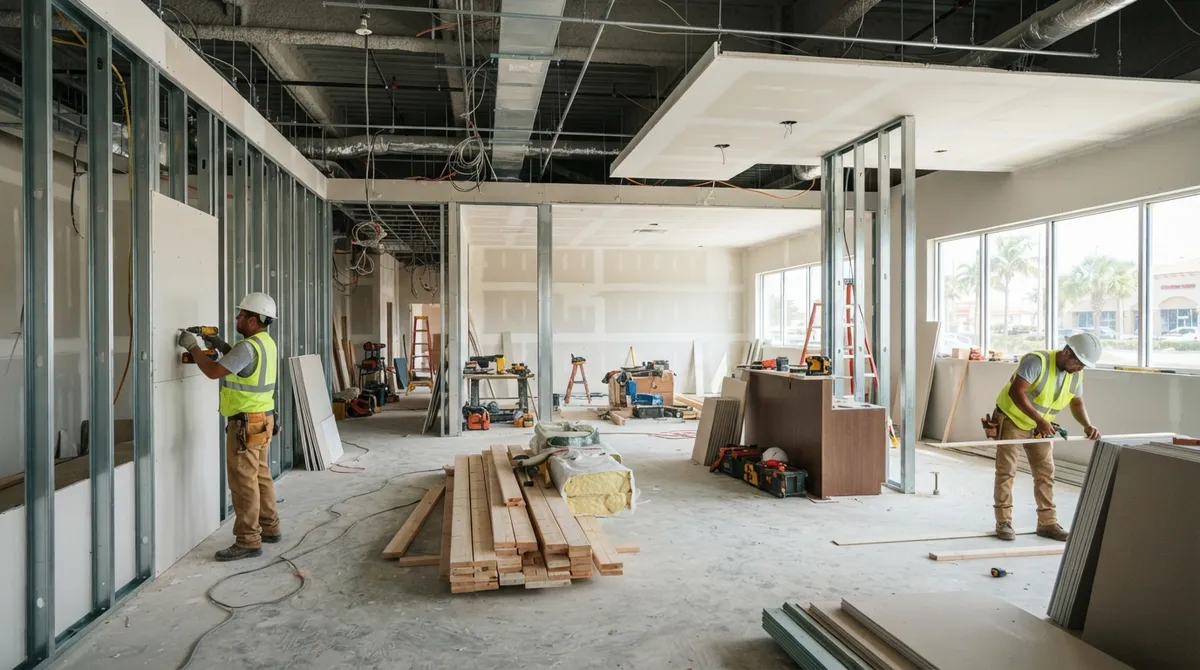
A tenant improvement, often shortened to TI, is interior work that adapts a commercial space for a specific occupant. Think of a vacant retail shell becoming a salon, or an older office suite turning into a dental practice. In Charlotte County, this type of work generally falls under the commercial remodel category.
The county describes interior remodels as work inside a building, including work that creates multiple business units. Electrical, drywall, and plumbing work are common parts of these projects. If your scope changes the building or touches regulated systems, plan on needing a permit.
Typical tenant improvement scopes include:
- New or relocated non-load-bearing partitions and doors
- Ceiling, lighting, and electrical panel or circuit changes
- Restroom additions or plumbing fixture relocations
- HVAC modifications, duct changes, or new equipment
- Fire alarm, sprinkler, or egress adjustments
- Finishes that trigger accessibility or fire-rating requirements
Cosmetic-only updates, such as paint, are often treated differently than systems or layout changes. Because exemptions depend on the exact scope, ask the building department before you assume a project is permit-free.
Who Issues Your Permit? Check the Jurisdiction First
Here is a surprise that trips up many business owners: Port Charlotte is a place name, not proof that your parcel sits in unincorporated Charlotte County. Permitting authority and procedures can differ by location, so verify your parcel's jurisdiction before you draw a single line or pay a single fee.
Charlotte County lists Commercial Remodel among its commercial permit types and provides online application, plan review, inspection, and closeout processes. That is a helpful roadmap if your property falls under the county. If it does not, a different office may control your project.
A quick way to avoid wasted effort is to confirm the following before you start:
- Pull your parcel number and property address from the lease or tax record.
- Confirm which agency has authority over that parcel.
- Download the current application checklist from that agency.
- Note the code edition and any local amendments referenced.
- Ask whether a pre-application meeting is available for your scope.
If you are unsure, our guide to which Florida jurisdiction reviews your project explains how to sort this out, even near tricky city lines.
Do You Actually Need a Permit for a Tenant Improvement?
In most cases, yes. A tenant improvement or commercial interior remodel may require a building permit when the work alters a building or touches regulated electrical, plumbing, mechanical, or gas systems. Charlotte County cites Florida Building Code Section 105.1 as the basis for requiring permits.
Why does this matter so much? Because unpermitted work can create problems that follow you. The county warns that work started without a permit may incur a penalty, and unresolved issues can complicate your Certificate of Occupancy or Certificate of Use later.
Here is a simple way to think about it:
| Scope of Work | Permit Likely Needed? | Why |
|---|---|---|
| New partition walls | Usually yes | Alters layout, egress, and possibly fire rating |
| Electrical panel or circuit changes | Yes | Regulated electrical system |
| Restroom or plumbing fixture changes | Yes | Regulated plumbing system |
| HVAC replacement or duct changes | Usually yes | Regulated mechanical system |
| Paint or simple finishes | Often no | Cosmetic, but confirm with the authority |
When in doubt, a short call to the building department or a permitting professional can save you weeks of rework. If you have already done work without approval, do not panic, because there are paths forward. Our article on how to fix a commercial build-out without a permit in Florida lays them out.
Which Reviews Can a Tenant Build-Out Trigger?
A tenant improvement is rarely just "one permit." The county's commercial permit process can include building, electrical, plumbing, mechanical, fire, zoning, and other reviews depending on the scope and the site. Think of it as a team of reviewers, each checking their own piece of the puzzle.
Here is a quick snapshot of how those reviews often line up:
| Review Type | What It Looks At | When It Commonly Applies |
|---|---|---|
| Building | Layout, egress, accessibility, fire separation | Nearly every TI |
| Electrical | Panels, circuits, lighting, load | New lighting, panels, or equipment |
| Plumbing | Fixtures, drains, water supply | Restrooms, sinks, kitchen equipment |
| Mechanical | HVAC, ventilation, exhaust | New or modified air systems |
| Fire | Alarm, sprinklers, extinguishers | Layout changes or occupancy shifts |
| Zoning | Use, parking, signage, site impacts | New use or site-related changes |
Because systems overlap, a change to one often affects another. Adding a restroom, for example, touches plumbing, may change ventilation, and can alter your accessibility layout all at once. Coordinating these reviews is a big part of why many owners lean on experienced help. You can read more about that service on our plan review coordination page.
What Plans and Documents Should You Prepare?
Reviewers can only approve what they can clearly see. The county's commercial permit guidance says plans should clearly show the full extent of proposed work and calls for signed and sealed plans where applicable. A vague sketch is the fastest route to a comment letter and a delay.
A solid submittal package often includes:
- A completed permit application for the correct permit type
- Architectural floor plans showing walls, doors, and finishes
- Life-safety and egress information
- Electrical, plumbing, and mechanical drawings when those systems change
- Structural information if any structural element is affected
- Contractor and licensing details
- Owner or landlord authorization when required
This is where drafting and engineering quality really pays off. Clean, code-aware drawings reduce back-and-forth with reviewers. If you are wondering who is allowed to put a seal on what, see who seals structural drawings for Florida permits. For plan sets built to move through review, explore our commercial plans and MEP engineering services.
If you want a deeper look at what makes plans approval-ready, our post on how to get permit-ready plans Florida officials approve is a helpful companion read.
How Does the Charlotte County Process Work Step by Step?
Charlotte County provides online permit application and digital plan-room services. Its Building Construction division describes a sequence of application intake, plan review when required, permit issuance, inspections during construction, and finalization with a Certificate of Occupancy or Certificate of Completion as appropriate.
Here is how that journey typically unfolds:
- Confirm jurisdiction and scope. Verify the parcel's authority and define exactly what you are building.
- Prepare plans. Have drawings (sealed where required) that show the full extent of work.
- Submit online. File through the county's online application and digital plan-room tools.
- Respond to plan review. Address reviewer comments and resubmit as needed.
- Pay fees and obtain the permit. Do not begin regulated work until the permit is issued.
- Record and post the Notice of Commencement. Required when the contract price exceeds the county threshold.
- Schedule inspections. Call for each required inspection as work progresses.
- Close out. Finish with the appropriate Certificate of Occupancy or Completion.
Each of those handoffs is a place where a project can stall. A missing seal, an unanswered comment, or a skipped inspection can pause everything. If your timeline is tight, it helps to have someone tracking every stage. Our permit facilitation and filing team does exactly that.
What Is a Notice of Commencement, and When Do You Need One?
A Notice of Commencement is a recorded document that tells the public a construction project is starting, and it ties into Florida's construction lien rules. Charlotte County requires one for improvements with a direct contract price greater than $5,000, and it must be submitted before the first inspection.
A few practical reminders:
- Confirm the exact recording and posting requirements for your specific project.
- Keep a copy on the job site so it is ready for the inspector.
- Make sure the contract price on the notice matches your actual contract.
- Do not wait until inspection day to realize it is missing.
It is a small piece of paperwork with an outsized ability to delay an inspection, so handle it early. Our overview of the Notice of Commencement in Florida goes deeper if you want the full picture.
What Do Fees and Timelines Look Like?
Costs vary with scope and valuation, so treat any number you hear as a starting point, not a quote. Charlotte County's commercial permit information lists a $200 commercial pre-application fee on some commercial permit pages, while fees overall vary by permit type and valuation. The county's published fee schedule also describes a 2.5% surcharge on applicable fees, with a $4 minimum.
| Fee Item | What Published Information Indicates | Verify Before Budgeting |
|---|---|---|
| Commercial pre-application fee | $200 on some commercial permit pages | Confirm if it applies to your remodel |
| Permit and review fees | Vary by permit type and valuation | Check the current fee schedule |
| County surcharge | 2.5% on applicable fees, $4 minimum | Confirm which fees it applies to |
Timelines depend on completeness, reviewer workload, and how many disciplines are involved. For general expectations, see how long a building permit takes in Florida. One more detail worth noting: the county's commercial application materials reference the Florida Building Code, 8th Edition (2023). Always confirm which code edition applies at the time you submit, since codes and local procedures can change.
What Inspections Should You Expect?
Once the permit is issued and work begins, inspections verify that what is built matches what was approved. The exact list depends on your approved scope, but a tenant build-out commonly involves a series of stages.
- Framing and partition inspections before walls are closed in
- Rough-in inspections for electrical, plumbing, and mechanical work
- Fire-related inspections where alarms or sprinklers are modified
- Final inspections for each trade and for the building overall
Do not cover work that still needs inspection. Covered work that missed its inspection can force you to open walls or provide engineering verification, and nobody enjoys that surprise. If it ever happens, our guide on how to handle covered work that missed inspection can help you recover. Some owners also speed up inspections through a licensed private provider; see how to use private provider inspections in Port Charlotte for details.
Common Mistakes That Slow a Tenant Improvement Permit in Port Charlotte
After seeing plenty of commercial remodels, a handful of patterns show up again and again. The encouraging part is that every one of them is avoidable.
- Starting before the permit is issued. This can trigger penalties and complicate closeout.
- Assuming the wrong jurisdiction. Port Charlotte addresses do not all fall under the same authority.
- Submitting incomplete plans. Reviewers need the full extent of work shown.
- Skipping seals when required. Missing signatures and seals are a classic rejection reason.
- Forgetting the Notice of Commencement. It must be in before the first inspection.
- Ignoring closeout. Without final approvals, your CO or CU can stay on hold.
Your Certificate of Occupancy or Certificate of Use is often the finish line for opening your doors. If that is where you are headed, our guide on getting a Certificate of Occupancy in Port Charlotte and our Certificate of Use service can help you cross it cleanly.
How Can a Permitting Partner Help You?
You are an expert in your business, not necessarily in plan review comments and permit portals. That is where a team like 1 Contractor Solutions comes in. We act as an outsourced permitting department, handling plan preparation, filing, tracking, reviewer comments, revisions, and closeout, with in-house drafting and engineering and a sealed set of drawings when you need one.
Because our drafting and engineering live in house, a reviewer's comment turns into a quick fix instead of a waiting game. We work across all 67 Florida counties, respond fast, and can pair your project with private provider plan review when that fits your schedule. Take a look at what real customers say when you visit us on Google — 1 Contractor Solutions, and stay connected if you follow us on LinkedIn or follow us on Facebook. Our website and marketing are supported by Brain Buzz Marketing.
Wondering whether a TI is the right path, or whether you need something different like a change of use or an owner-builder permit? Our resources for general contractors and commercial brokers break down the options, and our Charlotte County page covers local specifics.
Ready to Get Your Tenant Build-Out Approved?
A tenant improvement permit in Port Charlotte comes down to a few steady moves: confirm your jurisdiction, define your scope, prepare clear and sealed plans, work through each review, record your Notice of Commencement, and finish every inspection. Do those things in order, and the process feels a lot less mysterious. Keep checking current fees, forms, and code editions, because they can change.
If you would rather hand the paperwork to people who do this every day, we would be happy to help. Reach out to get a free quote, and let us help you open your doors with confidence.
FAQs
Do I need a permit for a tenant improvement or commercial interior remodel in Port Charlotte, Florida?
Usually, yes. A tenant improvement generally needs a building permit when the work alters the building or touches regulated electrical, plumbing, mechanical, or gas systems. Purely cosmetic updates may be treated differently, so confirm the exact scope with the building department before you start.
Which agency issues commercial tenant improvement permits for my Port Charlotte property?
It depends on where your parcel actually sits, because Port Charlotte is a place name rather than proof of unincorporated Charlotte County. Verify the parcel's jurisdiction first, then follow that authority's application and review process. If you are unsure, a permitting professional can sort it out quickly.
When is a Notice of Commencement required for a tenant build-out in Florida?
Charlotte County requires a Notice of Commencement for improvements with a direct contract price greater than $5,000, and it must be submitted before the first inspection. Confirm the recording and posting requirements for your specific project so your inspection is not delayed.
What happens if I start tenant improvement work before the permit is issued?
Starting regulated work early can lead to penalties and can complicate your inspections and closeout. The county's commercial guidance specifically warns about this. Wait for the permit to be issued, and if work has already begun, talk with a permitting professional about the best way to get compliant.
We do this work every day across all 67 Florida counties. Call (866) 314-6931 and we will tell you what your situation actually requires — including when you do not need us.
Related services
Permit Facilitation & Filing
You have a crew scheduled, a client asking for dates, and a permit sitting somewhere in a queue you cannot see. We file it, w…
See the servicePlan Review Coordination
A permit in plan review is not one queue. On a commercial project it can be six queues, each with its own reviewer, its own c…
See the serviceReady to get your permit moving?
One call tells you which jurisdiction controls your project, what it will take, and what it will cost. Most of the time we can scope it on the phone.