
Blog
What Disclosures Are Required for Unpermitted Work in Florida?
Learn what Florida law and sale contracts require when disclosing unpermitted work, plus how to legalize it before closing.
Key Takeaways
-
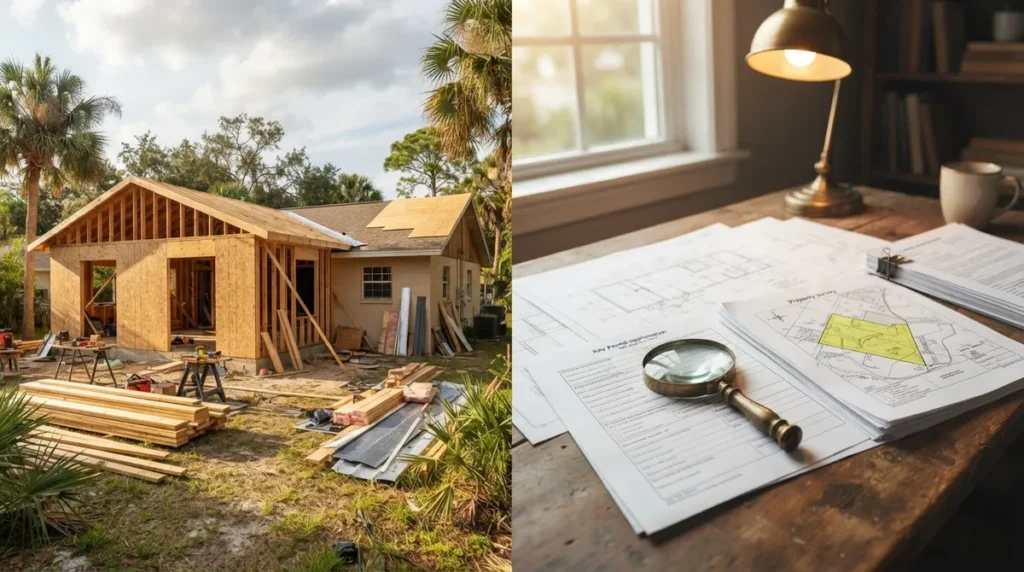
Florida sellers must disclose known unpermitted work under the Johnson v. Davis rule if it materially affects property value and isn't easily observable; selling as-is does not eliminate this duty.
-
The standard Florida Realtors/Florida Bar AS IS contract requires sellers to disclose unpermitted improvements and provide any available plans or documents, with specific reference to Florida Statutes §553.79.
-
Active code enforcement cases trigger mandatory statutory disclosure under Florida Statutes §162.06(2), requiring sellers to notify the code enforcement official within five days of transfer and provide all related materials to buyers.
-
Unpermitted work, open permits, and expired permits are three distinct situations with different resolution paths; only the local building department can confirm permit status and what's needed to resolve it.
-
Disclosure satisfies legal obligations but does not resolve the underlying permit issue; buyers and sellers must negotiate whether legalization occurs before or after closing through after-the-fact permitting or sealed drawings.
-
A strong disclosure includes a clear description of the work location, timeline, who performed it, permit status confirmation, any code enforcement notices, and supporting documentation like invoices or plans.
Selling or buying a Florida property and just discovered a lanai, a garage conversion, or an electrical panel upgrade with no permit on file? You're definitely not alone, and you're in the right place. Every year, thousands of Florida homes change hands with some kind of unpermitted work tucked into their history, and figuring out what you legally have to say about it can feel like reading a foreign language. The good news? Once you understand the actual rules, this becomes a lot less scary and a lot more manageable.
This guide walks through exactly what Florida law and standard sale contracts require when it comes to disclosing unpermitted work, who's responsible for what, and how to actually get the underlying permit problem fixed instead of just disclosed. Whether you're a homeowner prepping for a sale, a realtor guiding a client through closing, or a contractor trying to help someone clean up an old mess, this is written for you.
Does Florida Require Sellers to Disclose Unpermitted Work?
Here's the short, honest answer: Florida doesn't have one single statute that says "you must disclose every piece of unpermitted work on this specific form." But that doesn't mean sellers get a free pass. Florida courts have built a strong disclosure duty through case law, and the standard sale contract most Realtors use has its own built-in permits clause.
Let's break down where these obligations actually come from.
The Johnson v. Davis Rule
Back in 1985, the Florida Supreme Court decided a case called Johnson v. Davis, and it's still the backbone of residential disclosure law today. The rule is fairly simple once you say it out loud: if a seller knows about a fact that materially affects the property's value, and that fact isn't something a buyer could easily see or discover on their own, the seller has to disclose it.
Unpermitted work often fits this description perfectly. A finished attic space, an enclosed patio, or a converted garage might look totally normal to a walkthrough buyer, but if the seller knows it was never permitted, that knowledge usually needs to come out. Selling a home "as-is" doesn't erase this duty, either. As-is just means the seller isn't promising to make repairs, not that they can hide known problems.
What the Standard Contract Actually Says
Most Florida residential sales use the Florida Realtors/Florida Bar AS IS Residential Contract, and it includes specific language about permits. Under this contract, unless something is disclosed in writing, the seller is representing that they don't know of any improvements made without required permits, or permits that were never properly closed out under Florida Statutes §553.79.
If a seller does know about unpermitted work, the contract typically requires them to promptly hand over any plans or related documents they have. This is a good moment to mention that contract language does get updated periodically, so it's worth double-checking the exact version being used in your transaction.
Understanding Florida's Permit Requirement Baseline
Before we go further into disclosure specifics, it helps to understand why permits matter so much in the first place. Florida Statutes §553.79(1)(a) establishes that most construction, alteration, repair, or demolition work needs a permit before it starts. There are exceptions, and local jurisdictions add their own wrinkles, but the general rule is clear: significant work generally requires a permit.
This is exactly the kind of jurisdiction-specific puzzle that 1 Contractor Solutions helps untangle every day, since permit rules can look completely different depending on which of Florida's 67 counties you're in.
Open Permits vs. Unpermitted Work: Not the Same Thing
People often use these terms interchangeably, but they're actually two different animals, and each creates its own headache.
- Unpermitted work means no permit was ever pulled for the project at all.
- An open permit means a permit was pulled, but it was never finaled or closed out, often because a final inspection was missed.
- Expired permits fall somewhere in between, where work started under a valid permit but the permit lapsed before completion.
- All three situations can delay a sale, trigger lender concerns, or create code enforcement exposure.
- Only the local building department can confirm permit status and tell you what's needed to resolve it.
If you're not sure which category applies to your situation, our Open Permit Search tool is a great starting point, and our Building Department Lookup helps you find exactly who to contact locally.
| Situation | What It Means | Typical Next Step |
|---|---|---|
| No permit ever pulled | Work was completed without any building department involvement | Apply for an after-the-fact permit |
| Permit pulled, never closed | Application exists but final inspection or closeout is missing | Schedule final inspection or correct outstanding items |
| Permit expired mid-project | Work began legally but the permit lapsed before completion | Reactivate or reapply depending on local rules |
| Active code enforcement case | A violation notice or citation has already been issued | Statutory disclosure required under §162.06(2) |
Special Rules When Code Enforcement Is Already Involved
If there's already a pending code enforcement proceeding tied to the property, the disclosure requirements get a lot more specific and a lot less optional. Florida Statutes §162.06(2) lays out exact obligations for the seller, called the "transferor" in the statute.
- The seller must disclose the pending code enforcement proceeding to the buyer before the sale closes.
- The seller must provide the buyer with all related materials connected to that proceeding.
- The buyer needs to understand they're inheriting responsibility for compliance and any related orders once the transfer happens.
- The seller must notify the code enforcement official of the transfer within five days after it occurs, including the required disclosure information and copies.
This is a much stricter, statute-driven requirement than the general Johnson v. Davis duty, and missing these steps can create real legal exposure for a seller. If you're dealing with an active violation, our Code Compliance Violations team can help you understand the notice and start working toward resolution before it becomes a bigger problem.
What a Good Disclosure Actually Looks Like
So you know you have to disclose something, but what does a solid, honest disclosure actually include? Think of it less like a legal essay and more like giving the buyer (and their agent) enough information to make an informed decision.
Key Elements to Include
- A clear description of the improvement and exactly where it's located on the property
- What you know about when the work was done and who performed it, even if the details are fuzzy
- Whether the permit status has been confirmed with the local building department or remains uncertain
- Any open permits, expired permits, or active code enforcement notices tied to the property
- Copies of any plans, contractor invoices, or permit paperwork you still have on hand
One thing to avoid: never state or imply that unpermitted work is code-compliant unless you've actually had that verified. It's tempting to want to reassure a buyer, but an unverified claim can come back to bite you legally if problems surface later.
Documents That Strengthen a Disclosure
If you have any of the following, gather them before you list the property or before disclosure conversations begin:
- Original contractor invoices or receipts for the work performed
- Any drawings, sketches, or plans related to the improvement
- Prior inspection reports, even informal ones
- Correspondence with the local building department, if any exists
- Photos taken during construction, which can help establish scope and timeline
Our As-Built Drawings service is often the missing piece here. If original plans are long gone, we can document existing conditions accurately, which helps both with disclosure and with any future permitting process.
Disclosure Doesn't Fix the Permit Problem
This is the part that surprises a lot of sellers and even some agents: telling the buyer about unpermitted work satisfies your legal disclosure duty, but it does absolutely nothing to resolve the underlying permit issue. The property still has unpermitted work sitting on it after closing, and someone still has to deal with the local building department eventually.
Depending on the jurisdiction and the type of work, resolving it might involve an after-the-fact permit application, updated engineering documentation, a site inspection, or corrections to bring the work up to current code. This is exactly where After-the-Fact Expired Permits support becomes valuable, since our team handles files that many other firms simply decline to touch.
Who Typically Handles This: Seller or Buyer?
It genuinely depends on the negotiation. Some buyers request that the issue be resolved before closing as a condition of the sale. Others accept the property with the unpermitted work still in place and take on the responsibility themselves, sometimes in exchange for a price adjustment.
Real estate professionals working through this exact scenario regularly turn to our Realtor Closing Support service to keep transactions moving instead of stalling out over permit uncertainty.
How to Check Permit History on a Florida Property
Before disclosure conversations even start, it's smart to know exactly what you're dealing with. Here's a straightforward process:
- Identify the correct jurisdiction, since county lines and city boundaries can be confusing and sometimes overlap unexpectedly.
- Contact or search the local building department's permit records, often available online for many Florida counties.
- Compare the permit history against the physical improvements visible on the property.
- Flag any discrepancies, like a screened porch with no matching permit record.
- Reach out to a permitting professional if the history is unclear or the jurisdiction's system is hard to navigate.
Counties like Hillsborough County, Pinellas County, and Manatee County each maintain their own permit systems with their own quirks, which is part of why working with a team that's filed in over 400 municipalities across Florida can save enormous time and frustration.
Can Unpermitted Work Be Legalized?
Good news: in most cases, yes. Florida building departments generally allow after-the-fact permitting, though the exact process, required documentation, and fees vary quite a bit by jurisdiction.
Typical Steps Toward Legalization
- Confirm with the local building department whether after-the-fact permitting is available for the specific type of work
- Prepare or obtain sealed engineering drawings if structural or MEP elements are involved
- Submit the after-the-fact permit application along with required plans
- Schedule and pass any required inspections
- Complete corrections if the work doesn't currently meet code
- Obtain final permit closeout once everything checks out
Because 1 Contractor Solutions keeps drafting and engineering in-house, with our own engineer signing and sealing the work, reviewer comments get addressed quickly instead of sitting in a queue waiting on an outside consultant to call back. That matters a lot when a closing date is looming.
Comparing Disclosure Scenarios
| Scenario | Disclosure Trigger | Legal Basis |
|---|---|---|
| Seller knows about unpermitted addition | Material fact affecting value, not readily observable | Johnson v. Davis common law duty |
| Standard AS IS contract used | Seller representation regarding permits | Florida Realtors/Florida Bar AS IS Contract clause |
| Active code enforcement case pending | Mandatory statutory disclosure and notification | Florida Statutes §162.06(2) |
| Seller genuinely unaware of unpermitted work | No knowledge, generally no disclosure duty under Johnson v. Davis | Case-specific; consult an attorney |
Why This Matters So Much for Realtors and Contractors
If you're a real estate professional, unpermitted work discovered late in a transaction is one of the fastest ways to blow up a closing timeline. Buyers get spooked, lenders get nervous, and everyone starts pointing fingers. Getting ahead of the issue with a clear permit history check and a realistic legalization plan protects your reputation and your client's timeline.
For general contractors and solar companies, this topic matters just as much, since prior owners' unpermitted work sometimes surfaces mid-renovation or mid-installation, creating unexpected delays. Our teams supporting General Contractors and Solar Contractors deal with exactly this kind of surprise regularly, and having a same-day response partner makes a real difference.
You can also follow us on LinkedIn or follow us on Facebook for ongoing updates on Florida permitting changes that affect disclosure and legalization timelines.
A Few Friendly Words of Caution
Disclosure requirements can shift based on your specific contract, county, and circumstances, so nothing here should replace advice from a licensed Florida real estate attorney when the stakes are high. That said, understanding the general framework puts you miles ahead of where most people start. For more detailed county-specific guidance, resources from the Florida Realtors legal library and the official Florida Statutes database are worth bookmarking.
Wrapping It Up
Disclosing unpermitted work in Florida isn't about filling out one magic form and calling it done. It's a blend of common-law duty, contract language, and sometimes strict statutory requirements when code enforcement is already involved. The disclosure itself is just step one, though. Getting the actual permit issue resolved, whether that's an after-the-fact application, updated sealed drawings, or a final inspection, is what actually protects everyone at the closing table long term.
If you're staring down an unpermitted improvement, an open permit, or a code enforcement notice anywhere in Florida, our team at 1 Contractor Solutions has spent over 15 years handling exactly these situations across all 67 counties. We'd genuinely love to help you sort it out quickly and correctly, so feel free to get a free quote and let's get your permit situation squared away before it slows down your next transaction. You can also visit us on Google — 1 Contractor Solutions to see how we've helped homeowners, realtors, and contractors across the state resolve permitting challenges just like yours.
FAQs
Do Florida home sellers have to disclose unpermitted work?
In most cases, yes, if the seller actually knows about it. Under the Johnson v. Davis rule, sellers must disclose known facts that materially affect the property's value and aren't easily observable by the buyer, and unpermitted work often fits squarely into that category.
Does selling a Florida home as-is remove the duty to disclose unpermitted renovations?
Nope, and this trips up a lot of sellers! An as-is sale simply means the seller isn't promising to make repairs, but it doesn't erase the underlying legal duty to disclose known material facts like unpermitted work.
Can unpermitted work be legalized with an after-the-fact permit in Florida?
Yes, in most jurisdictions this is entirely possible, though the process and fees vary by county. It typically involves submitting plans, possibly updated engineering, passing inspections, and completing any needed corrections before the permit is finally closed out.
What happens if a Florida buyer discovers unpermitted work after closing?
This can get messy, potentially involving legal claims against the seller if the issue was known and undisclosed, plus the practical headache of resolving the permit problem after the fact. It's always better to catch and address this before closing whenever possible.
How can I check whether work on a Florida property was permitted?
Start by confirming the correct jurisdiction, since county and city lines can be surprisingly tricky, then search that local building department's permit records. If the history feels unclear or incomplete, a permitting professional can help track it down accurately.
We do this work every day across all 67 Florida counties. Call (866) 314-6931 and we will tell you what your situation actually requires — including when you do not need us.
Related services
Permit Facilitation & Filing
You have a crew scheduled, a client asking for dates, and a permit sitting somewhere in a queue you cannot see. We file it, w…
See the servicePlan Review Coordination
A permit in plan review is not one queue. On a commercial project it can be six queues, each with its own reviewer, its own c…
See the serviceReady to get your permit moving?
One call tells you which jurisdiction controls your project, what it will take, and what it will cost. Most of the time we can scope it on the phone.