
Blog
How to Scale Roofing & Solar Permits Across Florida
Discover how Florida roofing and solar contractors can scale permit volume with the right statewide permitting partner and expert engineering support.

Key Takeaways
-
Florida's decentralized permitting system across 67 counties requires jurisdiction-specific knowledge for document naming, submission portals, and review timelines—a specialized partner can eliminate rejections by submitting complete applications the first time.
-
High-Velocity Hurricane Zone counties (Miami-Dade and Broward) impose stricter product-approval and structural engineering requirements than standard Florida counties, requiring a permitting partner experienced in both HVHZ and non-HVHZ workflows.
-
In-house sealed engineering and MEP capabilities are critical for scaling—outsourcing plan corrections to third-party consultants adds days or weeks of delay that proactive partners eliminate by handling revisions internally.
-
Standardize intake processes with consistent job formatting, maintain organized product-approval libraries, and track cycle times by county to identify bottlenecks before they disrupt scheduling and crew productivity.
-
Solar permitting requires coordinated simultaneous review across building, electrical, structural, and utility interconnection departments—partners who manage parallel review tracks prevent sequential delays that compound project timelines.
-
Proactive correction management and real-time permit status tracking eliminate time spent chasing updates; a dedicated permitting partner catches rejections, fixes them, and resubmits without contractor involvement.
If you run a roofing or solar company in Florida, you already know the honest truth: your crews aren't the bottleneck. The permit office is. You can hire more installers, buy more trucks, and take on more jobs, but if your applications are sitting in a queue in Hillsborough or bouncing back with corrections in Broward, none of that growth matters. Finding the best partner for scaling roofing and solar permit volume in Florida isn't just a nice-to-have anymore. It's the difference between a company that grows smoothly and one that stalls out every hurricane season.
Here's the good news: you're not the first contractor to feel this pain, and this is a solvable problem. Florida's permitting system is decentralized, quirky, and sometimes downright confusing, but with the right partner handling intake, submissions, and follow-through, you can process dramatically more permits without adding headcount or losing your sanity. Let's walk through what that actually looks like.

Why Florida Permitting Is So Hard to Scale
Florida doesn't have one statewide permitting system. Instead, permitting is handled by local building departments, which means requirements, portals, fees, and review timelines can look completely different from one county to the next. What works in Pinellas County might get rejected outright in Miami-Dade County.
For a roofing or solar company trying to grow across multiple counties, this creates a few predictable headaches:
- Every jurisdiction has its own document naming conventions, submission portals, and checklist quirks
- Review timelines vary widely, and there's no reliable statewide average to plan around
- Product approval requirements differ, especially in the High-Velocity Hurricane Zone
- Inspection sequencing (dry-in, final, structural verification) isn't uniform
- Staff who know one county well often don't know the next one over
This is exactly why a specialized permitting partner matters so much. A good partner doesn't just "file paperwork." They understand the local nuances well enough to get it right the first time, every time, no matter which of Florida's 67 counties you're working in.
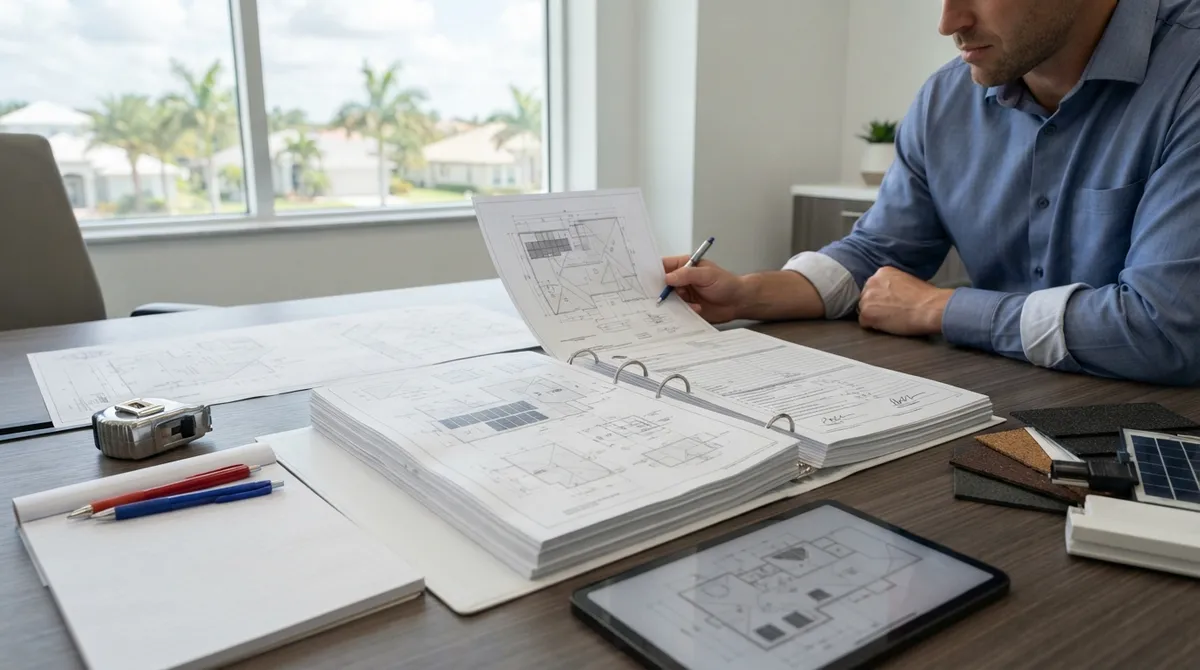
What a Roofing and Solar Permit Actually Requires
Before we talk about scaling, let's ground this in reality. A full roof replacement generally requires a building permit in Florida, and most jurisdictions ask for a similar core package, even if the format changes county to county.
Typical Roofing Permit Package
- Scope of work description and project valuation
- Roof plan or site plan showing the work area
- Material specifications, including Florida Product Approval numbers or Miami-Dade Notice of Acceptance documentation where applicable
- Contractor license and registration information
- Notice of Commencement, generally required once project value exceeds $5,000 in many counties, including Lee County and Orange County
- Inspection scheduling information, typically requiring at least a dry-in or underlayment inspection and a final inspection
Solar permitting adds even more moving parts. Rooftop installations often require coordinated documentation across building, electrical, structural, and sometimes zoning review tracks, plus utility interconnection approval. Larger ground-mounted systems can trigger stormwater or environmental review as well. If you want a deeper dive into timing expectations, our Florida solar permit timelines guide breaks down what to expect by project type.
The High-Velocity Hurricane Zone Factor
If any part of your business touches Miami-Dade or Broward County, you're operating in Florida's High-Velocity Hurricane Zone (HVHZ), and that changes the game. HVHZ jurisdictions can impose additional product-approval and structural engineering requirements that simply don't exist elsewhere in the state.
This is precisely why a one-size-fits-all permitting workflow falls apart the moment you try to scale statewide. A partner who's great in Tampa might have zero experience with HVHZ-specific documentation. You need a team that flexes between standard Florida Building Code requirements and the stricter HVHZ rules, sometimes within the same week, sometimes for the same client working in multiple counties.
| Region | Typical Requirements | Key Consideration |
|---|---|---|
| Standard Florida Counties | Florida Product Approval, standard FBC compliance | Requirements vary by local building department |
| Miami-Dade & Broward (HVHZ) | Notice of Acceptance (NOA), enhanced wind-load engineering | Stricter product approval and structural documentation |
| Coastal & Flood Zone Areas | Elevation certificates, additional structural review | May require engineering sign-off beyond standard permit |
What the Best Permitting Partner Actually Does for You
Scaling permit volume isn't about submitting faster. It's about submitting complete applications the first time, tracking everything in real time, and handling corrections before they turn into week-long delays. Here's what that looks like in practice.
1. Centralized Intake Across Every Jurisdiction
Instead of your team learning 20 different county portals, a strong partner acts as the single point of contact. You send the job details once, and they route it correctly, whether that's Hillsborough County, Manatee County, or anywhere else in the state.
2. Jurisdiction-Specific Checklists and Quality Control
A great partner maintains checklists for each building department so nothing gets missed. This alone can dramatically cut down on correction notices, which are often the single biggest source of delay for high-volume roofing and solar companies.
3. In-House Sealed Drawings
When your plans need an engineer's seal, waiting on an outside consultant to call back can add days or weeks. That's why in-house structural engineering and MEP engineering capability matters so much for solar and roofing projects that need fast turnarounds.
4. Proactive Correction Management
Corrections are inevitable, but the difference between a good and a great partner is speed of response. Instead of waiting for you to notice a rejection, a proactive team catches it, fixes it, and resubmits without you lifting a finger.
5. Status Tracking and Reporting
At scale, you need visibility into where every permit stands: submitted, under review, corrections needed, approved, or ready for inspection. Reporting on cycle time, approval rates, and aging permits helps you spot bottlenecks before they become a crisis.
6. Inspection Coordination
Roofing permits typically require at least a dry-in and a final inspection, though some jurisdictions ask for more. A good partner schedules these efficiently and keeps your crews from sitting idle waiting on a county inspector.
How to Evaluate a Permitting Partner for High Volume Work
Not every permitting service is built to handle real scale. Here's a practical checklist for evaluating whether a partner can actually support your growth.
- Do they have documented experience across multiple Florida counties, not just one metro area?
- Can they handle HVHZ-specific documentation for Miami-Dade and Broward projects?
- Do they offer in-house sealed engineering rather than outsourcing to third parties?
- Do they provide same-day or near same-day response for urgent submissions?
- Can they act as an authorized agent for your license, using proper power-of-attorney documentation where required?
- Do they distinguish between standard reroofing, structural roof work, rooftop solar, battery storage, and ground-mounted solar, since each can trigger different review paths?
- Do they provide transparent tracking so you always know permit status without chasing them for updates?
Some jurisdictions allow a licensed contractor to designate an agent through a site-specific, notarized power of attorney, which is how a permitting partner can legally file on your behalf. This is worth confirming up front, especially if you're working in a county for the first time. Tools like a contractor registration checklist can help you prepare before you even submit.
Common Permit Categories and How They Differ
Scaling successfully means treating different project types differently. Lumping everything into one workflow is a recipe for rejected applications.
| Project Type | Typical Review Focus | Extra Documentation Often Needed |
|---|---|---|
| Standard Reroof | Building, product approval | Material specs, valuation, NOC if over $5,000 |
| Structural Roof Repair | Building, structural | Engineering letter or sealed drawings |
| Rooftop Solar | Building, electrical, structural | Racking details, roof attachment specs, load calculations |
| Battery Storage | Electrical, fire, structural | Equipment specs, placement plans |
| Ground-Mounted Solar | Zoning, stormwater, environmental | Erosion control plan, site plan review |
Florida's 2026 solar-facility provisions, referenced in Chapter 163.3205 of the Florida Statutes, require erosion and sediment control measures designed for rainfall up to the 100-year, 24-hour storm event on applicable projects, along with certified inspection requirements during construction. That's a meaningful detail for solar companies expanding into ground-mounted installations, and it's the kind of requirement that trips up teams without dedicated permitting support.
Why 1 Contractor Solutions Fits This Role
This is exactly the operational gap that 1 Contractor Solutions was built to close. With coverage across all 67 Florida counties, in-house sealed drawings, and a dedicated Roof Permit Partnership Program, the team is set up specifically to help roofing and solar companies process higher volumes without sacrificing accuracy.
Because plan drafting and engineering are handled in-house, corrections get resolved quickly instead of waiting on a third-party consultant. And because the team works across HVHZ and non-HVHZ jurisdictions alike, whether that's Broward County, Lee County, or Pinellas County, contractors get one point of contact instead of juggling multiple vendors. If you want to see how other contractors describe working with the team, check out what customers say when you visit us on Google — 1 Contractor Solutions.
Building a Scalable Permit Workflow: A Step-by-Step Approach
- Standardize your intake process. Use a consistent format for job details, addresses, and scope of work so your permitting partner can move quickly.
- Build jurisdiction-specific plan templates. Standardized plan sets for common roofing and solar configurations dramatically cut drafting time.
- Maintain a product-approval library. Keep Florida Product Approval and NOA documentation organized so it's ready for every submission.
- Automate completeness checks where possible. Catching missing documents before submission avoids painful correction cycles.
- Track cycle time and approval rates by county. This data tells you where bottlenecks are forming so you can adjust before it affects your schedule.
- Assign clear escalation paths. When a permit stalls, know exactly who follows up and when.
For contractors managing high volumes of roofing work specifically, our high-volume roofing permit guidance for Orange County offers additional detail on managing multiple simultaneous submissions.
A Note for Solar Companies Navigating Multiple Review Tracks
Solar permitting is uniquely challenging because it often touches several review departments at once. Electrical inspectors care about different things than structural reviewers, and utility interconnection adds yet another layer entirely. A strong partner coordinates all of these simultaneously rather than treating them as separate, sequential tasks. This is where dedicated support for solar contractors becomes especially valuable, since it keeps every review track moving in parallel instead of stacking delays end to end.
Ready to Scale Without the Permit Headaches
Growing a roofing or solar business in Florida shouldn't mean drowning in paperwork or losing sleep over which county rejected your last submission. The right permitting partner turns that chaos into a predictable, trackable process, so you can focus on what you do best: building great roofs and installing great solar systems. If you're ready to see what that partnership looks like for your business, get a free quote and let's talk about your permit volume goals. You can also follow us on LinkedIn or follow us on Facebook for ongoing updates on Florida permitting trends and code changes that affect your business.
FAQs
What does a Florida permitting services partner do for roofing and solar contractors?
They handle everything from plan preparation and application filing to correction management and inspection scheduling, so your team can focus on installations instead of paperwork. Think of them as your outsourced permitting department, one that already knows the quirks of every county you work in.
Do roof replacements require permits in every Florida city and county?
Yes, a full roof replacement generally requires a building permit across Florida, though the exact documentation and process can vary by jurisdiction. It's always worth confirming local requirements before you start, since something as simple as a missing Notice of Commencement can hold up your whole project.
How do Miami-Dade and Broward permitting requirements differ from the rest of Florida?
Miami-Dade and Broward fall within Florida's High-Velocity Hurricane Zone, which typically requires Notice of Acceptance documentation and stricter wind-resistance engineering compared to standard Florida Product Approval elsewhere. If you're scaling into these counties, you'll want a partner who's genuinely comfortable with HVHZ paperwork, not just familiar with it.
Can a permitting company submit applications on behalf of a licensed Florida contractor?
In many jurisdictions, yes, a licensed contractor can designate an agent through a site-specific, notarized power of attorney to file permits on their behalf. It's a great way to offload the administrative burden while keeping your license and compliance status fully intact.
How can roofing and solar companies reduce permit rejections and correction notices?
The biggest lever is submission completeness: standardized plan sets, organized product-approval documentation, and jurisdiction-specific checklists catch problems before they become rejections. Pairing that with a proactive team that resolves corrections quickly keeps your permits moving instead of sitting in limbo.
We do this work every day across all 67 Florida counties. Call (866) 314-6931 and we will tell you what your situation actually requires — including when you do not need us.
Related services
Permit Facilitation & Filing
You have a crew scheduled, a client asking for dates, and a permit sitting somewhere in a queue you cannot see. We file it, w…
See the servicePlan Review Coordination
A permit in plan review is not one queue. On a commercial project it can be six queues, each with its own reviewer, its own c…
See the serviceReady to get your permit moving?
One call tells you which jurisdiction controls your project, what it will take, and what it will cost. Most of the time we can scope it on the phone.