Blog
6 Rules for High Volume Roofing Permits Orange County
Learn the 6 key rules for managing high volume roofing permits in Orange County, FL, from jurisdiction checks to closeout tracking.

Key Takeaways
-
Orange County is a patchwork of separate permitting authorities (Orlando, Ocoee, Winter Garden, etc.); verify jurisdiction before submitting any permit to avoid costly refiling and delays across your batch.
-
Submit standardized, complete applications every time by using intake checklists that verify project valuation, roof square footage, roofing material, and building permit numbers—missing fields at scale create repetitive corrections that stall entire permit queues.
-
Notice of Commencement is required for roofing work exceeding $5,000 and must be recorded before the first inspection; build this into your standard workflow rather than treating it as an afterthought to avoid stalled inspections.
-
Distinguish between simple re-roofs and structural roof work early; jobs involving structural repairs, framing changes, or solar mounting systems require sealed engineering drawings and follow a different review workflow.
-
Track every permit from issuance through final closeout with a formal system, not a forgotten spreadsheet; open permits discovered at closing create serious problems for homeowners, buyers, and insurance claims.
-
Confirm current permit fees before customer quotes and understand Orange County's fee structure ($26 base for residential re-roofs up to $1,000 value, plus $5 per additional $1,000) to avoid customer surprises.
If you're a roofing contractor running crews across Orlando, Ocoee, Winter Garden, and unincorporated Orange County, you already know the permit desk can make or break your week. One missing valuation figure or a mismatched square footage number, and suddenly a batch of ten permits turns into ten separate correction letters. That's not a great way to spend a Tuesday. The good news? High volume roofing permits Orange County work doesn't have to feel like a game of whack-a-mole with reviewer comments.
Whether you're a roofing company submitting dozens of applications a month through Fast Track, a solar installer tackling mounting and structural attachment details, or a homeowner just trying to get one roof replaced without a headache, the fundamentals are the same: know your jurisdiction, get your data right the first time, and stay on top of every permit until it's actually closed. This guide walks through six practical rules that keep high-volume roofing permit workflows moving smoothly in Orange County, plus the facts, fees, and FAQs you'll want on hand. And if you'd rather hand the whole thing off, 1 Contractor Solutions has been doing exactly this kind of work across Florida for years.

1. Confirm Jurisdiction Before You Ever Touch Fast Track
Here's the thing that trips up even experienced roofing companies: Orange County is not one single permitting authority. It's a patchwork. Orlando, Ocoee, Winter Garden, Apopka, Maitland, and other incorporated cities each run their own building departments, separate from Orange County Government's Fast Track system.
Submitting a roofing permit application to the wrong authority doesn't just waste time — it can delay an entire batch of jobs while you refile correctly. Before your crew even schedules the tear-off, verify who actually has jurisdiction over that specific address.
- Use a reliable building department lookup tool to confirm the correct authority for each property
- Double-check addresses near municipal boundary lines — these are the ones that most often get misfiled
- Keep a running log of which jurisdictions your active job list falls under, especially if you're managing 20+ roofs a month
- Never assume a neighboring property's permitting authority applies to the next house down the street
If you're managing high volume roofing permits Orange County wide, this jurisdiction check should be step one, every single time, no exceptions.

2. Build a Standardized, Complete Application Every Time
Orange County's Fast Track system is genuinely convenient for eligible roofing contractors and sub-trades, but it only works well when your data is complete. According to the county's official roof permit guidance, a typical application needs to identify the building classification, structure type, work type, project value, roof square footage, number of stories, and roofing material — plus the related building permit number when applicable.
When you're filing one permit, a missing field is a minor annoyance. When you're filing fifty, that same missing field becomes a repetitive correction that eats up your review team's time and delays every job in the queue behind it.
- Create a standardized intake checklist your office uses for every single roofing job before submission
- Verify project valuation against actual contract pricing, not a rough estimate
- Confirm roof square footage matches what's on file for the structure
- List the correct roofing material and confirm it matches current Florida Building Code requirements
- Attach the related building permit number if the roof work ties to another active permit
This kind of consistency is exactly where a dedicated permitting partner earns its keep. Our permit facilitation and filing team builds these checklists into every submission so nothing slips through.

3. Know the Fees Before You Quote the Job
Nothing frustrates a homeowner or a property manager more than a fee surprise. Orange County publishes a fee directory, but it's worth confirming current numbers before you finalize any customer quote, since schedules can shift.
| Permit Type | Base Fee | Additional Charge |
|---|---|---|
| Residential Re-Roof | $26 (up to $1,000 in work value) | $5 per additional $1,000 or fraction thereof |
| General Roof Permit | $54 (up to $1,000 in work value) | $5 per additional $1,000 or fraction thereof |
These figures come from Orange County's published fee schedule, but as always, verify current rates directly with the county or your permitting partner before locking in a customer estimate.
4. Handle the Notice of Commencement Correctly, Every Time
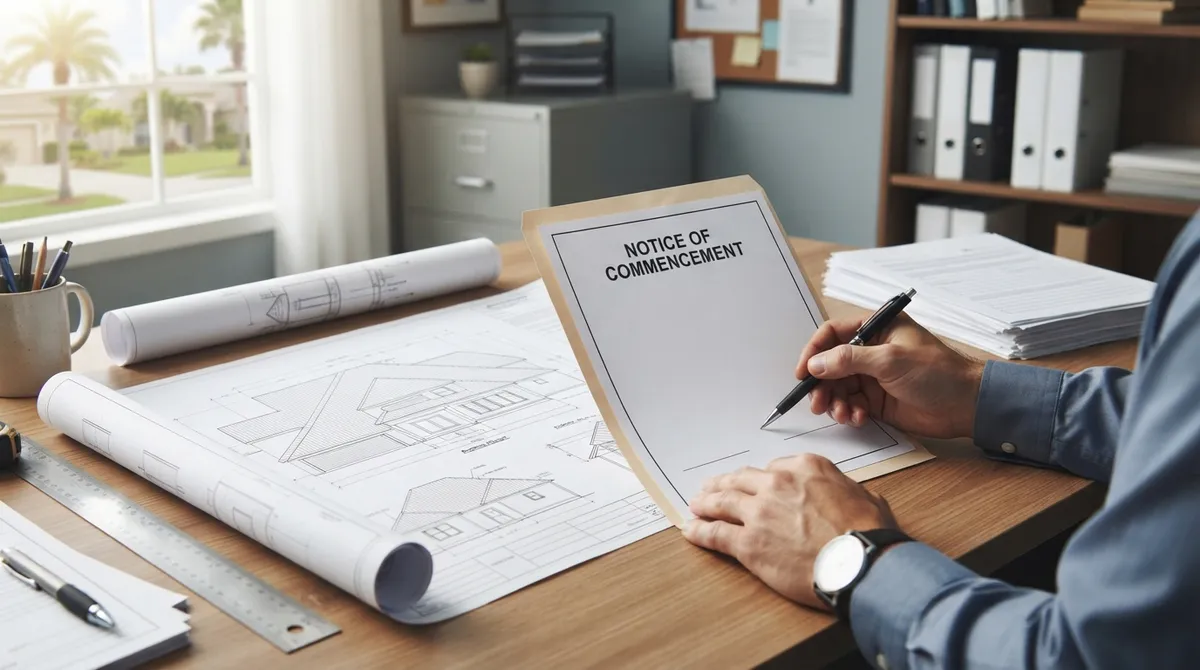
This one trips up more high-volume roofers than almost anything else. Orange County's roof permit process requires a Notice of Commencement whenever the work value exceeds $5,000. That recorded document generally needs to be available before the first inspection happens.
Skipping this step, or filing it late, can stall inspections right when your crew is ready to move to the next job. For contractors running a heavy roofing volume, building the Notice of Commencement into your standard workflow — rather than treating it as an afterthought — saves real time.
- Verify the current $5,000 threshold applies to your specific project before assuming it's required or not required
- Record the Notice of Commencement early, don't wait until the day before inspection
- Keep a copy on file and accessible for the inspector's visit
- Confirm recording requirements specific to the jurisdiction handling that address
For contractors juggling this across dozens of properties monthly, our Notice of Commencement Florida guide breaks down the requirements in more detail.
5. Separate Simple Re-Roofs from Structural Roof Work
Not every roofing permit is created equal, and treating them all the same is a mistake that costs time. A straightforward re-roof — same materials, same structure, no framing changes — moves through review differently than a job that involves structural repairs or alterations.
If your scope includes replacing damaged decking, altering the roof structure, or adding load from new equipment like solar arrays, you're likely looking at additional plans or digitally signed and sealed engineering documents. Orange County treats these as fundamentally different workflows, and reviewers will flag applications that don't account for the structural component.
When Structural Documentation Becomes Necessary
- Roof structure alterations affecting load paths or framing
- Solar panel mounting systems requiring structural attachment calculations
- Damaged decking replacement beyond standard repair thresholds
- Any work touching trusses, rafters, or the underlying structural system
This is where having in-house structural engineering capability matters. When a reviewer flags a structural concern, you don't want to be waiting on an outside consultant to call back — you want someone who can revise the sealed drawings the same day. That's a core part of what we built our engineering department to handle.
6. Track Every Permit Through Inspection and Closeout
Getting the permit issued is only half the job. A permit that stays open after the roof is done can create real problems down the road — for the homeowner refinancing, the buyer at closing, or the insurance company reviewing a claim.
High-volume roofing operations need a system for tracking every permit from issuance through final inspection and closeout, not just a spreadsheet that gets forgotten once the crew moves on to the next job.
- Log every issued permit with its expected inspection milestones
- Schedule inspections promptly once work reaches that stage
- Address correction comments quickly to avoid inspection delays
- Confirm final closeout status directly with the jurisdiction, not just assume it happened
- Keep closeout documentation on file in case it's needed for a future sale or insurance claim
Realtors and property buyers dealing with a stalled or forgotten permit already know how disruptive this can be at closing. If you've ever discovered an open permit found at closing, you understand exactly why closeout tracking matters as much as the initial filing.
Comparing DIY Filing vs. a Dedicated Permitting Partner
| Factor | Filing In-House | Working With a Permitting Partner |
|---|---|---|
| Jurisdiction verification | Manual research per address | Confirmed upfront using established processes |
| Application accuracy | Depends on office staff bandwidth | Standardized checklists reduce corrections |
| Structural/engineering needs | Outside consultant, added delay | In-house sealed drawings, same-day fixes |
| Correction handling | Reactive, one at a time | Proactively tracked across full portfolio |
| Closeout tracking | Often overlooked at scale | Built into ongoing permit monitoring |
For roofing companies filing double-digit permits monthly, this comparison usually settles the decision pretty quickly. It's not about capability — it's about bandwidth. Your office staff has a lot on their plate already, and permit tracking at volume is its own full-time job.
Working With Orange County's Fast Track System
Orange County's Fast Track platform supports roofing alongside other sub-trade categories like electrical, plumbing, irrigation, gas, and HVAC work. For eligible contractors, it's a genuinely efficient way to submit applications without an in-person office visit for every job.
That said, "fast" only applies when the submitted data is accurate. Unofficial industry estimates place standard residential roof permit review around 3-5 business days, with more complex applications sometimes taking 5-7 business days. These are general estimates, not a guaranteed timeline from the county, so build a little buffer into your scheduling.
Owner-builders working through Fast Track have their own path too, requiring a completed Owner-Builder Disclosure Statement. Licensed contractors acting as an agent for a property owner need a site-specific, notarized power of attorney on file. Our owner-builder permits service walks homeowners through exactly what's required if they're going this route themselves.
Why Partner Support Makes Sense at Scale
Roofing contractors managing high volume roofing permits Orange County wide are essentially running two businesses at once: the roofing work itself, and a permitting administration operation behind it. That second business — tracking applications, managing corrections, coordinating inspections, chasing closeout — takes real time away from what actually generates revenue: getting roofs installed.
This is exactly the gap a dedicated Florida permitting service is built to close. With sealed engineering drawings produced in-house and a private provider capability for plan review, corrections get resolved fast instead of sitting in a queue waiting on someone else's schedule. Roofing contractors interested in a structured ongoing partnership can also look into our Roof Permit Partnership program, built specifically for contractors filing regularly across Florida jurisdictions.
Curious what other roofing contractors and property professionals have experienced working with us? You can visit us on Google — 1 Contractor Solutions to see firsthand feedback, or check out what our team shares regularly when you follow us on LinkedIn and follow us on Facebook for permitting updates across the state.
Bringing It All Together
Managing high volume roofing permits Orange County wide really comes down to consistency: confirming the right jurisdiction, submitting clean and complete applications, understanding fees and Notice of Commencement rules, treating structural work differently from simple re-roofs, and tracking every permit all the way to closeout. Skip any one of these steps at scale, and the cracks start to show fast.
The Florida Building Code continues evolving too — the current 9th Edition brought updates that roofing contractors need to stay current on, particularly around wind resistance and material standards, so building that awareness into your permit prep matters just as much as the paperwork itself.
Whether you're a roofing company scaling up in Orlando, a solar installer coordinating structural attachments, or a homeowner just trying to get one roof done right, having a knowledgeable partner in your corner makes the whole process smoother. If you'd like help building a permitting workflow that actually keeps pace with your crew's schedule, get a free quote from our team today, and let's get your permits moving as fast as your roofs.
FAQs
How do I apply for a roofing permit in Orange County, Florida?
Most eligible roofing contractors apply through Orange County's Fast Track online permitting system, but you'll want to confirm your property isn't actually inside a municipality like Orlando or Ocoee first, since those cities run their own building departments. Once jurisdiction is confirmed, you'll submit project details including valuation, roof square footage, and material type.
Can roofing contractors submit multiple permits through Orange County Fast Track?
Yes, Fast Track is built to support roofing contractors and sub-trades submitting applications regularly, which makes it a great fit for high-volume operations. The key to keeping things smooth is standardizing your application data so you're not creating repeat corrections across dozens of submissions.
Is a Notice of Commencement required for a roof replacement in Orange County?
Generally, yes, once the work value exceeds $5,000, Orange County requires a recorded Notice of Commencement before the first inspection can happen. It's always worth double-checking current thresholds and recording rules for your specific project, since requirements can vary slightly by jurisdiction.
Do roof repairs involving structural work require engineered plans?
Often, yes! If your roofing scope includes structural repairs, framing changes, or added load from equipment like solar panels, you'll likely need sealed engineering documentation beyond a standard re-roof application. It's a completely different workflow, and treating it like a simple re-roof usually leads to review delays.
How can I check whether a roofing permit has been issued or closed?
You can typically check permit status directly through the issuing jurisdiction's online portal, whether that's Orange County or a specific city's building department. For contractors managing a large volume of permits, keeping an organized tracking system is honestly the easiest way to catch anything that's stalled before it becomes a bigger headache.
We do this work every day across all 67 Florida counties. Call (866) 314-6931 and we will tell you what your situation actually requires — including when you do not need us.
Related services
Permit Facilitation & Filing
You have a crew scheduled, a client asking for dates, and a permit sitting somewhere in a queue you cannot see. We file it, w…
See the servicePlan Review Coordination
A permit in plan review is not one queue. On a commercial project it can be six queues, each with its own reviewer, its own c…
See the serviceReady to get your permit moving?
One call tells you which jurisdiction controls your project, what it will take, and what it will cost. Most of the time we can scope it on the phone.