
Blog
How Florida Restoration Companies Get Emergency Permits
Learn how Florida restoration companies get emergency permits, what work can start early, and how local rules, floodplain reviews, and licensing shape the process.
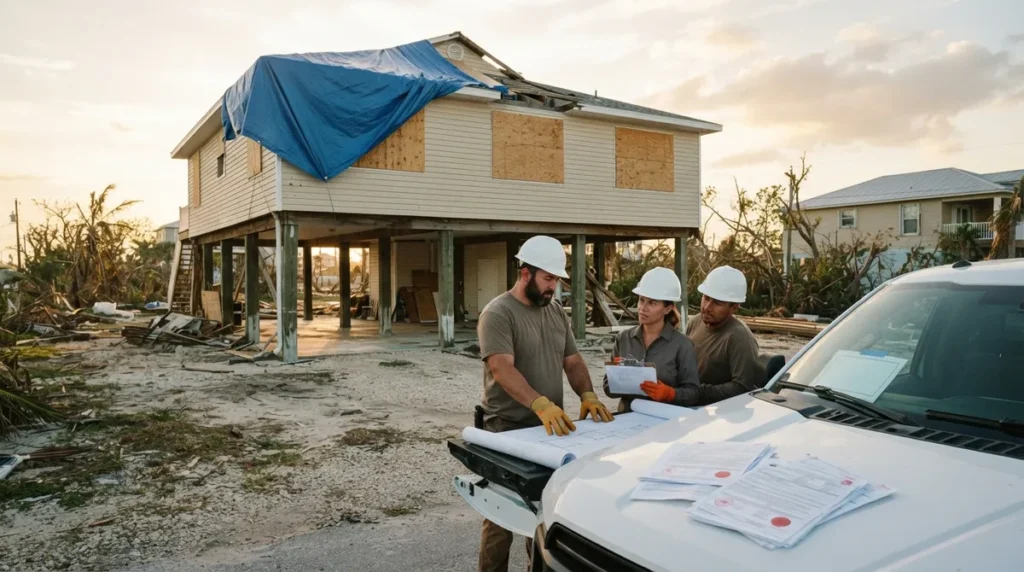
Key Takeaways
-
Florida has no single statewide emergency permit; each city or county runs its own expedited post-disaster process, so confirm the permitting jurisdiction and active rules before starting work.
-
Under Florida Statutes 553.7922, local governments must expedite permits not requiring technical review after a declared emergency, and may waive application and inspection fees.
-
Temporary measures like tarping, board-up, and limited water extraction are often allowed before a permit, but permanent roof, structural, and electrical, plumbing, or mechanical repairs usually require one.
-
Expedited does not mean exempt: technical or structural work still needs plans, engineering, review, and inspections, so complete applications with license, owner authorization, and product approvals are key to fast issuance.
-
In Special Flood Hazard Areas, repairs reaching 50% of a structure's market value may trigger substantial-damage rules requiring current floodplain compliance, so flag this early with the local floodplain administrator.
-
Florida's owner exemption under Statute 489.103 for shingle repairs is narrow and applies only to owner-occupied one-to-three family homes after a declared emergency, so don't assume it covers contractor-performed work.
The storm has passed, the phones are ringing, and your crews are staged and ready to roll. Then comes the question that stops a lot of restoration jobs cold: how do restoration companies get emergency permits in Florida, and how fast can it actually happen? If you have ever stood in a parking lot at 7 a.m. waiting on a building department portal to load, you know the feeling.
Here is the friendly truth: there is no single statewide "emergency permit" that covers every repair. What Florida has is a patchwork of local post-disaster permitting processes, each run by the city or county where the damaged property sits. State law pushes those local governments to speed things up after a declared emergency, but the details change from one jurisdiction to the next.
This guide walks you through how the process really works in 2026, what you can do before a permit is issued, what paperwork to gather, and where restoration contractors, solar companies, homeowners, and real estate professionals tend to get tripped up. Think of it as a roadmap from a team that lives in Florida permit offices every day.
What "Emergency Permit" Really Means in Florida
Let's clear up the biggest misconception first. In Florida, an "emergency permit" usually means a local building department's expedited or special post-disaster permitting process. It is not one statewide permit that authorizes all emergency restoration work.
The local building official decides the application route, the required documents, and the timeline. That is why a roof permit after a hurricane might be issued in a day in one county and take longer in a neighboring one.
Two things shape the process:
- The state framework: Florida Statutes § 553.7922 requires local governments affected by a natural emergency declared under § 252.36 to adopt special procedures that expedite permits not requiring technical review.
- The local rules: Each city and county sets its own application method, fees, inspection approach, and turnaround times.
So the first rule of emergency permitting is simple: always ask the local building department what is active right now.
What Florida Law Says About Expedited Post-Disaster Permits
After a qualifying declared emergency, § 553.7922 calls on affected local governments to speed up permits that do not need technical review. Typical examples include:
- Roof repairs or reroofing
- Electrical repairs or service changes
- Replacement of a single window or door
Local governments may also waive application and inspection fees for permits expedited under this section. "May" is the key word. Some jurisdictions waive fees, some do not, and some waive them only for certain permit types.
Expedited does not mean exempt. Expedited processing usually means priority handling, fast-track review, or rapid issuance for compliant applications. Technical or structural work can still require plans, review, and inspections.
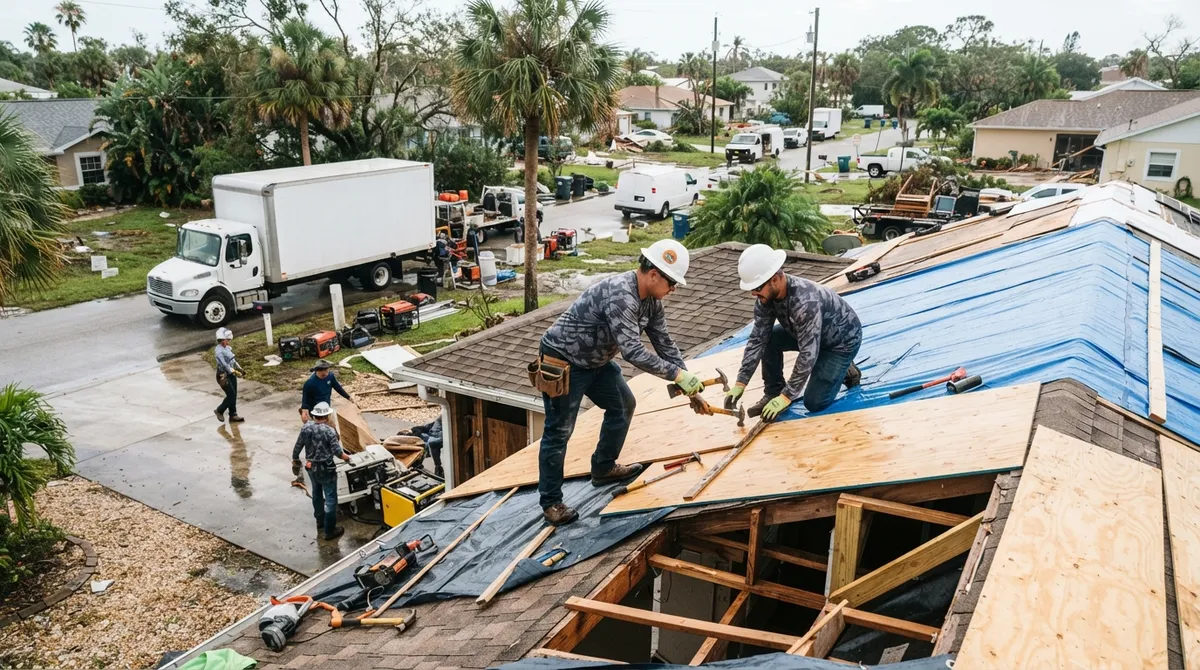
Which Repairs Can Start Before a Permit Is Issued?
This is the question restoration owners ask us most. The answer depends on the jurisdiction, but here is a general picture of how post-storm work tends to sort out.
| Type of Work | Often Allowed Before a Permit? | Things to Verify Locally |
|---|---|---|
| Temporary tarping or roof protection | Frequently yes | Some jurisdictions set size or scope limits |
| Board-up of openings | Frequently yes | Temporary only, not permanent replacement |
| Water extraction and limited cleanup | Often yes | Demolition beyond limited cleanup may need approval |
| Roof replacement or substantial roof repair | Usually no | Leon County, for example, lists roof work over 100 sq. ft. as permit-required |
| Electrical, plumbing, mechanical repairs | Usually no | Licensed trade contractor and trade permit typically required |
| Structural repairs | No | Plans, engineering, review, and inspections likely |
Notice the pattern: temporary protective measures are often exempt, while permanent repairs to the roof, structure, or electrical, gas, mechanical, and plumbing systems generally are not. The Florida Building Code requires a permit before regulated construction, alteration, or repair, and temporary exemptions do not authorize structural or trade-system repairs.
Local thresholds change, so confirm the current rules before relying on any example, including the ones in this article.
How Restoration Companies Get Emergency Permits: Step by Step
Here is the typical path from damage assessment to a permit in hand.
- Confirm the permitting jurisdiction. Property lines and city limits do not always match the mailing address. A home with a "Tampa" address might actually fall under the county. Our building department lookup tool helps you confirm who actually controls the parcel.
- Ask what is active post-storm. Contact the building department or check its website for a post-storm permitting guide. Ask which work can proceed immediately, which requires a permit, and whether an emergency or expedited pathway is open.
- Scope the work. Separate temporary mitigation (tarping, board-up, drying) from permanent repairs. Each may follow a different track.
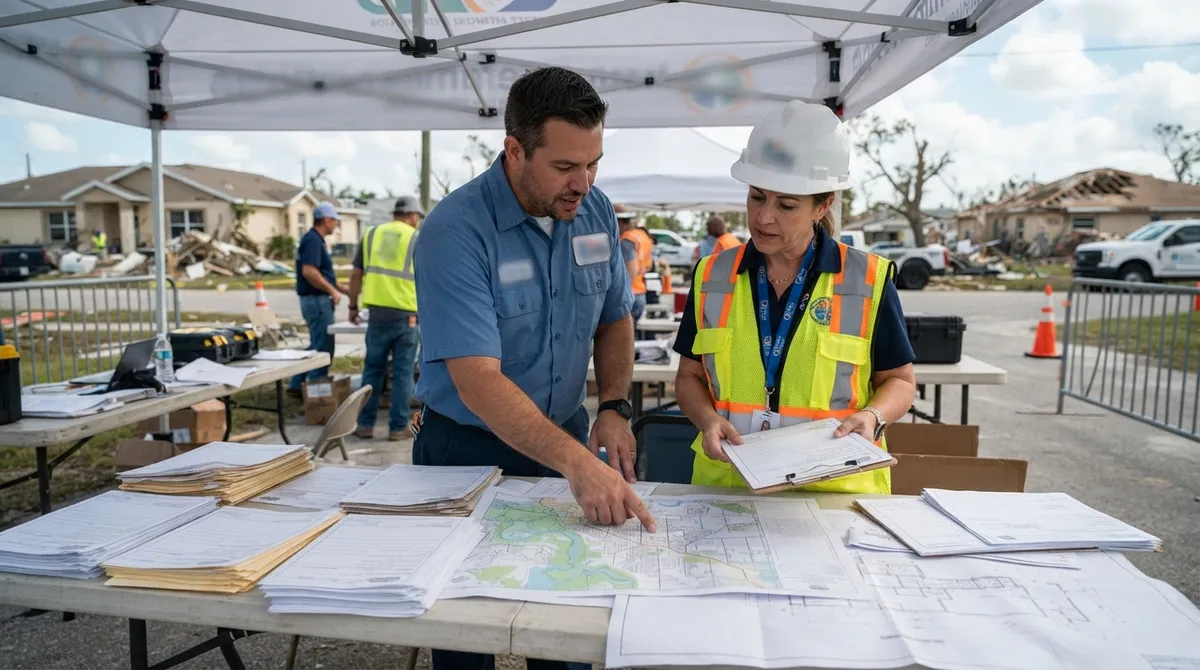
- Gather your documents. Requirements vary, but see the checklist below.
- Submit through the right channel. Most jurisdictions use an online portal; some also accept applications at the permit counter during disaster recovery.
- Respond to reviewer comments quickly. A compliant, complete application is what earns fast issuance.
- Schedule inspections. Expedited issuance does not eliminate inspection requirements.
Documents Building Departments Commonly Ask For
Depending on scope and jurisdiction, supporting materials may include:
- A detailed scope of work
- Property and owner information, plus owner authorization for the contractor
- Contractor license and insurance details
- Plans or engineering for structural or technical work
- Product approvals for roofing materials, windows, and doors
- Damage photographs
- Floodplain documentation where applicable
A clean, complete packet is the single best way to avoid back-and-forth. Missing a license number or a product approval can send an application to the bottom of a very tall pile after a major storm.
Local Examples: Why Every County Is Different
Florida's counties publish their own post-storm guidance, and the contrast is instructive.
| Jurisdiction | What It Publicly Describes |
|---|---|
| Nassau County | Reports that certain compliant storm-related roofing, mechanical, electrical, and plumbing permits are typically issued within 24 hours (a local service statement, not a statewide guarantee) |
| Leon County | Lists roof replacement or substantial roof repairs over 100 sq. ft. as permit-required, while identifying temporary tarping and certain minor repairs as generally exempt |
| Collier, Charlotte, Delray Beach, Seminole | Each publishes a post-storm or disaster recovery permitting page with its own process and requirements |
If you work across multiple counties, you already know how hard it is to keep every rule straight. That is exactly where an outsourced permitting department earns its keep. We handle filing across all 67 Florida counties, including areas like Lee County, Collier County, and Charlotte County, where hurricane recovery work often concentrates.
Floodplain Rules and the FEMA 50% Threshold
After a storm, floodplain rules matter just as much as the building code. Properties in a Special Flood Hazard Area may be subject to substantial-damage or substantial-improvement review. The commonly referenced FEMA threshold is 50% of the structure's market value, applied under local floodplain rules.
If a structure crosses that line, repairs may trigger requirements to bring the building into compliance with current floodplain standards, which can mean elevation or other major changes. The local floodplain administrator determines the valuation and what applies.
Restoration companies should flag this early. Starting permanent repairs before a substantial-damage determination can create expensive problems for the owner. We break the rule down further in our guide to the FEMA 50 percent rule in Florida.
Licensing and the Owner Exemption Trap
One more spot where restoration jobs can go sideways is licensing. Florida Statutes § 489.103 contains a narrow owner exemption for certain shingle repairs or replacements on one-, two-, or three-family residences damaged by a qualifying declared emergency. Conditions apply, including owner or tenant occupancy and not offering the property for sale within one year.
This is not a general exemption for restoration companies or for all repair work. A homeowner pulling a permit under that exemption is a very different situation from a company performing the work. Verify licensing and permit rules for the specific job, and review who can pull a permit in Florida if you are unsure who is eligible to apply.
Common Mistakes That Slow Emergency Permits Down
After years of working with contractors in the aftermath of storms, the same pitfalls show up again and again:
- Applying to the wrong jurisdiction. City versus county confusion is more common than you would think.
- Treating temporary work as permanent. A tarp is not a roof repair, and starting permanent work without a permit can lead to stop-work orders.
- Skipping product approvals. Windows, doors, and roofing materials must meet Florida product approval requirements.
- Ignoring floodplain review. Substantial-damage rules can change the entire scope.
- Incomplete applications. Missing owner authorization or license details cause rejections.
If work already started without proper permits, do not panic. Options exist, including after-the-fact and expired permit services, and our urgent permit rescue team handles denials and stop-work orders regularly.
When Technical Review and Engineering Come Into Play
Not every storm repair is a simple over-the-counter permit. When damage affects structure, roof framing, load paths, or major systems, the building department will likely want sealed drawings or an engineer's letter. That is where timelines usually stretch.
Having drafting and engineering handled in house keeps those jobs moving. With structural engineering, engineer letters, and MEP engineering all under one roof, a reviewer comment becomes a same-team fix rather than an outside consultant's callback. Where eligible, private provider plan review can also help you step around a crowded county queue.
How This Applies to Different Readers
Emergency permitting looks a little different depending on where you sit:
- Restoration companies and general contractors: Build a repeatable intake process: confirm jurisdiction, scope, documents, and filing route before the crew mobilizes. See our page for restoration companies.
- Roofers and solar companies: Roof work is the highest-volume post-storm permit type, and solar systems may need to be removed and reinstalled. Our roof permit services and the Roof Permit Partnership Program are built for that volume.
- Homeowners: Ask your restoration contractor who is pulling the permit and confirm it is in your property's record. Unpermitted storm repairs can complicate insurance claims and future sales.
- Real estate professionals: Open or missing permits on storm-repaired properties can surface at closing. Our realtor closing support helps clear those issues.
A Quick Pre-Filing Checklist
Before you submit anything after a storm, run through this list:
- Confirm the permitting jurisdiction for the parcel
- Check whether the area is in a Special Flood Hazard Area
- Separate temporary mitigation from permanent repairs
- Verify contractor license and insurance are current
- Collect owner authorization and property details
- Document damage with dated photographs
- Confirm product approvals for roofing, windows, and doors
- Determine whether plans or engineering are needed
For contractors registering to work across multiple municipalities, our contractor registration checklist can save a surprising amount of time.
Let Us Carry the Permit So Your Crews Can Work
Emergency permitting in Florida is really a local conversation, backed by a state framework that encourages speed. Confirm the jurisdiction, separate temporary protection from permanent repair, bring a complete packet, and watch floodplain thresholds. Do those things well and you will move faster than most.
You do not have to do it alone. 1 Contractor Solutions acts as Florida's outsourced permitting department, filing, tracking, and carrying permits through approval with same-day response and in-house sealed drawings. If a storm just landed on your schedule, get a free quote and let us take the paperwork off your plate. You can also see what our 1 Contractor Solutions customers say on Google, and follow us on LinkedIn or follow us on Facebook for Florida permitting updates.
FAQs
Is there a single statewide emergency permit for restoration work in Florida?
No. Florida does not issue one statewide emergency permit. Each city or county building department runs its own expedited or post-disaster process, so always confirm the active rules with the local jurisdiction before you start permanent repairs.
Can a restoration company tarp a roof or board up windows without a permit?
In many Florida jurisdictions, temporary protective measures like tarping, board-up, and limited cleanup are exempt or allowed right away. Exemptions vary and do not cover permanent structural or trade-system repairs, so a quick call to the building department is always worth it.
Do emergency permits waive inspections or plan review in Florida?
Not necessarily. Expedited processing speeds up issuance for compliant applications, but inspections and code compliance still apply. Under Florida Statutes 553.7922, local governments may waive application and inspection fees, but technical or structural work can still need plans, review, and inspections.
How does the FEMA 50% rule affect post-storm repairs?
In flood zones, if repair costs reach 50% of the structure's market value, the property may be treated as substantially damaged and need to meet current floodplain standards. The local floodplain administrator makes that determination, so raise it early in your project.
Can homeowners pull their own permit for storm repairs?
Only in limited cases. Florida Statutes 489.103 includes a narrow owner exemption for certain shingle repairs on one-, two-, or three-family homes after a declared emergency, with occupancy and sale conditions. It is not a general exemption, so verify the rules for your specific job.
We do this work every day across all 67 Florida counties. Call (866) 314-6931 and we will tell you what your situation actually requires — including when you do not need us.
Related services
Permit Facilitation & Filing
You have a crew scheduled, a client asking for dates, and a permit sitting somewhere in a queue you cannot see. We file it, w…
See the servicePlan Review Coordination
A permit in plan review is not one queue. On a commercial project it can be six queues, each with its own reviewer, its own c…
See the serviceReady to get your permit moving?
One call tells you which jurisdiction controls your project, what it will take, and what it will cost. Most of the time we can scope it on the phone.