
Blog
Do I Need a Permit for a New Garage Door in Florida?
Need a permit for a new garage door in Florida? Usually yes. Learn what the same-size rule really means, plus documents, wind ratings, and tips.
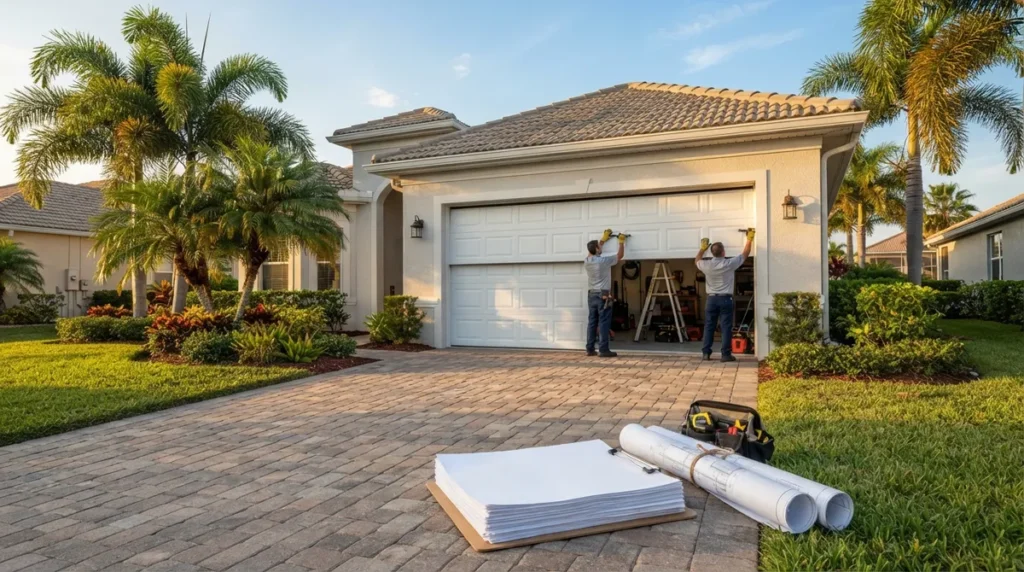
Key Takeaways
-
In most Florida jurisdictions, replacing a garage door requires a building or exterior-door permit, and the local city or county that controls your address makes the final call.
-
Florida Statutes §553.73 waives sealed design-professional drawings for qualifying same-size replacements in one- or two-family homes and townhouses, but it does not waive the permit itself.
-
A same-size swap qualifies for the streamlined path only if the door follows the manufacturer's wind-zone instructions, meets current design-pressure requirements, has instructions submitted, and fits the same opening.
-
Widening or raising the opening, or cutting a new opening, usually requires sealed drawings and structural details, so the project moves beyond the simple replacement lane.
-
Get the product approval number (or Miami-Dade NOA) and manufacturer installation instructions from your supplier before buying, since permit applications typically require them.
-
Close out the permit after final inspection; an open permit can surface during a sale or refinance and cause closing delays or insurance complications.
Picture this: your garage door has been groaning, sagging, or rattling for months, and you've finally picked out a gorgeous new one. The crew is booked, the date is set, and then a neighbor mentions the word that makes every Florida homeowner pause: permit. So, do I need a permit for a new garage door in Florida? Let's talk it through together, because the honest answer is a friendly "almost always, yes."
In most Florida jurisdictions, installing or replacing a garage door falls under a building permit or exterior-door permit. Orange County and Polk County, for example, explicitly list garage-door replacement as permit-required. The twist is that Florida also has a helpful provision for simple same-size swaps, and it's easy to misread. This guide walks you through what that provision actually does, what your local building department may ask for, and how to avoid the delays that trip up so many projects in 2026.
The Short Answer: Yes, Plan on a Permit
Florida garage doors aren't just big panels that go up and down. They're a major part of your home's wind-resistant envelope. In a hurricane, an unrated garage door that fails can let pressure inside the house and put the roof at risk. That's why local building departments treat a garage door replacement as permitted work.
Permit rules are administered locally, so the city or county that has jurisdiction over your property makes the final call. If your home sits inside a municipality, you'll generally use that city's permitting office rather than the county's. This matters more than people think, especially near city lines. If you're not sure who actually controls your address, our building department lookup tool can point you in the right direction.

The "No Sealed Drawings" Rule Is Not a Permit Exemption
Here's where a lot of homeowners and even some installers get confused. Florida Statutes §553.73 (2025) directs the Florida Building Code to allow replacement garage doors in existing one- or two-family homes and townhouses without sealed design-professional drawings when certain conditions are met. That's good news, but read the fine print: it waives the sealed drawings, not the permit itself.
To qualify for the streamlined, no-sealed-drawings path, all four of these conditions generally need to be true:
- The door is installed according to the manufacturer's instructions for the applicable wind zone.
- The door meets current Florida Building Code Residential design-pressure requirements.
- The installation instructions are submitted with the permit application.
- The new door is the same size and goes in the same existing opening.
If you hit all four, you can typically skip hiring an engineer to seal a drawing. You still need to apply, submit documentation, and pass inspection. Think of it as a shortcut on paperwork, not a shortcut around the building department.
Same-Size Replacement vs. Bigger Changes
Not every garage door project is created equal. The scope of your work decides how simple or complex your permit process will be.
| Project Type | Permit Likely Required? | Sealed Drawings Likely Required? | Typical Extras |
|---|---|---|---|
| Same-size replacement, same opening (one- or two-family home or townhouse) | Yes | Generally no, if all four statutory conditions are met | Product approval, installation instructions, application |
| Widening or raising the opening | Yes | Often yes, due to header and framing changes | Structural details, possibly engineer letter |
| New opening in a wall | Yes | Often yes | Structural plans, site or floor plan updates |
| Commercial property garage door | Yes | Varies; confirm locally | Product approval, possibly full plan review |
| Opener-only swap (no door change) | Often not for the opener itself; check locally | No | Electrical rules may apply if wiring changes |
Once you change the size of the opening or touch the framing, you've moved beyond the simple replacement lane. That's usually when homeowners benefit from having plans prepared properly, including structural engineering when a header or wall modification is involved.
Wind Ratings and Product Approval: The Part That Surprises People
Your new door has to be suitable for your site's wind design pressures and applicable windborne-debris requirements. In plain English, a door that looks great in the showroom still needs the right paperwork behind it.
Florida's product-approval system is how you verify that a door is approved for use. In Miami-Dade County, the building department also accepts applicable Florida Building Commission approvals and may require a current Notice of Acceptance (NOA) for its applications. Each product has an approval number, and your permit application often needs that number plus the installation instructions.
A handy pro tip: ask your door supplier for the approval number and the manufacturer's installation instructions before you buy. If you'd like a deeper explainer on decoding those numbers, our guide on Miami-Dade NOA vs. Florida Product Approval breaks it down nicely.
What Documents Will the Building Department Ask For?
Requirements vary from place to place, which is exactly why one neighbor's experience may not match yours. Here are real examples of what different jurisdictions request:
| Jurisdiction (Example) | Commonly Requested Items |
|---|---|
| Miami-Dade County | Application, contact sheet, wall elevation, door dimensions, product approval numbers, current NOA |
| Brevard County | Permit application, product-approval information or installation instructions, floor plan showing the door location |
| Charlotte County | Residential door permit application; a flat fee of $90 is listed on its residential door page |
Fees and fee schedules vary by jurisdiction and can change, so treat the numbers above as examples rather than promises. Always confirm with your local office.
A Simple Checklist to Gather Before You Apply
- Property address and parcel information
- Door dimensions and opening size
- Product approval number (or NOA where required)
- Manufacturer installation instructions for your wind zone
- A floor plan, elevation, or location sketch showing the door
- Contractor license and insurance information, if a contractor is applying
- Signed contract or valuation of the work
Who Applies for the Permit?
This varies by jurisdiction, so ask your building department whether the contractor or the owner must apply. In most cases, a properly licensed contractor pulls the permit, and that's the route we generally recommend. Use a licensed contractor where required, get the permit before work begins, and schedule the required inspections.
If you're an owner thinking about handling things yourself, there are specific rules around owner-builder permits and what you're responsible for. Our owner-builder permit support can help you understand the tradeoffs before you commit.
Notice of Commencement: When Does It Apply?
For higher-value jobs, a Notice of Commencement may be required. Charlotte County and Brevard County both identify a $5,000 direct contract price threshold for requiring one. A premium insulated or impact-rated door with installation can sometimes approach that figure, so don't assume your project is too small to need it.
The recording procedure and the exact threshold can differ by county, so verify the current rule with your local building department. For a straightforward walkthrough, see our guide to the Notice of Commencement in Florida.
Step-by-Step: How a Garage Door Permit Usually Works
While every jurisdiction has its quirks, most follow a rhythm like this:
- Confirm your jurisdiction. Figure out whether your city or county issues the permit.
- Choose an approved product. Pick a door with valid Florida product approval (or NOA in Miami-Dade) rated for your wind zone.
- Gather your documents. Collect installation instructions, approval numbers, dimensions, and any plan sketches.
- Submit the application. File online or in person, depending on your building department.
- Respond to reviewer comments. If something is missing, answer promptly so the application doesn't stall.
- Install after permit issuance. Work should begin only once the permit is approved.
- Pass inspection. Schedule the required inspection and keep the approved documents on site.
- Close out the permit. Make sure the permit reaches final approval so it doesn't linger open.
That last step matters more than most people realize. An open permit can surface later during a sale or refinance. If you ever need help, our permit facilitation and filing team handles filing, tracking, reviewer comments, and closeout so you don't have to chase it.
What Happens If You Skip the Permit?
We get it. When a door is just coming out and a new one is going in, the permit can feel like red tape. But skipping it can create real headaches:
- Insurance questions. An unpermitted door that fails in a storm can complicate a claim, and it may affect wind-mitigation discounts.
- Closing delays. Unpermitted work can hold up a sale when an inspector or title company notices it.
- Code enforcement attention. A neighbor's complaint or an inspector's visit can trigger a notice.
- Extra costs later. Legalizing after the fact usually costs more time and money than doing it right the first time.
If you've already installed a door without a permit, take a breath. It's very fixable. Start with our guide on how to legalize unpermitted work in Florida, or read about the after-the-fact garage permit process. And if a sale is looming, our piece on selling a Florida house with unpermitted work can help you plan.
Who Should Care Most About This?
Different readers hit different snags with garage door permits, so here's how it tends to play out:
- Homeowners: You want a safe, insurable door and a clean permit record when you sell. A same-size swap is usually simple if the paperwork is ready.
- General contractors: Missing product approvals or installation instructions are the classic cause of rejections and rework.
- Real estate professionals and investors: Verify permits on garage doors during due diligence, since an open or missing permit can surface late in a deal.
- Design and trade professionals: If you're changing the opening size, plan for structural details and a sealed set where required.
When to Bring in Professional Help
A same-size replacement with a rated door and good paperwork can be a smooth process. But you might want backup if:
- You're enlarging or altering the opening.
- You're not sure which jurisdiction controls your address.
- The reviewer keeps sending comments you don't understand.
- You're on a tight closing or construction schedule.
- The property is commercial or has unusual conditions.
Here at 1 Contractor Solutions, we act as Florida's outsourced permitting department. We prepare or review plans, file the application, track it, work every reviewer comment, and carry it through approval and closeout across all 67 Florida counties. Our drafting and engineering are in house, so if a reviewer flags something, we fix it without waiting on an outside consultant. If a denial or delay has you stuck, our urgent permit rescue service is built for exactly that moment.
Final Thoughts: Permit Smart, Sleep Better
So, do you need a permit for a new garage door in Florida? In most cases, yes. The statutory shortcut for same-size replacements saves you from needing sealed drawings, but it doesn't erase the permit, the product approval, or the inspection. Confirm your local requirements, choose an approved door rated for your wind zone, and keep your paperwork organized.
Doing it the right way protects your home in a storm, keeps your insurance happy, and spares you surprises at closing. If you'd like a hand, get a free quote and we'll tell you exactly what your jurisdiction expects. You can also visit us on Google — 1 Contractor Solutions to see what other Florida property owners and contractors say about working with us, or follow us on LinkedIn and follow us on Facebook for more practical permitting tips. Website and marketing support is provided by Brain Buzz Marketing.
FAQs
Do I need a permit to replace a garage door in Florida?
In most Florida jurisdictions, yes. Local building departments commonly treat garage door replacement as a permitted exterior-door or building project, and places like Orange County and Polk County list it explicitly. Always confirm with the city or county office that has jurisdiction over your property.
Can I replace a garage door without a permit if it's the same size?
Not as a rule. Florida law lets qualifying same-size replacements in existing one- or two-family homes and townhouses skip sealed design-professional drawings, but that's not a permit exemption. You'll still typically need an application, product approval details, installation instructions, and an inspection.
Do I need sealed engineering plans for a same-size garage door replacement?
Often no, if all four conditions are met: manufacturer instructions for your wind zone, current code design-pressure compliance, instructions submitted with the permit application, and the same size in the same opening. If you change or widen the opening, sealed drawings are more likely to be required.
Does a new garage door need Florida Product Approval or a Miami-Dade NOA?
Your door must be suitable for your site's wind pressures and debris requirements, which is verified through Florida's product-approval system. Miami-Dade County also accepts applicable Florida Building Commission approvals and may require a current Notice of Acceptance (NOA), so check what your local department requires.
Who applies for a garage door permit, and what inspections are required?
It depends on your jurisdiction, so ask your building department whether the contractor or owner must apply. Typically a licensed contractor pulls the permit before work begins, and you'll need to schedule the required inspection and make sure the permit is closed out.
We do this work every day across all 67 Florida counties. Call (866) 314-6931 and we will tell you what your situation actually requires — including when you do not need us.
Related services
Permit Facilitation & Filing
You have a crew scheduled, a client asking for dates, and a permit sitting somewhere in a queue you cannot see. We file it, w…
See the servicePlan Review Coordination
A permit in plan review is not one queue. On a commercial project it can be six queues, each with its own reviewer, its own c…
See the serviceReady to get your permit moving?
One call tells you which jurisdiction controls your project, what it will take, and what it will cost. Most of the time we can scope it on the phone.