
Blog
Attached vs. Freestanding: Which Pergola Needs a Venice Permit?
Wondering if your pergola needs a permit in Venice, FL? Compare attached vs. freestanding styles, fees, zoning, and how to apply online.
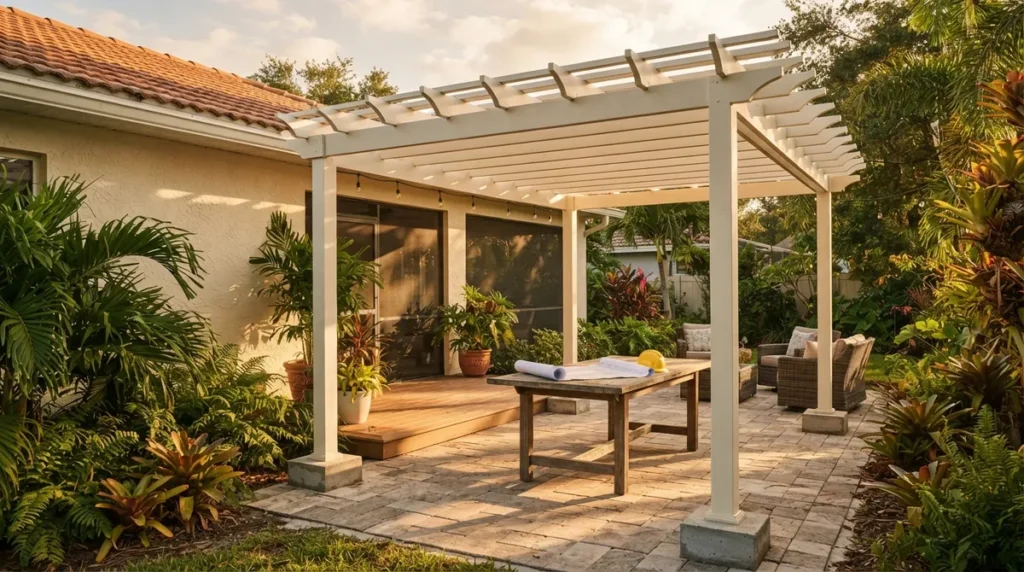
Key Takeaways
-
Venice requires a permit before constructing or altering a structure, and attached pergolas, footed structures, or roofed-deck-style pergolas are most likely to need building permit review.
-
An open-lattice roof does not automatically exempt a pergola; the structure must still meet Florida wind load requirements, and a building-code exemption does not waive zoning rules.
-
Verify zoning district, setbacks, easements, and lot coverage with Venice Planning and Zoning before placing the pergola, since a structure built in the wrong spot can require costly relocation.
-
Properties in Venice's Historic or Venetian Theme districts may need a Certificate of Architectural Compliance before the building permit is filed, so ask early to avoid redrawing plans.
-
Venice accepts permit applications only through its Online Permitting service; expect to submit a site plan, construction drawings, attachment details, and structural support information.
-
The base building permit fee is $90, plus plan review (0.00104 times valuation), a valuation fee (0.0104 times valuation), and a 2.5% state surcharge, though current fees should be verified with the city.
Picture this: you've picked out the perfect cedar pergola, you can already smell the morning coffee on your Venice patio, and then a neighbor mentions, "Don't you need a permit for that?" Cue the record scratch. The good news? You're asking the right question at the right time, and you're in great company. Plenty of Venice homeowners wonder about a pergola permit in Venice before the first post hits the ground.
Here's the friendly truth: there isn't one blanket answer. Whether your pergola needs a building permit depends on how it's built, how it's attached, and what's happening on your specific lot. An attached pergola with footings is a very different animal than a lightweight structure sitting on a paver patio. In this guide, we'll compare the two main styles side by side, walk through zoning, setbacks, and historic district rules, break down fees, and show you how to apply through the city's online system. Grab your coffee, and let's untangle it together.
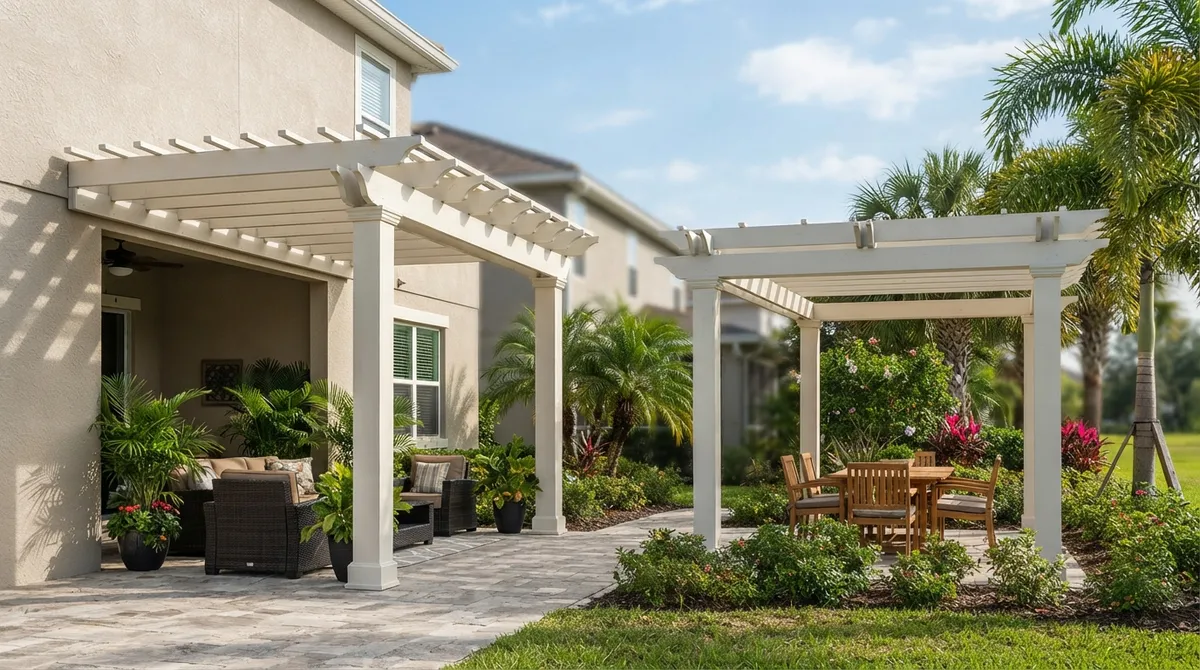
The Short Answer: It Depends on the Pergola
The City of Venice requires a permit before you construct or alter a building or structure, and the city's guidance points to the 2023 Florida Building Code, Section 105.1, as the basis for that rule. Whether your specific pergola qualifies for an exemption is something to confirm with the Building Department before you buy materials.
Venice's published permit guidance lists raised decks, attached or detached, with or without a roof, as requiring a permit. A pergola supported on posts, tied into your home, or built on footings may therefore need review. And here's a common trap: don't assume an open-lattice roof makes your pergola exempt. Open slats look airy, but the structure still has to stand up to Florida wind.
Keep in mind that a building-code exemption does not wipe out zoning or other local requirements. Even "no building permit" projects can still need other approvals. That's why a quick call before you build beats a stop work notice after.
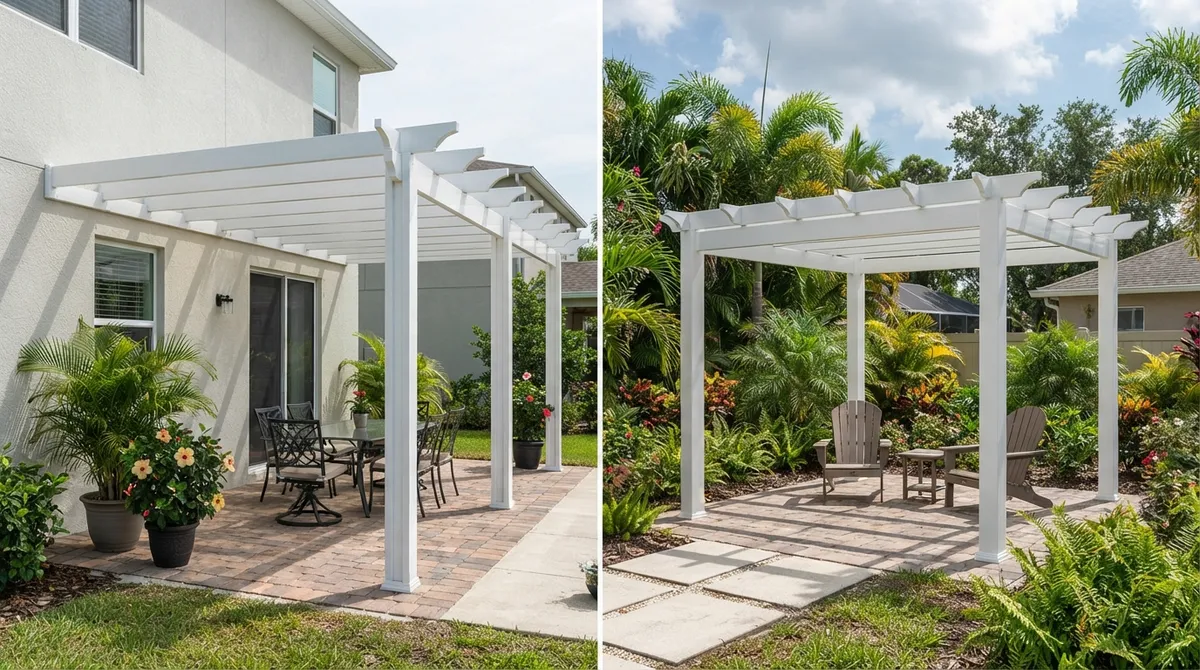
Attached vs. Freestanding Pergolas: Side-by-Side Comparison
Let's compare the two common styles. Treat this table as a starting point for your conversation with the city, not a final ruling. Venice reviews each project on its own details.
| Factor | Attached Pergola | Freestanding Pergola |
|---|---|---|
| Connection to home | Ledger or beam tied to the house structure | Stands on its own posts |
| Likely permit status | Likely needs building permit review | May need review depending on footings, posts, and size |
| Structural concerns | Load transfer into the house, wind uplift, flashing | Footing depth, post anchoring, lateral wind resistance |
| Zoning concerns | Often treated as part of the home for setbacks | Accessory structure rules, setbacks, lot coverage |
| Plans typically needed | Site plan plus construction drawings with attachment details | Site plan plus drawings showing footings and supports |
| Best verified with | Venice Building Department | Venice Building and Planning and Zoning |
Why Attachment Matters So Much
When a pergola ties into your house, it becomes part of your home's load path. Wind pushing up on that roof structure gets transferred into your wall and framing. That's exactly the kind of detail a plan reviewer wants to see, and it's why attached structures draw closer scrutiny.
The "Freestanding Means Exempt" Myth
It's tempting to think a standalone pergola dodges the paperwork. Not necessarily. If it's supported on posts with footings, or if it functions like a roofed deck, review may still apply. Venice's guidance does say decks and patios directly on grade without footings are exempt from a building permit but still require Zoning and Engineering permits. So even the "exempt" path usually involves some city sign-off.
Zoning, Setbacks, and Lot Coverage in Venice
Here's where many projects quietly get tripped up. Before you design or place your pergola, verify your parcel's zoning district, setbacks, easements, lot coverage, and any neighborhood or planned-development rules with Venice Planning and Zoning. Requirements can vary by property and by project.
Think of it like a puzzle with a few key pieces:
- Zoning district: Determines what's allowed and how far structures must sit from property lines.
- Setbacks: Required distances from front, side, and rear lot lines.
- Easements: Utility or drainage strips where building is restricted or prohibited.
- Lot coverage: The total percentage of your lot that structures can occupy.
- HOA or planned-development rules: Separate from city rules, but just as binding for your project.
Skipping this step is the most common reason a beautiful pergola ends up in the wrong spot. A pergola built into a setback or over an easement can become a costly relocation, and it can complicate a future sale. If you're a real estate professional or investor, that's a big deal during due diligence, as we explain in how to sell a Florida house with unpermitted additions.
Venice Historic and Venetian Theme Districts
Venice has a distinctive architectural personality, and the city protects it. Properties in the Historic or Venetian Theme districts may face additional architectural review for exterior alterations. The city FAQ states that exterior alterations in these districts must comply with district regulations.
For you, that means one more question to ask early: does my pergola need a Certificate of Architectural Compliance before I apply for the building permit? In these districts, materials, color, and design details may matter as much as structural soundness. Confirm the answer with the city before you finalize your design, so you don't redraw plans halfway through.
Plans and Documents You Should Expect to Prepare
The city's general guidance says plans are reviewed when needed to show compliance with building codes and applicable laws. Because each pergola is different, ask the Building Department for the pergola-specific checklist. In general, you should be ready with:
- A site plan showing the pergola's location on the lot, distances to property lines, and nearby structures.
- Construction drawings showing dimensions, materials, and overall layout.
- Attachment details showing exactly how the structure connects to the home, if applicable.
- Structural support information covering posts, footings, beams, and connections.
- Owner or agent information and valuation of the work.
This is where professional help can save real time. Clean, code-aware drawings reduce back-and-forth with reviewers. Contractors who want the details right the first time can learn more about who seals structural drawings for Florida permits, and our team can prepare site plans and structural engineering in house.
What a Venice Pergola Permit Costs
Let's talk numbers, because nobody likes budget surprises. The City of Venice's published permit-cost sheet lists a building permit fee of $90, plus valuation-based charges. Here's how the published components break down:
| Fee Component | How It's Calculated |
|---|---|
| Base building permit fee | $90 |
| Plan review | 0.00104 times project valuation |
| Valuation fee | 0.0104 times project valuation |
| State surcharge | 2.5% of permit and plan-check fees, $4 minimum |
Valuation is determined using the latest International Code Council Building Valuation Data or your contract valuation. The city's sheet also notes a 20% reduction to the valuation-fee multiplier under City Resolution 2021-05. The fee document available was updated in 2025, so verify current numbers with the city before you budget.
To make that concrete, a hypothetical $10,000 pergola would generate roughly $10.40 in plan review and $104 in valuation charges (before the reduction noted above), on top of the $90 base fee and the state surcharge. Treat that as an illustration only, since the city's current fee sheet controls.
How to Apply Through Venice's Online Permitting
Here's a sweet piece of news: Venice accepts building permit applications electronically through its Online Permitting service and no longer accepts paper applications. An owner or authorized agent may apply, and an authorized agent must meet the city's contractor-registration requirements.
If you're a contractor working in the city for the first time, take a look at 5 steps to contractor registration in Venice, FL. Here's a simple path to follow:
- Call first. Contact the Building Department at (941) 882-7547 to confirm whether your pergola needs a building permit.
- Check zoning. Verify setbacks, easements, and lot coverage with Planning and Zoning.
- Confirm district rules. If you're in a Historic or Venetian Theme district, ask about architectural compliance.
- Prepare your plans. Gather your site plan and construction drawings.
- Submit online. Apply through the city's Online Permitting service.
- Pay and schedule. Pay fees and schedule inspections through the same system.
The Building Department is located at 401 West Venice Avenue, Venice, FL 34285, and its permitting page directs applicants to the online system for applications, payments, and inspection scheduling.
Who Benefits Most From Getting This Right?
A pergola seems small, but permit questions touch many people:
- Homeowners: You want your outdoor living space legal, insurable, and sale-ready.
- General contractors: Accurate drawings and correct filing keep crews on schedule. See our services for general contractors.
- Real estate professionals and investors: Unpermitted structures can stall closings, so catching them early matters.
- Designers and trades: Outsourced drafting and engineering keep projects moving without adding overhead.
What If the Pergola Is Already Built?
Maybe you bought a Venice home with a pergola already standing, or a prior owner built one without telling anyone. Don't panic. This is more common than you'd think, and it's fixable. The path usually involves documenting the structure, verifying it meets code, and filing the right permit. Our guides on getting an after-the-fact permit for a pergola in Florida and 7 steps to legalize unpermitted work in Florida lay out the process in plain English.
If you're curious how another Gulf Coast city handles similar questions, our article on getting a pergola permit in Cape Coral is a handy comparison. And if your permit gets rejected, who can rescue a denied building permit in Florida explains your options.
Common Mistakes to Avoid
- Assuming open lattice equals exempt. The roof style alone doesn't decide it.
- Ignoring setbacks and easements. A permit approval won't save a pergola built in the wrong place.
- Skipping district review. Historic and Venetian Theme properties can require extra approval.
- Underestimating wind. Florida wind loads are real, and reviewers look closely at attachment and anchoring.
- Relying on neighbors' experience. Their lot, zoning, and design may be totally different from yours.
Remember that a quick phone call is almost always cheaper than a correction later. We're big believers in asking before building.
How 1 Contractor Solutions Can Help
If all this feels like a lot, take a deep breath. That's literally what we do. 1 Contractor Solutions acts as Florida's outsourced permitting department, handling permit filing and tracking, plan review coordination, and in-house drafting and engineering, with our own engineer signing and sealing the work. We respond within 30 minutes, day or night, and se habla español. You can follow us on LinkedIn and follow us on Facebook for more Florida permitting tips, or see what customers say when you visit us on Google — 1 Contractor Solutions. Our marketing partner, Brain Buzz Marketing, helps us share these guides with Florida builders and homeowners.
Working in Sarasota County? Our team supports the Venice permitting area, and you can explore our full permit facilitation and filing service.
Conclusion: Build Your Pergola With Confidence
So, which pergola needs a Venice permit? The honest answer is that attached pergolas, footed structures, and anything resembling a roofed deck are the likeliest to require review, while true on-grade installations may skip the building permit but still need zoning and engineering sign-off. Your lot, your district, and your design all play a role, and the City of Venice makes the final call.
The winning move is simple: confirm with the Building Department, check zoning, prepare solid drawings, and apply online. Do that, and your pergola goes from daydream to done without the drama.
Ready to skip the guesswork? Get a free quote from our team, and let us handle the permit paperwork while you pick out patio furniture.
FAQs
Do I need a permit to build a pergola in Venice, Florida?
Often, yes. It depends on the pergola's design, attachment, footings, and your property's zoning. Venice requires permits for many structures and raised decks, so confirm with the Building Department at (941) 882-7547 before you build.
Are freestanding pergolas exempt from permits in Venice?
Not automatically. A freestanding pergola with posts and footings may still need review, and even exempt on-grade structures can require Zoning and Engineering permits. Always verify with the city first.
How do I apply for a pergola permit in Venice?
Apply through the City of Venice's Online Permitting service, since paper applications are no longer accepted. An owner or an authorized, registered agent can submit your site plan and construction drawings.
How much does a Venice pergola permit cost?
The city's published fee sheet lists a $90 building permit fee plus valuation-based plan review and valuation charges, and a 2.5% state surcharge. Fees can change, so check the current schedule with the city before budgeting.
Does a pergola in a Venice historic district need extra approval?
Possibly. Exterior alterations in the Historic or Venetian Theme districts must comply with district regulations, and a Certificate of Architectural Compliance may be needed. Confirm this before submitting your building permit application.
We do this work every day across all 67 Florida counties. Call (866) 314-6931 and we will tell you what your situation actually requires — including when you do not need us.
Related services
Permit Facilitation & Filing
You have a crew scheduled, a client asking for dates, and a permit sitting somewhere in a queue you cannot see. We file it, w…
See the servicePlan Review Coordination
A permit in plan review is not one queue. On a commercial project it can be six queues, each with its own reviewer, its own c…
See the serviceReady to get your permit moving?
One call tells you which jurisdiction controls your project, what it will take, and what it will cost. Most of the time we can scope it on the phone.