
Blog
6 ADA Compliance Review Mistakes That Stall Florida Permits
Learn what an ADA compliance review for a Florida permit checks, how it differs from federal ADA rules, and 6 mistakes that stall approvals.

Key Takeaways
-
A permit approval under the Florida Building Code: Accessibility does not certify full federal ADA compliance, so design to satisfy both the state code and the 2010 ADA Standards.
-
Reviewers want specific dimensions, clearances, slopes, and routes drawn and labeled; a general 'ADA compliant' note on a sheet rarely satisfies them.
-
Alterations to a primary-function area can trigger accessible path-of-travel requirements, including relevant restrooms, beyond the exact area being remodeled, so plan for this early.
-
Accessibility requirements are enforced locally, so confirm your building department's current accessibility submittal checklist before uploading your application.
-
Keep site plans, floor plans, and detail sheets coordinated so routes, doors, restrooms, and parking agree across every drawing set.
-
State the project use, occupancy, existing conditions, and scope of alteration clearly on page one to avoid reviewer questions that add days to the timeline.
Picture this: your plans are done, your crew is scheduled, and the permit comes back with a note that says, "Accessibility items not shown." Suddenly the calendar you built so carefully starts to wobble. If that sounds familiar, you are in very good company. Accessibility comments are one of the quieter reasons Florida permits slip, and most of them are avoidable.
So, what is an ada compliance review for a permit? In plain terms, it is an accessibility-focused look at your proposed plans, checking them against the accessibility requirements that apply to your project. In Florida, that review is tied to the 2023 Florida Building Code: Accessibility, Eighth Edition, effective December 31, 2023, and it is administered by your local building authority. It is related to federal ADA obligations, but the two are not the same thing, and that difference trips people up all the time.
In this friendly walkthrough, we will cover what reviewers actually check, where the federal ADA fits in, and the six mistakes that cause the most delays. Whether you are a general contractor, a homeowner, a realtor, or a designer, you will leave knowing what to put on your drawings the first time.
What Is an ADA Compliance Review for a Permit?
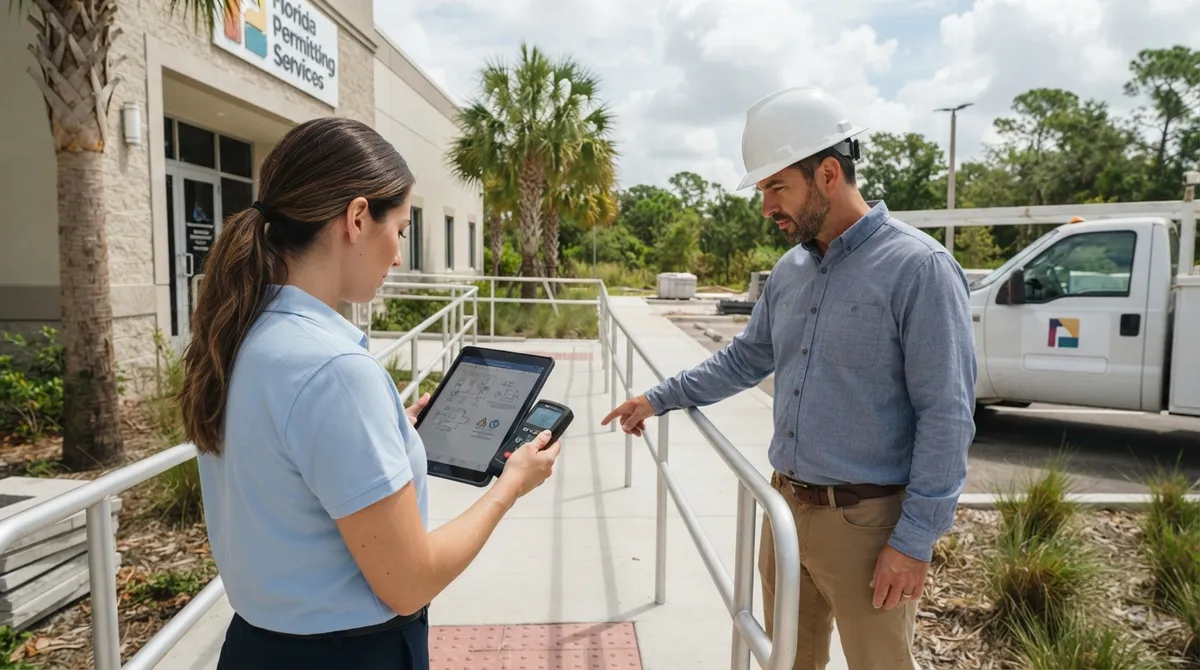
An ADA compliance review for a permit is a plan-based examination of accessibility features. A reviewer looks at your drawings and asks: can people with disabilities reach, enter, and use the spaces this project creates or alters? The review happens as part of building permit plan review, not as a separate trip to a federal office.
Here is the part that surprises many people. In Florida, the accessibility requirements enforced at permitting come from the Florida Building Code, which includes a dedicated Accessibility volume. Under Florida Statutes §553.73, enforcement and interpretation of the code rest with designated local boards or agencies. That means submittal checklists and procedures can look a little different from one jurisdiction to the next.
The Americans with Disabilities Act, on the other hand, is a federal civil-rights law. Its design requirements come from the U.S. Department of Justice's 2010 ADA Standards. A permit review is not the same as a federal ADA certification, which we will unpack in a moment.
Quick Definition You Can Remember
- Review type: Plan-based accessibility check during permit review
- Who runs it: Your local building department or designated reviewing authority
- Main Florida reference: Florida Building Code: Accessibility, Eighth Edition (2023)
- Federal companion: 2010 ADA Standards, which apply separately to covered projects

What Does the Reviewer Actually Check?
The exact list depends on your building's use, your project scope, and the code's scoping provisions. That said, most reviews touch on a familiar set of elements. Think of it as tracing the journey of a visitor from the parking lot to the restroom.
| Element | What Reviewers Commonly Look For |
|---|---|
| Accessible route | A continuous path from parking or the public way to the entrance and through the space |
| Entrances and doors | Clear widths, maneuvering clearances, thresholds, and hardware |
| Parking | Accessible space counts, access aisles, and signage where required |
| Ramps and elevators | Slopes, landings, handrails, and elevator provisions where required |
| Restrooms | Turning space, fixture clearances, grab bars, and fixture heights |
| Signage | Required accessible signs and mounting details |
| Rooms and spaces | Accessible features in the spaces the project covers |
Not every project triggers every line item. A small interior remodel looks very different from a new restaurant. The key is that your drawings need enough detail for the reviewer to verify dimensions and routes without guessing.
Florida Code Review vs. Federal ADA: Not Interchangeable
This is the single most important idea in this article, so let's slow down. The Florida code review and your federal ADA obligations are related, but one does not automatically satisfy the other.
A permit approval tells you that the local authority reviewed your plans against the applicable code. It does not, by itself, certify full compliance with every federal ADA obligation, and it does not prevent later enforcement. Think of the permit as a major checkpoint, not a lifetime guarantee.
| Topic | Florida Building Code: Accessibility | Federal ADA |
|---|---|---|
| Nature | State building code | Federal civil-rights law |
| Enforced by | Local building authorities | Federal enforcement and civil actions |
| Design reference | 2023 FBC: Accessibility, Eighth Edition | 2010 ADA Standards (DOJ) |
| Permit approval means | Plans reviewed against local code | Does not equal ADA certification |
The practical takeaway: design to satisfy both, and have your design professional resolve any code questions before you submit. It is far cheaper to fix a dimension on paper than in concrete.
Which Date Controls the ADA Standard?
For the federal side, the applicable standard is generally tied to a trigger date. Under the 2010 ADA Standards, that date is typically when the last building-permit application (or extension) is certified complete, or received where the jurisdiction does not certify completeness. If no permit is required, the trigger is the start of physical construction or alteration.
Why does this matter? Because a project that sits in review or gets resubmitted can end up with questions about which rules apply. Keeping your application clean and complete helps you avoid that headache.
6 Mistakes That Stall Florida Permits
Now for the fun part, the mistakes we see most often. Fix these and you will save yourself weeks.
1. Assuming Permit Approval Means You Are Fully ADA Compliant
It is a natural assumption, and it is a risky one. Local plan review addresses the Florida code. Federal obligations can still apply on their own track. Treat approval as a strong milestone, not a legal shield.
2. Showing Accessibility as a General Note Instead of Dimensions
A note reading "ADA compliant" on a sheet rarely satisfies a reviewer. They want to see the actual clearances, slopes, widths, and routes drawn and labeled. Specific beats general every time.
3. Ignoring the Path of Travel in Alterations
Here is where renovations get interesting. Under the 2010 ADA Standards, alterations that affect a primary-function area generally trigger accessible path-of-travel considerations, including relevant restrooms, subject to the standards' limits and exceptions. In other words, your obligations may extend beyond the exact area you are remodeling. Planning for that early prevents nasty mid-project surprises.
4. Skipping the Local Submittal Checklist
Because Florida's code is enforced locally, checklists vary. One building department may want an accessibility sheet, another may want details embedded in the architectural set. Always check your jurisdiction's current requirements before you upload. If you have ever dealt with a rejection, our guide on who can rescue a denied building permit in Florida shows how to recover.
5. Submitting Uncoordinated Plan Sets
Accessibility lives in more than one drawing. The site plan shows the route and parking. The floor plan shows doors and restrooms. The details show grab bars and clearances. When these sheets disagree, reviewers flag it. Coordinated architectural and site plans make the review smooth. For a deeper look, see how to get permit ready plans Florida officials approve.
6. Not Identifying Use, Occupancy, and Existing Conditions Up Front
Scoping depends on what the building is and what you are changing. If your application does not clearly state the project type, occupancy or use, existing conditions, and scope of alteration, the reviewer has to ask, and every question adds days. State it clearly on page one.
A Simple Step-by-Step Prep Process
Want a practical routine you can reuse? Here is a friendly checklist to follow before you submit.
- Define the project: Write down the use, occupancy, and scope of work in plain language.
- Document existing conditions: Capture current doors, routes, restrooms, and parking.
- Pull the local checklist: Confirm your building department's current accessibility submittal requirements.
- Draw the accessible route: Show it from parking or the public way through the entrance and to key spaces.
- Dimension the details: Label clearances, slopes, door widths, and restroom layouts.
- Coordinate the sheets: Make sure site, floor plan, and detail sheets all agree.
- Get a professional check: Have a design professional resolve code questions before filing.
Who Needs to Care About This Most?
Accessibility review touches almost everyone in the permitting world, just in different ways.
- General contractors: Missed accessibility details lead to resubmittals that push your crew schedule.
- Design trade professionals: Architects and designers carry the coordination burden across sheets.
- Real estate professionals: Buyers and investors renovating or changing a property's use need to understand what could be triggered.
- Homeowners and residential property owners: Many private residential projects are scoped differently, but your local department determines what applies, so ask early.
If you are buying or selling and unpermitted work is complicating the picture, these resources may help: how to sell a Florida house with unpermitted additions and 7 steps to legalize unpermitted work in Florida.
When Corrections Come Back
Even careful teams get review comments. Do not panic. A correction notice is a conversation, not a verdict. Read each comment, respond item by item, and update the affected sheets together so nothing falls out of sync. Our article on denied permit help in Miami walks through a solid resubmittal approach, and it applies well beyond Miami.
Sometimes the fix needs engineering support, such as a sealed letter or revised structural details. In that case, it helps to know who seals structural drawings for Florida permits so you are not hunting for a signature at the last minute.
How 1 Contractor Solutions Can Help
At 1 Contractor Solutions, we act as Florida's outsourced permitting department. We prepare or review plans, file applications, track them, and work every reviewer comment, including accessibility comments, through approval and closeout. Because our drafting and engineering are in house and our own engineer signs and seals the work, reviewer questions get answered quickly rather than bouncing between outside consultants. We serve all 67 Florida counties and respond within 30 minutes, day or night.
If you would like to see how others describe working with us, you can Visit us on Google — 1 Contractor Solutions. And if you like keeping up with Florida permitting tips, feel free to follow us on LinkedIn or follow us on Facebook. Our marketing partner, Brain Buzz Marketing, helps us share that guidance.
Final Thoughts
An ADA compliance review for a permit is simply a careful accessibility check of your plans, handled locally under the Florida Building Code: Accessibility, with federal ADA obligations running alongside. The projects that sail through are the ones with specific dimensions, coordinated sheets, a clear project description, and a design professional who resolved questions before submittal.
You do not have to navigate it alone. If you want a team that handles the plans, the filing, and the reviewer back-and-forth, get a free quote and let's get your permit approved and your project moving.
FAQs
What does an ADA compliance review check on building permit plans in Florida?
It checks accessibility features such as accessible routes, entrances, parking, doors and clearances, ramps, elevators where required, restrooms, and signage. Exactly which items apply depends on your building's use and project scope. Your local building department makes the final call, so it never hurts to ask for their checklist.
Does a building permit approval mean my project is ADA compliant?
Not by itself, and that is a great thing to know before you build. A permit approval means your plans were reviewed against the applicable Florida code, but it does not certify full compliance with every federal ADA obligation or prevent later enforcement. Design to satisfy both and you will be in much better shape.
What is the difference between the Florida Accessibility Code and the ADA?
The Florida Building Code: Accessibility is a state code enforced locally at permitting, while the ADA is a federal civil-rights law with its own 2010 design standards. They are related, but they are not interchangeable. One does not automatically satisfy the other.
Do renovations trigger accessibility upgrades outside the area being remodeled?
They can. Under the 2010 ADA Standards, alterations affecting a primary-function area generally trigger path-of-travel considerations, including relevant restrooms, subject to limits and exceptions. Checking this early helps you budget and plan without surprises.
Who reviews accessibility plans for a permit in Florida?
Your local building department or designated reviewing authority handles it, since Florida Statutes §553.73 places code enforcement and interpretation with local boards or agencies. Because procedures vary by jurisdiction, confirming the current submittal checklist before you file is a smart move.
We do this work every day across all 67 Florida counties. Call (866) 314-6931 and we will tell you what your situation actually requires — including when you do not need us.
Related services
Permit Facilitation & Filing
You have a crew scheduled, a client asking for dates, and a permit sitting somewhere in a queue you cannot see. We file it, w…
See the servicePlan Review Coordination
A permit in plan review is not one queue. On a commercial project it can be six queues, each with its own reviewer, its own c…
See the serviceReady to get your permit moving?
One call tells you which jurisdiction controls your project, what it will take, and what it will cost. Most of the time we can scope it on the phone.