
Blog
5 Steps to a Tent Permit in North Port, FL (2026)
Planning an event in North Port? Learn the five steps to a tent permit, from special event and TUP routes to fire-safety rules and deadlines.
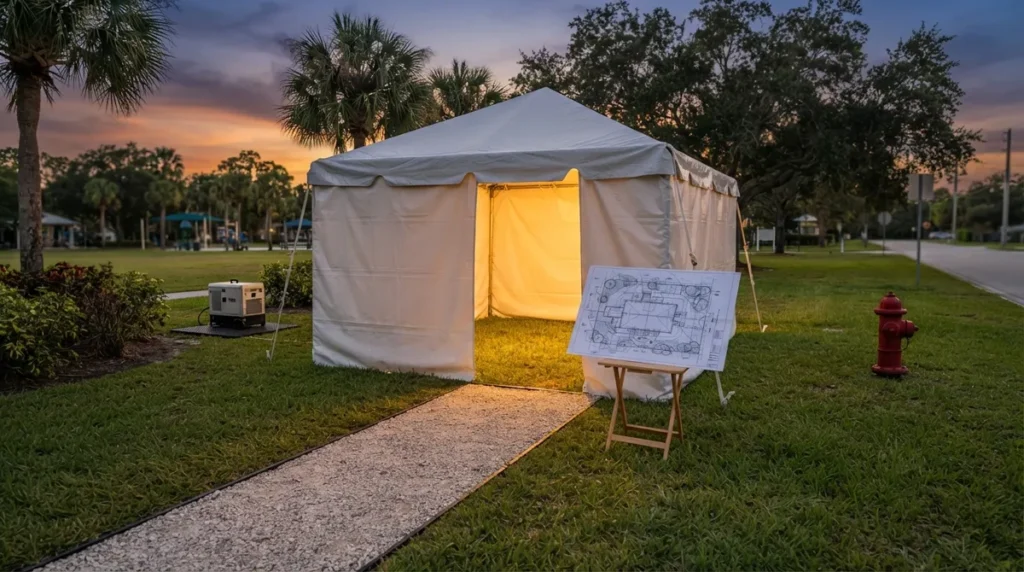
Key Takeaways
-
Confirm your permit route first: events on City property generally use the Special Event Permit, while temporary uses on other property may also need a Temporary Use Permit (TUP).
-
Any tent of 120 sq. ft. or more needs NFPA 701 flame-propagation certification and must go through the Special Event process; a 10-by-20 tent (200 sq. ft.) crosses the line.
-
Submit a Special Event application at least 30 days before an event on City property, and request a TUP at least 60 days ahead, since missing documents can restart the clock.
-
Key fire-safety limits: tents cover no more than 75% of the premises, generators sit at least 20 feet from tents, and no open-flame cooking under tents (at least 10 feet away).
-
Build a clear, to-scale site plan showing tent sizes, placement, exits, hydrants, and access routes, and confirm insurance certificates match the number of tents listed.
-
Budget beyond permit fees for flame-certified rentals, insurance, generators, toilets, and extinguishers, and verify current fees ($120 TUP, waived for nonprofits; $77 inspection) with the City.
Planning a backyard wedding, a church festival, a grand opening, or a fundraiser in North Port? Then a big white tent is probably on your wish list. And if you are searching for a tent permit in North Port, FL, you have likely already figured out that the answer is not one simple form. It is a small puzzle, and the good news is that it is a puzzle you can solve with a little planning.
In North Port, approval depends on where the tent goes and why you are using it. A tent on City property generally follows the City's Special Event Permit process. A tent on other property may also need a Temporary Use Permit, and North Port Fire Rescue weighs in on safety. Each piece has its own paperwork and its own lead time.
Below, we walk through five practical steps, with the numbers the City has published as of 2026. Think of it as a friendly roadmap from "we want a tent" to "we are cleared to set up." Pour a coffee and let's dive in.

Step 1: Figure Out Which Approval Route Applies to Your Tent
Before you fill out anything, pin down two facts: who owns the land and what the tent is for. Those two answers decide your route. Many first-time organizers skip this step and end up with the wrong application.
Where the tent goes matters most
For events on City property, North Port generally uses its Special Event Permit process. For events or temporary uses on other property, such as a private lot, a church parking area, or a commercial site, you may also need a Temporary Use Permit (TUP). Some events can touch both processes, so it pays to ask early.
Why the tent is there matters too
A one-day birthday party is a different animal from a month-long seasonal sale or a tent revival. The City's TUP application lists temporary uses such as fairs, festivals, tent revivals, and other nonpermanent structures or events. If your use is closer to that list, expect to deal with Planning, not just the events office.
Here is a quick comparison to help you orient yourself:
| Situation | Likely Route | Key Lead Time |
|---|---|---|
| Event on City property | City Special Event Permit | Submit at least 30 days before |
| Temporary use on other property (fair, festival, tent revival) | Temporary Use Permit | Requested at least 60 days before |
| Tent of 120 sq. ft. or more | Special Event process plus Fire Rescue review | Confirm with the City |
| Small event, unclear status | Call the City and confirm | Ask before you buy or rent |
The simplest rule of all: confirm with the City before you set anything up. A five-minute phone call can save you a very expensive reschedule.
Step 2: Know the Fire-Safety Rules Before You Book a Tent
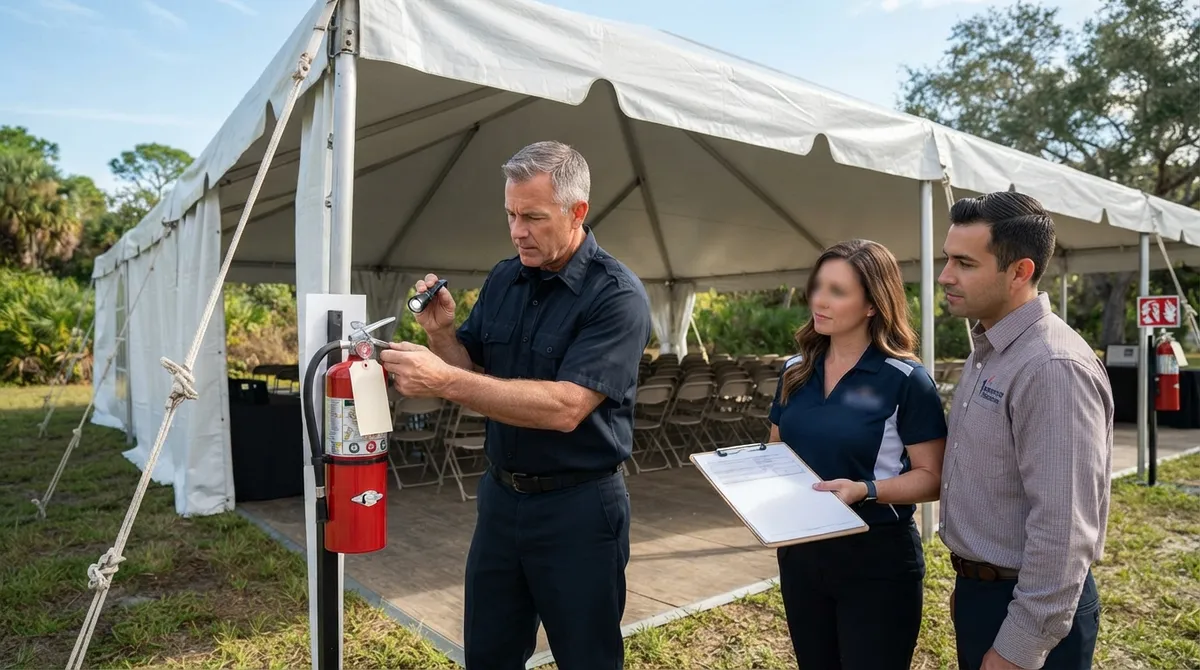
Here is a tip we love sharing: check the fire rules before you pay a rental company, not after. North Port Fire Rescue publishes an event safety checklist, and several items affect what tent you can use and how you can arrange the site.
The 120-square-foot threshold
According to the City's Fire and Life Safety Requirements (dated July 22, 2025), tents of 120 square feet or more need fabric flame-propagation certification under NFPA 701 and must be permitted through the Special Event process. That is smaller than you might think. A standard 10-by-10 canopy is 100 square feet, but a 10-by-20 is 200 square feet and crosses the line.
The key safety numbers
Here are the figures the City has published that you will want on your radar:
| Safety Item | What the City Says |
|---|---|
| Flame-resistance certificate | NFPA 701 certification for tents 120 sq. ft. or larger |
| Maximum tent coverage | No more than 75% of the premises |
| Generator separation | At least 20 feet from tents or temporary structures |
| Open-flame cooking | None under tents or canopies; at least 10 feet away per the special-event manual |
| Fire and life-safety inspection | $77 per inspection in the City's 2026 special-event application (verify current fee) |
Other items on the checklist
- No-smoking signage posted at the tent
- Approved fire extinguishers with proper signage
- A site layout that keeps exits and access routes clear
- Properly weighted tents, since wind is no joke in Southwest Florida
Ask your tent rental company for the flame-spread certificate up front. Reputable rental companies usually have one on file, and you will need to include it in your application packet.
Step 3: Build a Clear Site Plan and Gather Your Documents
If there is one thing reviewers love, it is a clean, readable site plan. If there is one thing that slows applications down, it is a vague one. This step is where a little care pays off in days saved.
What the site plan should show
The City's Temporary Use application calls for a site plan showing tent locations and dimensions, structures, seating, cooking areas, stages, generators, vendors, toilets, fire hydrants, access routes, parking, and waste facilities. Even if you are only applying for a Special Event Permit, the same level of detail is a smart goal, since the City's guidance asks for tent quantity, size, and placement to appear on the plan.
Your document checklist
For a City-property special event, the application should include:
- A written narrative describing the event, dates, hours, and expected attendance
- A detailed site plan with tent size, number, and placement
- Insurance documents
- Applicable safety documentation, including tent flame-spread certificates
- Any extra items the City requests for vendors, cooking, or power
Insurance details to watch
For applicants subject to the requirement, the TUP application specifies commercial general liability coverage of $300,000 per occurrence and $600,000 aggregate, naming the City as an additional insured. Talk to your insurance agent early, because certificates can take a few days to issue.
Stakes, weights, and utilities
The City's event guidance says tents should be properly weighted. If you plan to dig to install stakes, you may need a Sunshine State One Call clearance ticket. The City's tutorial notes an exception for standard 10-by-10-foot tents, but ask whether it applies to your specific site and setup.
Drawing a site plan to scale is not everyone's favorite hobby. If your event is large, or your property has tricky setbacks and utilities, a professional drafter can produce a clean, to-scale layout that reviewers can read at a glance. Our team handles exactly this kind of work through site plan preparation, and we are happy to help.
Step 4: Mind the Deadlines and Budget for the Real Costs
Timing is where good events get into trouble. The City has published lead times, and they are longer than many organizers expect. Treat them as minimums, not goals.
| Permit or Fee | Cost | Lead Time |
|---|---|---|
| City Special Event Permit (City property) | No application fee; service or resource costs may apply | Submit a complete application at least 30 days before |
| Temporary Use Permit | $120 application fee, waived for nonprofits | Requested at least 60 days before |
| Fire and life-safety inspection | $77 per inspection in the City's 2026 application | Confirm need with Fire Prevention |
Things to keep in mind about timing
- The 30-day and 60-day figures are for a complete application. Missing documents can restart the clock.
- The TUP application describes a temporary use as generally lasting more than two weeks but less than one year, with the permit valid for 12 consecutive months from issuance. Verify the current code with Planning, since the City's web materials may be revised.
- Fees and forms can change, so always check the City's current application before budgeting.
Budget beyond the permit
The permit fees are only part of the picture. Remember to plan for flame-certified tent rental, insurance certificates, portable toilets, generator rental with proper separation, signage, and fire extinguishers. A realistic budget keeps surprises out of your final week.
One more friendly nudge: if your event falls in a busy season, such as winter weekends when the whole region seems to throw a festival, start early. Padding your timeline by a couple of weeks costs nothing, and it gives you room to answer any questions the City raises.
Step 5: Submit Cleanly, Follow Up, and Prepare for Inspection
You have done the homework. Now it is time to send it in and shepherd it through.
- Double-check the packet. Confirm the narrative, site plan, insurance, and certificates all match. If the site plan shows two tents, your certificates should cover two tents.
- Submit through the correct channel. Use the City's current Special Event Application or Temporary Use Application, and confirm where it goes.
- Respond fast to comments. If a reviewer asks for a revised layout or an extra document, a quick reply keeps you inside your timeline.
- Schedule any inspection. If Fire Prevention requires an inspection, line it up well before the day of the event.
- Keep paperwork on site. Have your approval, certificates, and site plan handy on event day.
A quick pre-event walk-through
Before guests arrive, walk the site with your checklist. Are the generators at least 20 feet from the tent? Are extinguishers mounted and signed? Is any cooking happening outside the tent and at least 10 feet away? Is the no-smoking signage up? Are the tent weights secure? Ten minutes here can save a headache later.
When it makes sense to bring in help
Plenty of small events can be handled in-house. But once you add multiple tents, vendors, generators, a stage, or a lot of overlapping departments, coordination becomes a real job. That is where an experienced team earns its keep. At 1 Contractor Solutions, we act as an outsourced permitting department across all 67 Florida counties, and we offer special event permit support, including filing, tracking, and reviewer follow-up. If you are curious how similar events work in nearby cities, our guides on getting a tent permit in Cape Coral and common tent permit mistakes in Sarasota offer helpful comparisons. We also have a walkthrough of tent permit rules in nearby Venice.
Who Benefits Most From Professional Help With a Tent Permit?
Not everyone needs a consultant, but certain readers tend to get the most out of one:
- General contractors running a commercial grand opening or job-site event who need clean drawings and fast filing
- Real estate professionals and investors hosting open houses, model-home events, or community days
- Homeowners planning a large backyard wedding or milestone party and wanting to avoid a last-minute denial
- Design and trade professionals who need dependable site plans without maintaining in-house drafting staff
- Property owners staging seasonal sales or temporary commercial uses that may trigger the TUP route
Because our drafting and engineering are in house, a reviewer's comment about layout or structure gets fixed by our own team, not passed to an outside consultant. If something goes sideways, we also handle urgent permit rescue. Learn more about how we help local clients on our North Port permitting page, and see how other residents describe their experience by checking our 1 Contractor Solutions reviews on Google.
You can also stay in the loop with our latest permitting tips if you follow us on LinkedIn or follow us on Facebook. Our web presence is supported by Brain Buzz Marketing.
Final Thoughts: Plan Early and Party Confidently
A tent permit in North Port, FL is really a short checklist in disguise: decide your route, learn the fire rules, build a clear site plan, respect the deadlines, and follow through. Do those five things, and the process feels far less mysterious.
Remember that City materials can be updated, so confirm current fees, forms, and requirements with the City of North Port before you commit. Rules and numbers cited here reflect the City's published materials as of 2026.
Ready to hand off the paperwork and enjoy your event? We would love to help you with site plans, filing, and reviewer coordination. Reach out today to get a free quote, and let's get your tent approved and standing tall.
FAQs
Do I need a permit for a tent in North Port, Florida?
Often, yes. Events on City property generally use the City's Special Event Permit process, and temporary uses on other property may also need a Temporary Use Permit. Tents of 120 square feet or more also need NFPA 701 flame-propagation certification and must go through the Special Event process, so confirm with the City before you set up.
How far in advance should I apply for a North Port tent or event permit?
The City asks for a complete Special Event application at least 30 days before an event on City property. The Temporary Use Permit application requests submission at least 60 days ahead. Applying earlier gives you breathing room if the City asks for changes.
What does a tent permit cost in North Port?
The City-property Special Event application has no fee, though City services or resources may add costs. The Temporary Use Permit lists a $120 fee, waived for nonprofits, and the City's 2026 special-event materials list a $77 fire and life-safety inspection fee. Always verify current amounts with the City before budgeting.
What are the main fire-safety rules for tents in North Port?
Tents of 120 square feet or more need NFPA 701 flame-propagation certification, and tents may not cover more than 75% of the premises. Generators must sit at least 20 feet from tents, and open-flame cooking is not allowed under tents and must stay at least 10 feet away. You will also need no-smoking signage and approved fire extinguishers.
We do this work every day across all 67 Florida counties. Call (866) 314-6931 and we will tell you what your situation actually requires — including when you do not need us.
Related services
Permit Facilitation & Filing
You have a crew scheduled, a client asking for dates, and a permit sitting somewhere in a queue you cannot see. We file it, w…
See the servicePlan Review Coordination
A permit in plan review is not one queue. On a commercial project it can be six queues, each with its own reviewer, its own c…
See the serviceReady to get your permit moving?
One call tells you which jurisdiction controls your project, what it will take, and what it will cost. Most of the time we can scope it on the phone.