
Blog
12 Typical After-the-Fact Permit Fees in Florida (2026)
Wondering what after-the-fact permit fees cost in Florida? Learn the 12 cost factors, from doubled fees to surcharges, and how to estimate your total.
Key Takeaways
-
Florida has no statewide after-the-fact permit fee; each city and county sets its own penalties, so costs vary significantly by jurisdiction—request a current, project-specific estimate from your local building department.
-
Many Florida jurisdictions charge roughly double the normal permit fee as a base penalty, but repeat offenses can escalate dramatically (e.g., Pinellas County charges 10x for repeat violations within 12 months by the same contractor).
-
The penalty fee is only one component; plan review, inspections, surcharges, as-built drawings, engineering letters, and mandatory code corrections can add substantially to the total cost.
-
Paying the penalty does not make noncompliant work acceptable—any work failing to meet Florida Building Code must be corrected before permit closure, which can become the largest cost line item.
-
Some jurisdictions exclude certain fees (like plan review and surcharges) from the doubling penalty, so clarify which specific fees get multiplied and which remain at standard rates.
-
New owners may qualify for exemptions or waivers when they did not perform the unpermitted work, and temporary relief programs occasionally apply—verify current exceptions directly with your local building department.
Let's be honest: nobody wakes up hoping to deal with an after-the-fact permit. But if you've found out that work on your property was done without a permit, you've probably got one big question running through your head. What is this going to cost me?
Here's the friendly truth. The answer to what are typical after the fact permit fees in Florida is not one single number. Florida has no statewide after-the-fact fee. Each city and county building department sets its own fees, penalties, and exceptions. So the bill you see depends heavily on where your property sits.
The good news? Once you understand the pieces that make up the bill, budgeting gets much easier. In this guide, we'll walk through 12 cost factors that typically show up, from the headline penalty to the sneaky extras. Whether you're a contractor, solar company, realtor, or homeowner, you'll leave knowing what to expect and what to ask.
Quick note: fee schedules change, so always confirm numbers with your local building department before you budget. Think of the figures below as a map, not a final price tag.
The Quick Answer: What Do After-the-Fact Permits Usually Cost?
If you want the short version, here it is. Many Florida jurisdictions charge about twice the normal permit fee when work starts without a permit. Some add a fixed minimum on top. Some charge far more for repeat offenses.
But the penalty is only one slice of the pie. Plan review, inspections, surcharges, drawings, and code corrections can all add up. Here's a snapshot of how a few local schedules handle the penalty piece.
| Jurisdiction (per published schedule) | Typical Penalty Approach | Repeat Offense Note |
|---|---|---|
| Pinellas County | 2x normal permit fees | A subsequent after-the-fact permit to the same licensed contractor within 12 months is listed at 10x |
| Homestead | Double permit fee, plus a $100 minimum | Higher amounts for subsequent offenses |
| Miami Lakes | Double fee plus $100 (first offense) | Plus $200 for a second offense, plus $500 for later offenses |
These examples come from published local schedules and may be updated, so treat them as illustrations and verify the current adopted version.
1. The Doubled Permit Fee (The Headline Penalty)
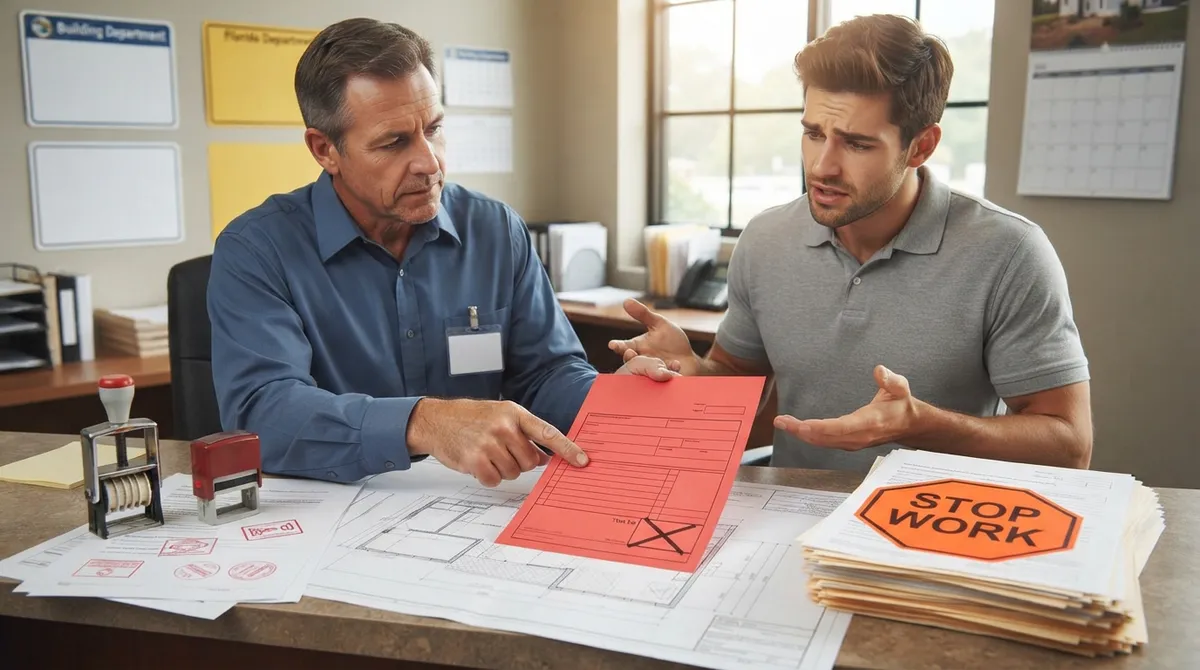
This is the one most people have heard about. Many local departments charge the regular permit fee plus an additional amount equal to it. In plain English, you pay roughly double.
Say your normal permit fee would have been $400. A doubling approach could put the permit-fee portion near $800. That's a rough illustration only, since your actual figures depend on your jurisdiction and project value.
Not every department doubles. Some use different multipliers, and some apply the penalty only to certain fee categories. That's why a project-specific estimate matters so much.
2. Fixed Minimum Penalties
Some jurisdictions add a flat charge on top of the doubled fee. Homestead's schedule, for example, lists a double permit fee plus a $100 minimum for work started without a permit.
Why does this matter? On small jobs, the flat minimum can feel larger than the doubling itself. A small fence repair or a water heater swap might see the minimum drive the penalty.
3. Repeat-Offense Penalties
Here's where things can get pricey. Several schedules climb quickly for repeat violations. Miami Lakes lists add-ons of $100, $200, or $500 depending on offense history. Pinellas County's schedule lists a much higher multiplier for repeat after-the-fact permits by the same licensed contractor within 12 months.
If you're a contractor, this one is worth printing and taping to your monitor. A single slip can be fixable. A pattern gets expensive fast.
4. The Regular Permit Fee Still Applies
This surprises people. The penalty doesn't replace the ordinary permit fee. It's typically layered on top of it, or built into a doubled total.
So when you budget, start with the fee the permit would have cost originally. Then add the penalty structure your jurisdiction uses. Your project's valuation, scope, and permit type all shape that base number.
5. Plan Review Fees
An after-the-fact permit usually still needs plans. A reviewer still has to confirm that the completed work meets the Florida Building Code. That review can carry its own fee.
Here's a detail worth knowing. Some jurisdictions exclude plan review from the doubling. A Citrus County audit, for instance, describes doubling building and associated building fees while excluding items like surcharges, site reviews, plan reviews, product approvals, and land-development fees. Other places may treat it differently. Ask which fees get doubled and which don't.
If you need help assembling a clean, reviewer-friendly package, our plan review coordination team handles comments and resubmittals so you're not stuck guessing.
6. State and Local Surcharges
Surcharges are the small add-ons that quietly build up. A Tampa-focused source reports the Florida Building Permit Surcharge as 2.5% of permit value or a $4 minimum. Whether and how that applies can vary, so confirm the current calculation with your jurisdiction.
The good news is that these are usually modest compared with the penalty. The bad news is they're easy to forget when you're building a budget.
7. Inspection and Reinspection Charges
Every permit needs inspections, and after-the-fact permits are no exception. Some departments include inspections in the base fee. Others charge separately, especially for reinspections after a failed visit.
Here's a friendly tip: prepare before the inspector arrives. Failed inspections can mean extra fees and extra time. Our inspections support helps you walk in ready.
8. As-Built Drawings and Documentation
When work is already finished, the building department often wants drawings that show what actually exists. That's where as-builts come in. These documents capture dimensions, structure, and systems as they sit today.
Costs vary with project size and complexity. A simple deck is a different story from a full addition. You can read more about our as-built drawings service if you're wondering what's involved.
9. Engineering and Engineer Letters
Some work can't be judged by eye alone. Structural framing, roof trusses, wind connections, and electrical loads may need a licensed engineer to verify compliance, sometimes with a sealed letter.
This is often where owners feel a little nervous, and that's normal. The right engineer can turn a scary unknown into a clear yes-or-no. Explore our engineer letters and structural engineering options for a sense of how that works.
10. Opening Up Concealed Work
Here's a cost that doesn't show up on any fee schedule. If walls, ceilings, or floors were closed up before inspection, the inspector may ask you to open them so they can see wiring, plumbing, or framing.
That means demolition, then patching and repainting afterward. It's not a permit fee, but it's a real part of the final cost. Budget a little breathing room here.
11. Code Corrections
This is the big one to understand. Paying a penalty doesn't make noncompliant work acceptable. If something doesn't meet the Florida Building Code, it must be corrected before the permit can close.
That could mean replacing undersized wiring, adding proper fasteners, upgrading a connection, or reworking something that looks fine but isn't. Correction costs vary wildly. Sometimes it's a quick fix. Sometimes it's the largest line item on the whole job.
12. Exceptions, Waivers, and Temporary Relief
Now for some brighter news. Rules and exceptions differ by place, and sometimes you get a break. The Citrus County audit mentioned earlier notes an exception when the current owner did not perform the unpermitted work. That's a big deal for buyers who inherited someone else's shortcut.
Temporary relief programs also pop up. Pinellas County described a limited penalty waiver for certain storm-repair permits through June 30, 2026, though standard permit fees still applied, and fees were reinstated July 1, 2026. Since we're now past that date, never assume a waiver is active. Verify directly with the department.
A Quick Cost Breakdown You Can Use
To keep everything straight, here's how the pieces typically stack up. Use this as a checklist when you request an estimate.
| Cost Component | Is It Usually Doubled? | What to Ask Your Department |
|---|---|---|
| Base permit fee | Often yes | What multiplier applies? |
| Fixed minimum penalty | Flat add-on | Is there a minimum or offense-history charge? |
| Plan review | Varies | Is plan review excluded from the penalty? |
| Surcharges | Often excluded | Which surcharges apply? |
| Inspections and reinspections | Varies | Are inspections included in the base fee? |
| Drawings, engineering, corrections | Not a permit fee | What documents are required? |
How to Get an Accurate Number for Your Project
Ready to stop guessing? Follow these steps to land on a real figure.
- Confirm your jurisdiction. Near city lines, it isn't always obvious who controls your address. Our building department lookup can help.
- Check for open permits. A quick open permit search can reveal what's already on file.
- Request the current fee schedule. Ask for the adopted schedule, not an old PDF.
- Ask about the penalty method. Find out what gets doubled, what's excluded, and whether a minimum applies.
- Get a project-specific estimate. Share your scope, valuation, and drawings if you have them.
Local Examples: Why Your County Matters
Florida is huge, and local practices vary. A project in Pinellas County may follow a different fee approach than one in Miami-Dade County or Hillsborough County.
Even cities within the same county can have their own schedules. That's why one neighbor's story rarely matches yours. If you're in the Tampa Bay area and want to see how local teams work, you can see what 1 Contractor Solutions customers say on Google via Visit us on Google — 1 Contractor Solutions.
What Each Type of Reader Should Watch For
- General contractors: Watch repeat-offense rules. Repeat penalties tied to a license can climb sharply.
- Solar companies: Confirm whether your jurisdiction applies a penalty to the permit fee or the system valuation, and keep sealed documentation ready.
- Realtors and investors: Check open permits early, before inspection periods run short. Exceptions for non-responsible new owners may apply.
- Homeowners: Ask whether you, as the current owner, are exempt when a prior owner did the work.
- Design trade professionals: Provide clear as-builts and engineering to avoid rework and extra reviews.
Smart Ways to Keep the Total Lower
You can't change the fee schedule, but you can avoid piling extra costs on top. A few friendly habits make a real difference.
- Gather photos, receipts, and any prior permit records before you apply.
- Submit a complete package the first time to avoid resubmittal delays.
- Fix obvious code issues before the inspector arrives.
- Ask whether a private provider route could speed review.
- Don't ignore a notice. Fines and penalties can grow while you wait.
If you're facing a stop-work order or a looming closing, our urgent permit rescue team steps in fast. And our after-the-fact and expired permits service is built for exactly these files. For deeper reading, check out our guide to after-the-fact permit costs in Florida.
Final Thoughts: You've Got This
So, what are typical after the fact permit fees in Florida? Often around double the normal permit fee, sometimes with a flat minimum or steeper repeat-offense charges. But the real total also includes plan review, surcharges, inspections, drawings, engineering, and any code corrections.
The best move is to get a current, project-specific estimate from your local building department. And remember, a penalty is just money. Unpermitted work is a very fixable problem when you have the right team.
Want a hand sorting it out? Get a free quote from our team. We respond fast, we work in all 67 Florida counties, and we'll help you find the clearest path to a closed permit. You can also follow us on LinkedIn or follow us on Facebook for more Florida permitting tips. For the official baseline on state requirements, the Florida Building Commission is a helpful authoritative resource.
FAQs
How much does an after-the-fact permit cost in Florida?
There's no single statewide price, because each city or county sets its own fees. A common approach is about twice the normal permit fee, sometimes plus a flat minimum. Your best bet is to ask the local building department for a current, project-specific estimate.
Are plan review fees and surcharges also doubled?
It depends on your jurisdiction. Some departments double only the main building fees and exclude items like surcharges and plan review, as one Citrus County audit describes. Ask exactly which fees get the penalty so there are no surprises.
Can I still get a permit if the work is already finished?
Yes, in many cases you can apply for an after-the-fact permit. You'll usually need plans or as-built drawings, supporting documents, and passing inspections. Just remember that paying the penalty doesn't make noncompliant work acceptable, so corrections may be needed.
Can a new owner be charged for work a previous owner did?
Sometimes yes, but some jurisdictions carve out exceptions when the current owner didn't perform the unpermitted work. The rules vary by location, so check with your local department early, ideally before closing.
We do this work every day across all 67 Florida counties. Call (866) 314-6931 and we will tell you what your situation actually requires — including when you do not need us.
Related services
Permit Facilitation & Filing
You have a crew scheduled, a client asking for dates, and a permit sitting somewhere in a queue you cannot see. We file it, w…
See the servicePlan Review Coordination
A permit in plan review is not one queue. On a commercial project it can be six queues, each with its own reviewer, its own c…
See the serviceReady to get your permit moving?
One call tells you which jurisdiction controls your project, what it will take, and what it will cost. Most of the time we can scope it on the phone.