
Blog
Who Should You Hire for a Florida After-the-Fact Notice?
Got a Florida correction notice for work done without a permit? Learn who to hire first, who seals plans, and how to avoid costly mistakes.
Key Takeaways
-
Hire a Florida permitting consultant or expediter first, ideally one with local after-the-fact experience in your specific city or county, to read the notice and identify what you actually need.
-
An after-the-fact permit documents work already built but does not automatically legalize it; the local authority decides whether the work meets code and what corrections are required.
-
Engineers or architects are typically needed for structural changes, life safety issues, or sealed plans and calculations, while licensed contractors handle physical corrections within their license category.
-
Verify every professional's Florida license through the Department of Business and Professional Regulation (DBPR) and confirm the license category matches the scope of work before hiring.
-
Get the scope, fees, and responsibilities in writing, and ask who will sign and seal plans and who handles inspections and permit closeout.
-
Never hire anyone who guarantees approval or promises to make the notice disappear, and never ignore the notice, since missed deadlines can bring fines or stop work orders.
Opening that official envelope is never fun. Maybe a code officer spotted your new lanai. Maybe a buyer's inspector found a bathroom remodel nobody permitted. Now you're holding a correction notice, a deadline is ticking, and one big question is front and center: who should I hire for a correction notice after the fact in Florida?
Take a breath. You are far from the first person to land here, and this problem is very fixable. The tricky part is that "after the fact" cleanup can involve several different professionals, and hiring the wrong one first can cost you weeks and real money.
In this friendly guide, we'll walk through who does what, who to call first, and how to size up anyone you're thinking about hiring. Whether you're a homeowner, a general contractor, a solar company, or a real estate pro, you'll leave knowing exactly where to start. We'll keep it simple, and we'll keep it honest. No pressure, just clarity.

What a Correction Notice Really Means
A correction notice is a written message from your local building department or code enforcement office. It tells you that work was done without a required permit, or that something on a permit needs to be fixed. Florida law generally requires a permit before construction, alteration, repair, or demolition begins (Fla. Stat. § 553.79).
An after-the-fact permit is the local process for documenting and reviewing work that is already built. Here's the important part: it does not automatically legalize anything. The authority still decides whether the work meets code, what documents it needs, and whether any corrections are required.
Notices usually point to one of these situations:
- Work completed with no permit at all
- A permit that expired before final inspection
- Work that does not match the approved plans
- A code enforcement case tied to a complaint or an inspection
Knowing which situation you're in helps you pick the right hire. If your case involves an after-the-fact or expired permit, the steps differ from a pure code violation. And if it's a code compliance violation, the clock may run differently too.
The Four Pros Who Might Be on Your Team
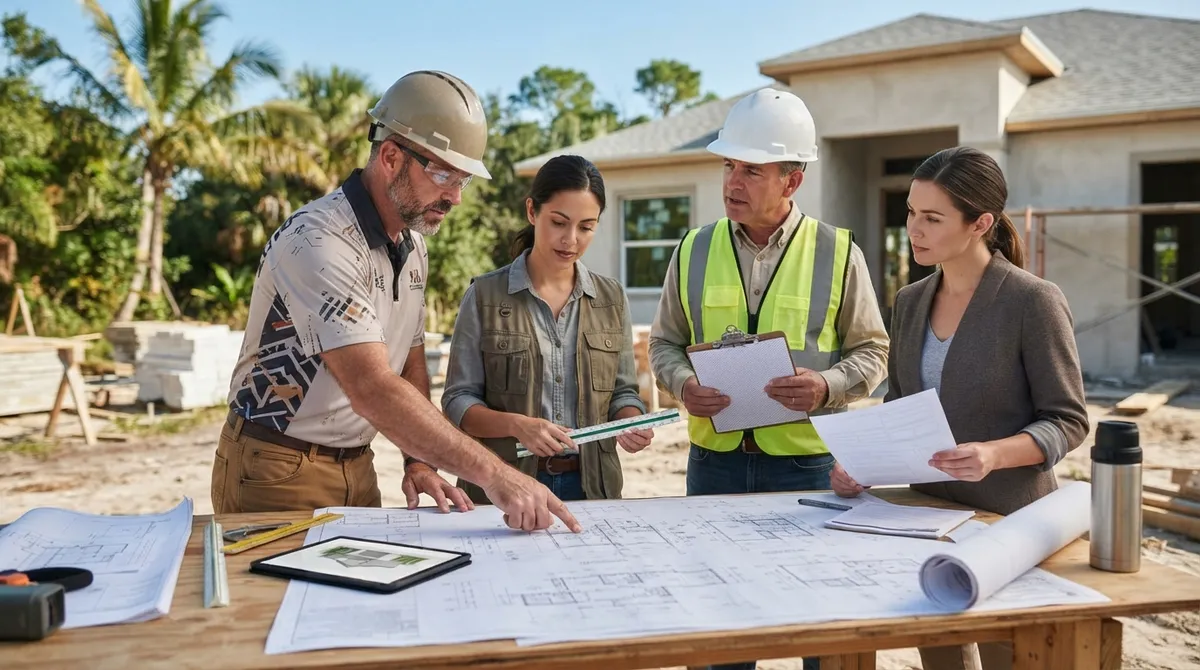
Here's the secret nobody tells you up front: you rarely hire just one person. Most after-the-fact cases need a small team, and each member has a distinct job.
| Professional | What They Do | What They Cannot Do |
|---|---|---|
| Permitting consultant or expediter | Reads the notice, identifies the authority, coordinates filing, tracks comments, manages deadlines | Cannot seal plans or perform regulated construction unless separately licensed |
| Architect or professional engineer | Documents existing conditions, designs corrections, signs and seals plans and calculations | Does not usually manage filing or tracking |
| Licensed contractor | Performs corrective construction within their license category | Cannot seal engineering documents |
| Private provider | May perform plan review or inspections where local rules allow | Does not override what the local authority requires |
Think of it like a relay race. The consultant runs the first leg and hands the baton to the right specialists. Nobody on the team replaces anyone else.
Who to Hire First: The Permitting Consultant
For most people, the best first call is a Florida permitting consultant or permit expediter who has real experience with your specific city or county and with after-the-fact cases. Why first? Because they can look at your notice and tell you what you actually need before you spend money on the wrong professional.
A good consultant will:
- Read the notice and confirm the issuing authority
- Identify the response deadline and case or permit number
- Confirm whether work must stop
- Determine which submittals are required
- Tell you whether you need an engineer, an architect, or a contractor
- Coordinate, file, and track the application through approval
Local knowledge matters enormously here. Florida has hundreds of jurisdictions, and fees, deadlines, documentation, and review times vary from one to the next. A consultant who knows Hillsborough County may not know every quirk in Miami-Dade County, so ask about local experience.
If you want a team that handles filing, tracking, and revisions end to end, our permit facilitation and filing service is built for exactly this. You can also use our building department lookup tool to confirm which office controls your address.
When You Need an Architect or Engineer
If your notice involves structural changes, life safety, or anything that requires signed and sealed plans or calculations, you'll need a Florida-licensed architect or professional engineer. The local building official decides what documents are required, but these projects commonly call for design professionals:
- Room additions and enclosed patios
- Roof framing or truss changes
- Load-bearing wall removal
- Pool cages and screen enclosures
- Garage conversions
- Electrical, plumbing, or mechanical changes that need design review
For existing work, the professional often prepares as-built drawings to show what was actually built. Sometimes an engineer letter is enough to verify that existing work is sound. Other times, full structural engineering or MEP engineering is needed.
One practical tip: ask who will sign and seal the work, and when. A firm with in-house drafting and sealed drawings tends to move faster, because reviewer comments get answered right away instead of bouncing between outside parties.
When You Need a Licensed Contractor
Sometimes the authority wants physical corrections. Maybe a wall must be opened for inspection. Maybe wiring needs to be redone, or a connection needs reinforcement. That work calls for a Florida-licensed contractor whose license category covers the scope.
Florida Statutes Chapter 489 governs contractor licensing, and local agencies may require a licensed contractor to apply for or complete permitted work. Before you hire anyone, verify their license and status through the Florida Department of Business and Professional Regulation (DBPR).
Beware of anyone who says they can "handle everything" while holding no license for the construction. A consultant should never present themselves as an architect, engineer, or contractor unless they hold that specific license. Ask directly: who prepares the plans, who builds, and who handles inspections and closeout?
If you're a homeowner thinking about pulling the permit yourself, our guide to owner-builder permits explains when that route is possible and when it's not.
A Quick Decision Guide
Not sure where your situation lands? This table gives you a starting point. Remember, the local authority has the final word on what your case requires.
| Your Situation | Hire First | Likely Next Step |
|---|---|---|
| Got a notice and don't understand it | Permitting consultant | Consultant tells you what to add |
| Unpermitted addition or structural change | Consultant, then engineer or architect | Sealed as-built plans |
| Expired permit, work seems complete | Consultant | Reinstatement or new permit and final inspection |
| Unpermitted electrical, plumbing, or HVAC | Consultant and licensed trade contractor | Inspection, possible corrections |
| Closing is held up by an open permit | Consultant with real estate experience | Fast filing and closeout coordination |
| Work doesn't match approved plans | Consultant, then design professional | Revision and resubmittal |
Under a time crunch? Our urgent permit rescue service is designed for denials, stop work orders, and closings on the clock.
Questions to Ask Before You Hire Anyone
Hiring in a stressful moment is when mistakes happen. Slow down for ten minutes and ask these questions. A professional who is happy to answer is usually a good sign.
- Have you handled after-the-fact cases in my specific city or county? Local experience matters more than a long résumé.
- What is included, and what is excluded, in your written scope and fee? Permit fees, engineering, and inspections are often separate costs.
- Who will prepare and sign any plans? You want a name and a Florida license number.
- Who is responsible for inspections and permit closeout? Many cases drag on here.
- Can you provide references? Recent ones from similar projects are best.
- Do you guarantee approval? If the answer is yes, walk away.
That last one is important. No consultant can guarantee approval or waive what the authority requires. An honest professional will tell you the likely path, the possible risks, and the unknowns.
What the Authority Will Probably Ask For
Every jurisdiction is different, but after-the-fact cases commonly involve some combination of the following:
- A permit application for the existing work
- Documentation of existing conditions, such as photos and measurements
- Drawings or as-built plans
- Engineering or sealed calculations when required
- Permit fees, which may be higher for work done without a permit
- Inspections, possibly including exposing concealed work
- Corrective work, and in rare cases, removal of work that cannot meet code
It's reasonable to feel nervous about that last bullet. In practice, many projects can be documented and brought into compliance, but there's no universal rule, and outcomes depend on the work itself and the local official's review. That's one more reason to hire someone who knows how your jurisdiction operates.
If you want a look at how this plays out locally, our guide on responding to a correction notice after the fact in Florida goes deeper, and our overview of after-the-fact permit costs in Florida helps you plan a budget.
Tailoring Your Hire to Who You Are
Different readers need slightly different help. Here's how it tends to break down.
Homeowners
If you bought a house with unpermitted work or a prior owner skipped permits, you probably want one point of contact who explains each step in plain English. Look for a consultant who manages the engineers and trades for you.
General Contractors and Design Trades
If your own project drew the notice, speed and documentation are the priorities. An outsourced team that handles drafting, engineering, and permit tracking lets you keep crews moving. See our page for general contractors for how that works.
Solar Companies
Solar jobs hinge on structural and electrical documentation. If an install went in before the permit closed, you need a team comfortable with code-compliant roof and electrical documentation. Our solar contractor support covers this.
Real Estate Professionals
Open permits and unpermitted work can derail a closing fast. Agents and investors benefit from a partner who can research permit history and move quickly. Check out realtor and closing support for more.
Red Flags to Watch For
Most professionals in this space are honest. A few warning signs are still worth knowing:
- A guarantee of approval or a promise to "make the notice go away"
- No Florida license number for anyone who will seal plans or build
- Vague pricing with no written scope
- Pressure to skip the building department entirely
- No local experience with your jurisdiction
- Advice to hide or ignore the notice
Ignoring a notice is the one move that almost always makes things worse. Missing a deadline can lead to additional fines, escalated enforcement, or a stop work order. If you're short on time, contact the issuing office and ask about your options while you line up help.
How 1 Contractor Solutions Can Help
At 1 Contractor Solutions, we act as Florida's outsourced permitting department. We're not a construction contractor. We're the team you call when the permit stands between you and your next step. We work in all 67 Florida counties and have filed in more than 400 municipalities, so we know how local quirks can change your path.
Our drafting and engineering are in-house, with sealed drawings from our own engineer. That means when a reviewer comments, we fix it directly instead of waiting on an outside party. We're also a licensed private provider, which can help in situations where that route applies.
You can see what customers say by reading our 1 Contractor Solutions reviews on Google, and you can follow us on LinkedIn or follow us on Facebook for updates and permitting tips.
Your Next Steps
Here's a simple plan you can start today:
- Read the notice carefully and note the deadline, case number, and cited violations.
- Contact the issuing office to confirm the requirements and whether work must stop.
- Gather what you have: photos, old permits, receipts, contracts, and prior plans.
- Hire a permitting consultant with local after-the-fact experience.
- Add an engineer, architect, or contractor only if your case calls for it.
- Follow through on inspections and closeout so the file is truly closed.
Remember, there's no reliable statewide figure for how long or how much after-the-fact permits take, because fees and review times are set locally. Be wary of anyone who quotes you a flat answer before they've looked at your case.
Final Thoughts
A correction notice feels like a big problem, but it's really a process, and processes can be managed with the right help. Start with a permitting consultant who knows your area. Bring in a licensed engineer, architect, or contractor only when your scope requires it. Verify every license, get your scope in writing, and never trust a guarantee of approval.
If you'd like a calm, straight answer about your situation, we're glad to help. Just get a free quote and tell us your address and what the notice says. We respond fast, day or night, and we'll point you toward the right next move.
FAQs
Who should I hire first when I get a correction notice for unpermitted work in Florida?
In most cases, start with a Florida permitting consultant or expediter who has experience with your city or county and with after-the-fact cases. They can read the notice, confirm what the authority requires, and tell you whether you also need an engineer, architect, or contractor. It's a friendly first step that keeps you from paying for the wrong specialist.
Can a permitting consultant seal plans or do the construction work?
No, not unless they hold the separate license required for that role. Sealed plans must come from a Florida-licensed architect or professional engineer, and regulated construction must be done by a properly licensed contractor. A consultant coordinates the process, but they don't replace those licensed professionals.
Do I always need an engineer for an after-the-fact permit?
Not always. Engineering is typically needed for structural changes, life safety issues, or anything requiring signed and sealed plans or calculations. The local building official decides what documents your project needs, so confirm requirements with the issuing office or a local consultant before you hire.
How can I verify a Florida contractor, architect, or engineer license?
You can check license status through the Florida Department of Business and Professional Regulation (DBPR). Always confirm the license category matches the work being done, and ask for the license number in writing. A few minutes of checking can save you a lot of trouble later.
What happens if I miss the deadline on a Florida correction notice?
Missing a deadline can lead to additional fines, escalated code enforcement, or a stop work order, and exact consequences vary by jurisdiction. If you're running short on time, contact the issuing office right away and ask about your options. Getting help early is almost always better than waiting.
We do this work every day across all 67 Florida counties. Call (866) 314-6931 and we will tell you what your situation actually requires — including when you do not need us.
Related services
Permit Facilitation & Filing
You have a crew scheduled, a client asking for dates, and a permit sitting somewhere in a queue you cannot see. We file it, w…
See the servicePlan Review Coordination
A permit in plan review is not one queue. On a commercial project it can be six queues, each with its own reviewer, its own c…
See the serviceReady to get your permit moving?
One call tells you which jurisdiction controls your project, what it will take, and what it will cost. Most of the time we can scope it on the phone.