
Blog
How to Use an As-Built Survey to Fix Unpermitted Work
Learn how an as-built survey supports Florida after-the-fact permits, what it does and doesn't cover, and how to legalize unpermitted work.
Key Takeaways
-
An as-built survey documents location and dimensions of unpermitted construction but does not certify code compliance—separate inspections and engineer letters are required to verify electrical, plumbing, structural, and mechanical work meets Florida Building Code.
-
After-the-fact permits in Florida require multiple steps beyond the survey: sealed plans from licensed professionals, required inspections (often involving exposed concealed work), corrective action if deficiencies are found, and final approval before the work is legally closed out.
-
County-by-county requirements vary significantly across Florida's 67 counties and 400+ municipalities; confirm your exact jurisdiction before submitting anything, as some require surveys dated within one year and additional penalty fees beyond standard permit costs.
-
Order your as-built survey early in the process since scheduling delays are common, and have structural and MEP documentation ready before applying rather than scrambling after reviewer feedback to avoid costly resubmittals.
-
Florida Statute §553.79(1)(a) requires permits before construction begins; applying for an after-the-fact permit does not automatically legalize unpermitted work—the building department must still review, confirm code compliance, and may require corrective action.
-
Hire a Florida-licensed Professional Surveyor and Mapper (PSM) governed under Chapter 472 of Florida Statutes, as an inaccurate survey can be rejected outright, sending your application back to square one and causing costly delays.
So you found out there's unpermitted construction on your Florida property, and someone mentioned you need an "as-built survey" to fix it. Take a breath — you're not alone, and this is genuinely fixable. Every week, our team at 1 Contractor Solutions talks to homeowners, real estate agents, and general contractors who are staring down the same puzzle: a pool enclosure, a converted garage, or an addition that was built without a permit years ago, and now it needs to be legalized before a sale, a refinance, or a code enforcement deadline closes in.
Here's the good news. An as-built survey for an after the fact permit in Florida is a well-established tool, and thousands of properties get through this process successfully every year. This guide walks you through exactly what the survey does, what it doesn't do, and how to move your project from "unpermitted headache" to "approved and closed out" without wasting time or money on the wrong first steps.
What Is an As-Built Survey in the After-the-Fact Permit Process
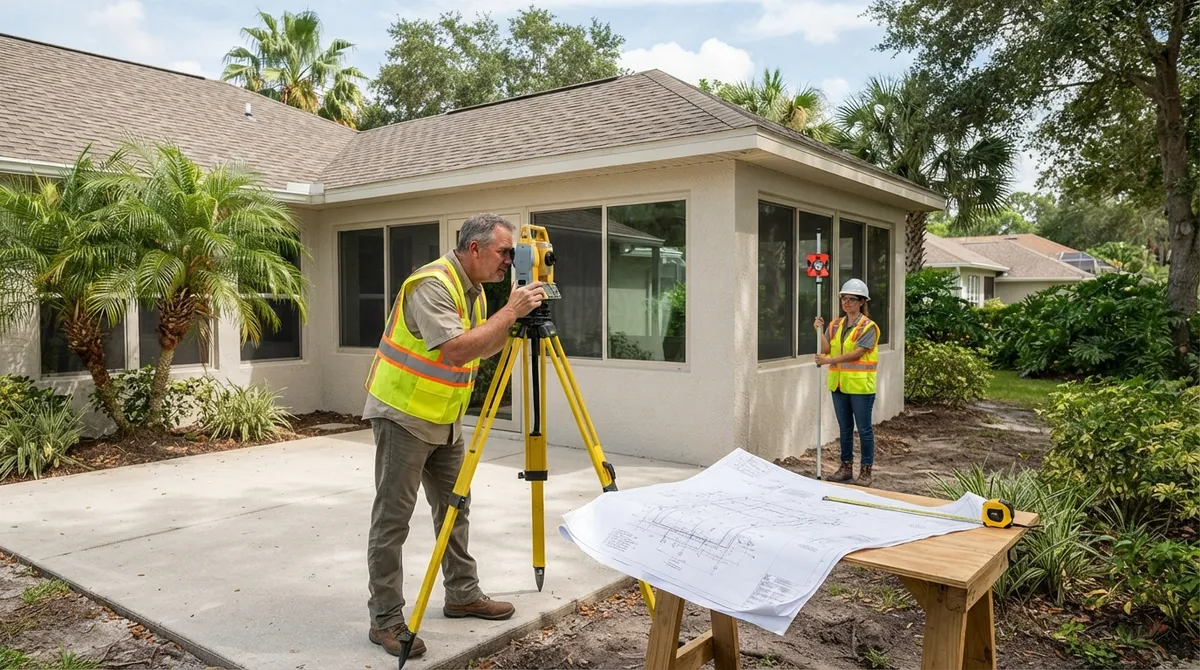
An as-built survey is a document prepared by a Florida-licensed Professional Surveyor and Mapper (PSM) that shows exactly where existing construction sits on your property. Think of it as a snapshot in time — it captures the real-world location, dimensions, and setbacks of a structure that's already been built, whether that's a screened lanai, a shed, a carport, or a full room addition.
For an after-the-fact permit, this survey typically gets paired with your permit application to show the local building department how the unpermitted work relates to your property lines, easements, other structures, and finished-floor elevation. It's a foundational piece of the puzzle, but it's important to understand what it isn't.
What the Survey Does Not Do
Here's where a lot of people get tripped up, so let's clear it up right away. A survey documents location and dimensions. It does not certify that your electrical, plumbing, structural, or mechanical work meets the Florida Building Code. That's a separate process involving inspections, engineer letters, and sometimes exposing concealed work so an inspector or engineer can verify it was built correctly.
- A survey shows where the structure sits — not whether it was built to code
- A survey supports your application — it does not replace required plans or inspections
- A survey alone will not resolve an open code violation or stop a fine from accruing
- A survey must generally be recent — some counties require it dated within the past year
Why Florida Requires Permits Before Construction Begins
Under Florida Statutes §553.79(1)(a), it's generally unlawful to begin covered construction, alteration, or repair work without a permit unless a specific exception applies. This isn't a minor technicality — it's the legal backbone of the entire building safety system in our state, especially given Florida's hurricane exposure and flood risk.
Applying for a permit after work is already complete does not automatically make it legal. The local building department still has to review the work, confirm it meets applicable code requirements, and in many cases require corrective action before signing off. That's exactly why an as-built survey is often just step one of a longer process, not the finish line.
Step-by-Step: How the After-the-Fact Permit Process Typically Works
While every county and city runs its own version of this process, most follow a similar sequence. Here's what you can generally expect:
- Document the existing condition. This starts with the as-built survey, plus photos and any existing plans or records you have on the structure.
- Submit the local after-the-fact application. Each jurisdiction has its own checklist, fee schedule, and submittal requirements — Indian River County, for example, calls for multiple copies of specific documents and may require a Notice of Commencement before your first inspection if the job value exceeds $2,500.
- Provide sealed plans if required. If the structure involves structural, electrical, plumbing, or mechanical systems, you'll likely need drawings sealed by a Florida-licensed design professional showing what was actually built.
- Pay applicable fees. After-the-fact permits often carry additional penalty fees on top of standard permit costs, so budget accordingly.
- Complete required inspections. This might mean exposing concealed work — cutting into drywall, for example — so an inspector can verify framing or wiring that's otherwise hidden.
- Correct any deficiencies. If something doesn't meet code, you'll need to fix it before you can move forward.
- Obtain final approval. Once everything checks out, the building department closes the permit and the work is officially legalized.
If any of this sounds overwhelming, that's completely normal — and it's exactly why our team handles after-the-fact and expired permits every single day across Florida. We take on the files other firms decline.
Who Needs to Be Involved in Your As-Built Survey and Permit Package
Depending on the scope of your unpermitted work, you may need more than just a surveyor. Here's a quick breakdown of the professionals commonly involved:
| Professional | Role in the Process | Governed By |
|---|---|---|
| Florida-licensed PSM | Prepares the as-built survey showing location, dimensions, and site features | Chapter 472, Florida Statutes |
| Structural Engineer | Reviews or certifies framing, load paths, and structural elements | Local building code and Florida Building Code |
| MEP Engineer | Evaluates electrical, mechanical, and plumbing systems for compliance | Florida Building Code, applicable trade codes |
| General Contractor or Owner-Builder | Coordinates corrective work and inspections | Local building department requirements |
| Permit Expediter | Files, tracks, and manages communication with reviewers | N/A — administrative support role |
Because our drafting and engineering are handled in-house, we can move quickly when a reviewer flags something on your as-built drawings or structural documentation. There's no waiting on an outside consultant to return a call — our own engineer signs and seals the work, so corrections happen fast.
County-by-County: Requirements Vary More Than You'd Think
One of the biggest mistakes people make is assuming after-the-fact permitting works the same everywhere in Florida. It doesn't. Palm Beach County's survey policy generally requires documents to be no more than a year old at the time of application unless the building division approves otherwise. Indian River County has its own detailed checklist with specific copy requirements. Miami-Dade, Broward, and Hillsborough each run their own review processes with different fee structures and timelines.
| County | Notable Requirement |
|---|---|
| Palm Beach County | Survey generally must not be dated more than 1 year before application |
| Indian River County | Four copies of submittal documents; Notice of Commencement required over $2,500 job value |
| Miami-Dade County | Often requires additional structural certification for concealed work |
| Hillsborough County | Reviews vary by municipality within the county — confirm exact jurisdiction first |
This is exactly why we recommend using a tool like our building department lookup before you assume you know which office actually reviews your project. We've seen plenty of cases where a property near a city line was actually under county jurisdiction, or vice versa — and that mistake alone can cost weeks.
Common Scenarios We See Across Florida
Every audience we work with runs into this issue from a slightly different angle:
- General contractors inherit a job where a previous owner added a room or converted a garage without permits, and now the current renovation can't move forward until it's resolved.
- Solar companies discover that a roof-mounted structure or existing electrical panel upgrade was never permitted, which can delay interconnection approval.
- Real estate professionals hit a wall during due diligence when a title search or inspection reveals an open permit or unpermitted addition, threatening to derail closing.
- Homeowners want to sell or refinance and learn — often for the first time — that a screened patio or shed built decades ago was never permitted.
If you're a real estate agent working a deal that's stuck, our realtor and closing support team specializes in untangling exactly this kind of last-minute surprise.
Tips for a Smoother As-Built Survey and Permit Process
After 15-plus years and more than 5,000 permits filed across all 67 Florida counties, we've picked up a few things that consistently save our clients time and money:
- Order your survey early — many delays happen simply because the survey takes longer to schedule than expected.
- Confirm your exact jurisdiction before submitting anything, since city and county boundaries aren't always intuitive.
- Ask about penalty fees upfront so there are no surprises in your budget.
- Have your structural and MEP documentation ready before you apply, rather than scrambling after a reviewer comment.
- Keep photos and any historical records of the structure — they can support your case if questions arise about age or scope.
Our engineering team frequently prepares the sealed drawings and engineer letters needed to satisfy structural certification requirements, working right alongside the survey to build a complete, reviewer-ready package.
When to Bring in a Permitting Partner
If you're managing this alone, the back-and-forth with a building department can feel like a part-time job. A missed document, an outdated survey, or an incomplete plan set can bounce your application back and cost you weeks. That's the exact gap we fill.
Our team handles permit facilitation and filing, coordinates plan review, manages revisions and resubmittals, and — because we're a licensed private provider — we can often perform your plan review ourselves instead of leaving you waiting in a county queue. Whether you're in Pinellas County, Manatee County, or anywhere across the state, we know the local checklist and we know how to get an application moving.
You can learn more about how our clients feel about working with us by checking out our reviews, or see what our 1 Contractor Solutions customers say on Visit us on Google — 1 Contractor Solutions. We also stay active on LinkedIn and Facebook, sharing updates on Florida permitting rules as they evolve.
A Quick Word on Chapter 472 and Surveyor Licensing
Florida takes surveyor licensing seriously, and for good reason — an inaccurate survey can create real problems down the line. Chapter 472 of the Florida Statutes governs the licensing and practice of professional surveyors and mappers in our state, and it's worth confirming that whoever prepares your as-built survey holds an active Florida PSM license. This isn't a place to cut corners; a survey that doesn't meet the required standards can get rejected outright, sending you back to square one.
Bringing It All Together
An as-built survey is a genuinely useful, often necessary piece of the after-the-fact permitting puzzle in Florida — but it's one piece, not the whole picture. Pairing it with the right plans, engineering documentation, and a clear understanding of your specific jurisdiction's requirements is what actually gets a permit approved and closed out.
We know this process can feel intimidating, especially if you're staring down a closing deadline or a code enforcement notice. But you don't have to figure it out solo. Our team at 1 Contractor Solutions has spent over 15 years learning exactly what each of Florida's 67 counties and 400-plus municipalities expects, and we bring drafting, engineering, and permit filing together under one roof so nothing falls through the cracks.
Ready to get your unpermitted work legalized the right way? Request your free quote today, and let's get your permit approved and your project moving.
FAQs
What is an as-built survey for an after-the-fact permit in Florida?
It's a document prepared by a Florida-licensed surveyor that shows exactly where existing, unpermitted construction sits on your property in relation to boundaries and other site features. It's typically submitted alongside your after-the-fact permit application, but on its own it doesn't prove the work meets building code — that's a separate review step, and we're happy to walk you through it.
Does Florida allow after-the-fact building permits for unpermitted work?
Yes, most Florida jurisdictions have a process for after-the-fact permits, though the specific checklist, fees, and requirements vary by city and county. It's absolutely fixable, and our team helps folks through this exact process every week across all 67 counties.
Do I need a Florida-licensed surveyor for an after-the-fact permit?
In most cases, yes — the survey needs to be prepared and sealed by a Florida-licensed Professional Surveyor and Mapper. Some counties also require the survey to be fairly recent, sometimes within the past year, so timing matters.
Will an as-built survey prove my unpermitted construction meets Florida Building Code?
Not by itself, and this trips up a lot of good people. The survey documents location and dimensions, but code compliance for structural, electrical, plumbing, or mechanical systems usually requires separate plans, inspections, or an engineer's certification — which is exactly where our in-house engineering team steps in.
What happens if an inspection finds that my existing work doesn't meet code?
You'll typically be asked to make corrections before the permit can be closed out, which might mean exposing concealed work or hiring a licensed contractor to bring things up to standard. It sounds stressful, but it's a very normal part of the process, and getting ahead of it early saves a lot of headache later.
We do this work every day across all 67 Florida counties. Call (866) 314-6931 and we will tell you what your situation actually requires — including when you do not need us.
Related services
Permit Facilitation & Filing
You have a crew scheduled, a client asking for dates, and a permit sitting somewhere in a queue you cannot see. We file it, w…
See the servicePlan Review Coordination
A permit in plan review is not one queue. On a commercial project it can be six queues, each with its own reviewer, its own c…
See the serviceReady to get your permit moving?
One call tells you which jurisdiction controls your project, what it will take, and what it will cost. Most of the time we can scope it on the phone.