
Blog
How to Manage High Volume Roofing Permits in PBC
Learn how roofing contractors manage high volume roofing permits in Palm Beach County with jurisdiction checklists, tracking, and compliance tips.
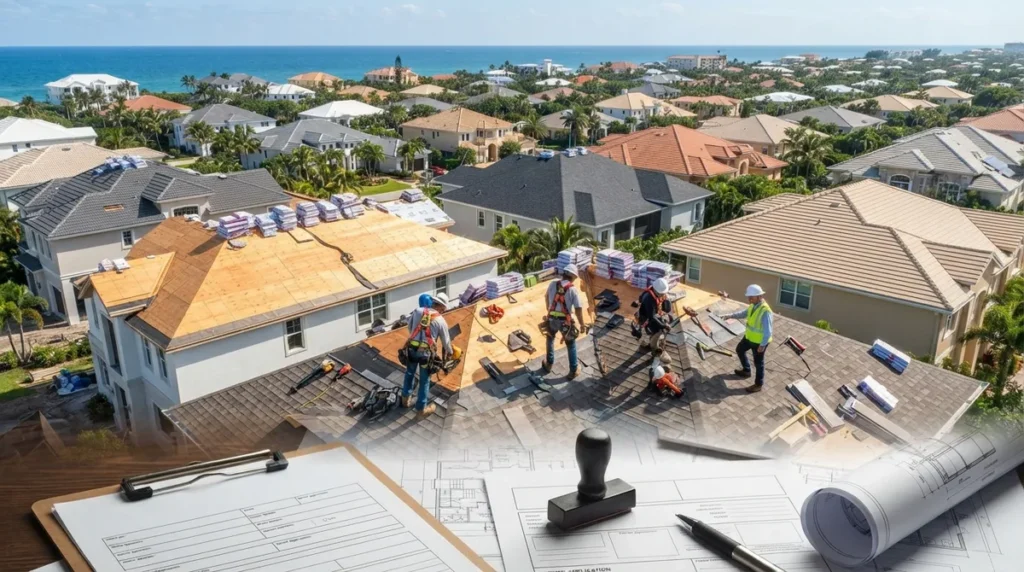
Key Takeaways
-
Palm Beach County issued 6,737 roofing permits across five major cities in 2025, averaging 18 permits daily, with permit volume growing 20.6% year-over-year, making a scalable permitting system essential.
-
Palm Beach County is fragmented across multiple jurisdictions (West Palm Beach, Boca Raton, Delray Beach, Wellington, Palm Beach Gardens, unincorporated areas), each with different building departments, submission portals, and fee schedules requiring jurisdiction-specific checklists.
-
All roofing work except minor maintenance requires permits and must comply with the 8th Edition Florida Building Code; wind-resistance requirements are especially strict due to coastal hurricane exposure, with product approvals and fastening schedules varying by jurisdiction.
-
Implement a centralized tracking system that documents property address, jurisdiction, submission date, reviewer comments, resubmittal status, and inspection schedule to manage high-volume permits efficiently and prevent expired permits or missed inspections.
-
Most roofing jobs require two mandatory inspections: dry-in/underlayment inspection before roof covering installation and final inspection after completion; missing either delays certificate of completion or real estate closings.
-
Median declared roofing job values vary significantly across Palm Beach County cities, ranging from $23,300 in West Palm Beach to $51,750 in Palm Beach, affecting both valuation-based permit fees and market planning strategies.
If your roofing crews are booked out for weeks and your office manager is drowning in permit paperwork, you're not imagining it. Palm Beach County roofing contractors filed thousands of permits last year alone, and that number keeps climbing every storm season. Between juggling different city requirements, tracking product approvals, and scheduling inspections across multiple job sites, high volume roofing permits Palm Beach County work can turn into a full-time job that pulls you away from what you actually do best: putting roofs on houses.
Here's the good news. You don't have to build this system alone, and you definitely don't need to reinvent it for every job. Whether you're a roofing company running 20 permits a week, a general contractor coordinating roof replacements as part of larger renovations, or a homeowner trying to understand why your roofer needs a permit in the first place, there's a clear path to staying organized and compliant. Let's walk through exactly how high-volume roofing permitting works in Palm Beach County, and how a dependable process (or partner) keeps every job moving instead of stuck in a review queue.

Why Palm Beach County Roofing Permits Get Complicated at Scale
One roof permit is manageable. Fifty roof permits spread across a dozen different municipalities is a different animal entirely. Palm Beach County isn't a single permitting authority. It's a patchwork of jurisdictions, each with its own building department, submission portal, fee schedule, and sometimes its own interpretation of the Florida Building Code.
A roofing permit filed in unincorporated Palm Beach County follows one set of rules through the county's Building Division. The same job three streets over in Boca Raton, West Palm Beach, Delray Beach, Wellington, or Palm Beach Gardens might follow a completely different process. For a contractor running high volume, that means your team needs to know exactly which building department actually has jurisdiction over each address before a single form gets filled out.
The Numbers Behind the Workload
According to a third-party analysis of municipal permit records, roughly 6,737 roofing permits were issued in 2025 across just five cities: Boca Raton, West Palm Beach, Delray Beach, Wellington, and Palm Beach Gardens. That works out to about 18 permits a day in those cities alone. The same analysis found 7,572 permits issued in 2024, up from 6,277 in 2023, a 20.6% jump year over year.
That growth trend tells contractors something important: the demand isn't slowing down, and neither should your permitting workflow. The same data found that March, April, and May accounted for 28.1% of roofing permits issued between 2023 and 2025, which means spring is when your permitting process gets tested the hardest.
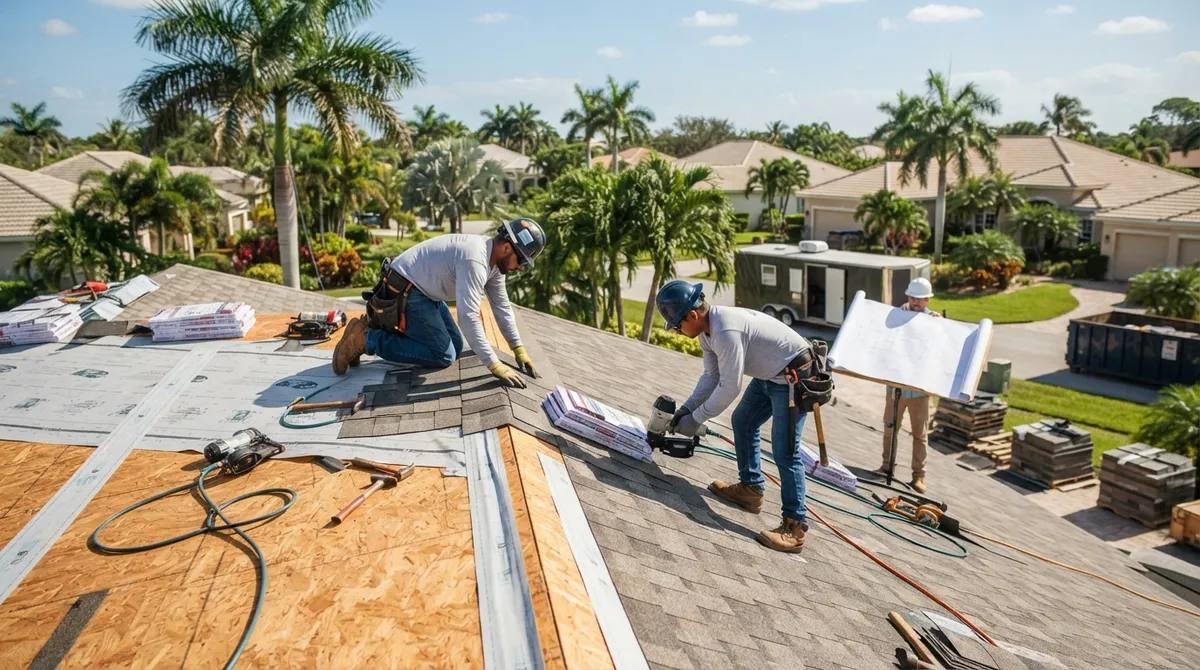
What Actually Requires a Roofing Permit in Palm Beach County
Most roofing work in Florida requires a permit, but the exact line between "needs a permit" and "routine maintenance" isn't always obvious. Here's a general breakdown:
- Full or partial roof replacement, including tear-off and re-cover work
- Structural repairs to decking, sheathing, or the roof assembly
- Skylight installation or replacement
- Changes to the roof covering material or fastening system
- Tile, metal, or shingle re-roofing projects of any significant scope
Minor maintenance, like gutter cleaning or very limited nonstructural repairs, may be exempt, but that determination ultimately rests with the local building official. When in doubt, it's always safer to confirm before starting work rather than risk a stop-work order mid-project.
Florida Building Code and Wind Compliance
Every roofing permit in Palm Beach County needs to demonstrate compliance with the 8th Edition (2023) Florida Building Code, which governs permits issued through the 2024-2026 cycle. Given Palm Beach County's coastal exposure, wind-resistance requirements are especially strict. Depending on the property's location and roof type, your application may need to address High-Velocity Hurricane Zone-related criteria or other wind-design provisions specific to that jurisdiction.
This is where a lot of high-volume roofers get tripped up. Product approval documentation, fastening schedules, and underlayment specs all have to line up with what the local building department expects, and that expectation isn't identical everywhere.
Building a Scalable Roofing Permit Workflow
If you're pulling permits one at a time with a spreadsheet and a lot of hope, it's time for a system upgrade. Here's a practical, step-by-step approach that scales whether you're filing five permits a month or fifty:
- Create jurisdiction-specific checklists. Document exactly what West Palm Beach requires versus what Delray Beach or unincorporated Palm Beach County wants. Include submission portals, fee schedules, and typical review timelines.
- Standardize your product approval documentation. Keep a master file of Florida Product Approvals or Miami-Dade NOAs for every roofing material your crews use, updated as approvals expire or get superseded.
- Track every permit by property, not just by permit number. A centralized tracker should show the address, jurisdiction, submission date, reviewer comments, resubmittal status, and inspection schedule.
- Assign accountability for corrections. Reviewer comments pile up fast at high volume. Someone on your team (or your permitting partner) needs to own resubmittals so nothing sits untouched for weeks.
- Schedule inspections proactively. Dry-in inspections need to happen before roof covering goes on, and final inspections close out the job. Missing either one can delay a certificate of completion or hold up a real estate closing down the line.
- Monitor permit expiration dates. An expired permit means starting over, and that's expensive when you're managing dozens of active jobs at once.
Typical Roofing Permit Fees and Documentation
Palm Beach County publishes a fee schedule that gives contractors a general sense of costs, though actual fees depend on scope and valuation. Here's a snapshot of some published examples:
| Type of Roofing Work | Approximate Fee |
|---|---|
| Flat roof under four squares | $150 |
| Master/product-approved roof penetration | $75 |
| Vent or skylight installation | $100 |
| Roofing repair under two squares or $2,500 value | $75 |
Worth noting: Palm Beach County increased several fees by 2.7% effective March 1, 2026, based on Consumer Price Index adjustments, though building permit fees specifically were excluded from that increase. Always verify current fees directly with the relevant building department before quoting a client, since schedules do change.
Documents You'll Typically Need
- Completed permit application with accurate contractor license information
- Project valuation and detailed scope of work
- Roof plans or diagrams, when required by the jurisdiction
- Florida Product Approval or applicable evaluation reports
- Engineering documents for structural repairs, if applicable
- Owner authorization or required notices
Median Job Values Vary Significantly by City
Declared roofing job values aren't uniform across Palm Beach County, and that matters for both valuation-based fees and market planning. A sample of 575 permits from 2023 through 2026 found median declared values ranging from around $23,300 in West Palm Beach up to $51,750 in the Town of Palm Beach. These figures come from a third-party sample, not an official countywide average, but they illustrate just how much local market conditions can shift your numbers.
City-by-City Permitting Differences
| Jurisdiction | Key Consideration |
|---|---|
| Unincorporated Palm Beach County | Filed through the county Building Division; standard countywide fee schedule |
| West Palm Beach | Own municipal building department and submission portal |
| Boca Raton | High permit volume; often stricter architectural review in some neighborhoods |
| Delray Beach | Separate application system; historic district considerations in some areas |
| Palm Beach Gardens | Municipal review process distinct from county timelines |
| Town of Palm Beach | Higher-value properties; often more detailed architectural review |
For contractors working across several of these cities in the same week, keeping requirements straight is genuinely one of the biggest operational headaches in the business. This is exactly the kind of challenge a dedicated roof permitting service is built to solve.
Inspections: The Part Contractors Can't Skip
Every roofing job in Palm Beach County typically requires at least two inspections:
- Dry-in or underlayment inspection, conducted before the finished roof covering goes down
- Final inspection, conducted once the entire roofing system is complete
Depending on the scope of work, you may also need additional inspections for structural decking repairs, tile fastening systems, or metal roofing installations. Contractors and owner-builders generally need the correct identification number to schedule inspections through the county's online portal, and it's always worth double-checking official status directly with the relevant building department rather than relying on secondhand updates.
Why High Volume Roofers Bring in Permitting Support
At a certain point, the math stops making sense to handle in-house. Every hour your office staff spends chasing down a missing product approval or re-submitting corrected paperwork is an hour not spent scheduling crews or following up with clients. That's where outsourced permitting support earns its keep.
1 Contractor Solutions works across all 67 Florida counties, including Palm Beach County, handling everything from permit filing and tracking to sealed structural drawings when a roof job needs engineering support. Our in-house drafting and engineering team means that when a reviewer flags a correction, we can fix it directly instead of waiting on an outside consultant to call back. We're also a licensed private provider, which means we can perform plan review ourselves instead of leaving your job sitting in a county queue.
For roofers specifically, we run a dedicated Roof Permit Partnership Program designed around exactly this kind of high-volume workflow. We also support general contractors, solar contractors, realtors, and homeowners who need permits pulled correctly the first time.
What a Permitting Partner Should Handle
- Jurisdiction-specific application checklists and templates for every Palm Beach County municipality
- Product approval verification against current requirements
- Centralized permit-status tracking across multiple properties
- Correction and resubmittal management so nothing falls through the cracks
- Inspection scheduling coordination
- Reporting so you always know exactly where every permit stands
If you've got permits stuck, expired, or piling up faster than your team can process them, our urgent permit rescue service exists specifically for that kind of backlog. And if you're just getting started building a volume workflow, our plan review coordination team can help you set up a repeatable process from day one.
A Quick Word on Responsibility and Licensing
It's worth being clear about something important: permit applications need to be submitted by the properly licensed contractor or an authorized party. A permitting service can absolutely coordinate documents, manage submissions, and track applications on your behalf, but it should never misrepresent licensing, contractor responsibility, or property ownership authorization. Good permitting partners understand this distinction and work within it, not around it.
Curious what other contractors say about working with a permitting team day in and day out? You can visit us on Google — 1 Contractor Solutions to see feedback directly from clients who've been through the process. You can also follow us on LinkedIn or follow us on Facebook for updates on code changes and permitting trends across Florida.
Bringing It All Together
Managing high volume roofing permits Palm Beach County work doesn't have to mean chaos, missed deadlines, or frustrated crews standing around waiting on paperwork. With the right jurisdiction-specific checklists, accurate product approval documentation, and a tracking system that follows every permit from submission through final inspection, you can scale your roofing business without scaling your headaches right along with it.
Whether you're managing five roofs a month or fifty, the fundamentals stay the same: know your jurisdiction, document everything, track relentlessly, and don't let corrections sit. And if the volume ever outpaces your team's bandwidth, remember that you don't have to solve it alone. Ready to get your roofing permits moving faster and with fewer headaches? Request your free quote and let's talk about building a permitting workflow that actually keeps up with your crews.
FAQs
Do I need a permit to replace a roof in Palm Beach County?
Yes, in nearly all cases! Full or partial roof replacements, structural repairs, and changes to the roofing assembly typically require a permit under the Florida Building Code. Minor maintenance might be exempt, but it's always worth checking with the local building official before you assume you're in the clear.
How much does a roofing permit cost in Palm Beach County?
It really depends on the scope of work and which jurisdiction you're filing in. Published examples show fees like $150 for a flat roof under four squares or $75 for a small repair, but always confirm current numbers with the relevant building department since fees can shift year to year.
Can a permitting service submit and track multiple roofing permits for my company?
Absolutely, and that's exactly the kind of workload a dedicated permitting partner is built for. A good service can standardize your application checklists, verify product approvals, and track every permit across multiple Palm Beach County municipalities so nothing gets lost in the shuffle.
What inspections are required for a roof replacement in Palm Beach County?
Most roofing jobs need at least two inspections: a dry-in or underlayment inspection before the roof covering goes on, and a final inspection once the job is complete. Depending on the scope, you might also need inspections for structural decking or specialized fastening systems.
How do roofing permit requirements differ between West Palm Beach, Boca Raton, and unincorporated Palm Beach County?
Each of these areas has its own building department, submission process, and sometimes slightly different documentation expectations, even though they all follow the same statewide Florida Building Code. That's why keeping a jurisdiction-specific checklist for each city saves so much time and prevents avoidable rejections.
We do this work every day across all 67 Florida counties. Call (866) 314-6931 and we will tell you what your situation actually requires — including when you do not need us.
Related services
Permit Facilitation & Filing
You have a crew scheduled, a client asking for dates, and a permit sitting somewhere in a queue you cannot see. We file it, w…
See the servicePlan Review Coordination
A permit in plan review is not one queue. On a commercial project it can be six queues, each with its own reviewer, its own c…
See the serviceReady to get your permit moving?
One call tells you which jurisdiction controls your project, what it will take, and what it will cost. Most of the time we can scope it on the phone.