
Blog
How to Handle Solar Permit Filing in Miami-Dade in 2026
Learn how solar permit filing in Miami-Dade works, from jurisdiction checks to documents, portals, review comments, and inspections.
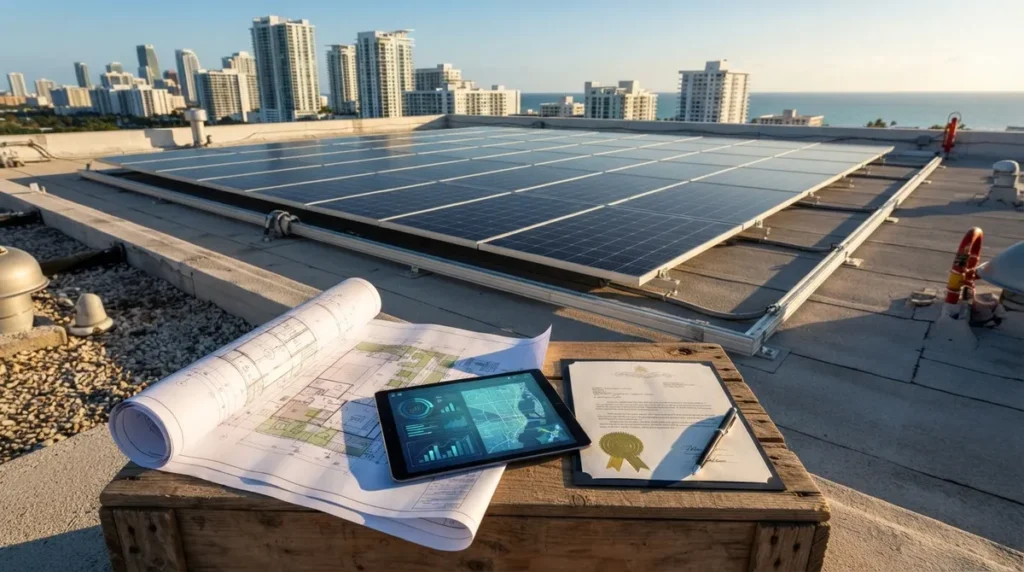
Key Takeaways
-
Confirm the jurisdiction first: unincorporated Miami-Dade and each municipality (like the City of Miami) run separate permitting, so filing in the wrong place is the most common rejection.
-
Unincorporated County solar PV applications route through the online portal under Concurrent Plans and Processing, which lets departmental reviews happen simultaneously rather than sequentially.
-
Roofing permits differ by location: unincorporated County may require one for PV work, while City of Miami residential projects do not, but commercial projects need a stand-alone roofing permit.
-
Core County packets need a notarized building permit application, electrical fee sheet (Category 34), signed PDF plans, an FSEC certification form, and an owner solar-system disclosure form.
-
Rooftop plans should show wind-uplift zones and pressures, roof clearances, and penetration/flashing details, and the electrical diagram must match the array's module count.
-
Converting paper plans to electronic format can add roughly 24 to 48 hours, so submitting electronically from the start avoids a needless delay.
You've signed the contract, the panels are on order, and your crew is ready to roll. Then someone asks the question that stops everything: "Who actually issues the permit for this address?" If you've ever dealt with solar permit filing in Miami-Dade, you know that simple question can turn into a maze of portals, jurisdictions, and document checklists.
Here's the good news: it's very manageable once you understand the roadmap. Miami-Dade is a big place, with unincorporated County areas and dozens of municipalities that each run their own show. Knowing which door to knock on, and what to carry in your hands, is most of the battle.
This guide walks you through the process step by step, in plain language. Whether you're a solar installer juggling dozens of jobs, a general contractor adding PV to a build, a realtor sorting out a pending sale, or a homeowner wondering what all those forms mean, you'll leave with a clear plan. Let's get your solar project permitted and moving.
Why Solar Permitting in Miami-Dade Feels Tricky
Solar photovoltaic (PV) installations generally require both building and electrical permits. That part is straightforward. The tricky part is that where you file depends on where the property sits.
Miami-Dade County runs its own permitting for unincorporated areas, but many municipalities administer their own building departments, with their own fees, forms, and procedures. A property with a Miami mailing address, for example, may or may not be inside the City of Miami limits. Near city lines, that is not always obvious.
If you want a deeper look at how these jurisdictions differ, our guide on which Florida jurisdiction reviews your project is a handy companion read.
Who Benefits Most From a Clear Process
- Solar companies that need repeatable, code-compliant packets for every job
- General contractors coordinating PV alongside roofing, electrical, and structural work
- Realtors and investors who need to confirm permit status before closing
- Homeowners who want to understand what their installer is filing on their behalf
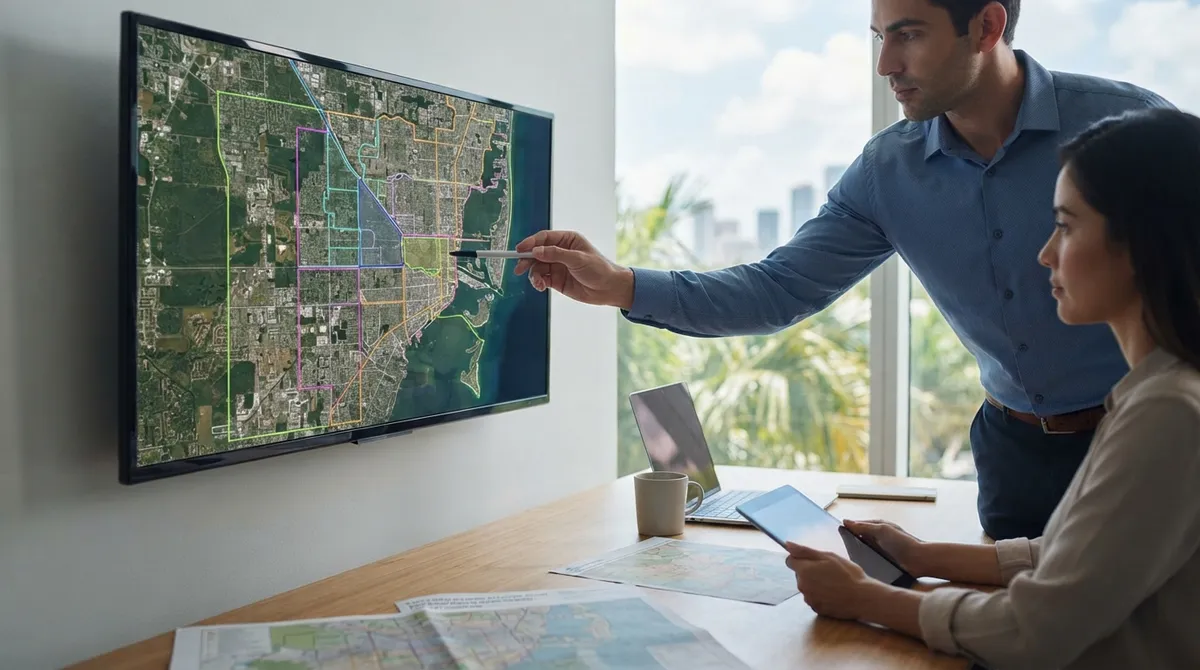
Step 1: Confirm the Permitting Jurisdiction
Before you draw a single line or fill out a single form, confirm who has authority over the property. This one step prevents the most common (and most frustrating) rejection: filing in the wrong place.
- Pull the folio number or full address for the property.
- Check whether it falls in unincorporated Miami-Dade or inside a municipality. Our building department lookup tool can help point you in the right direction.
- Download that jurisdiction's current solar checklist. Don't assume County requirements apply inside a city.
- Note the portal, fees, and submission format before you build your packet.
You can also see how local requirements play out on our Miami-Dade County page and our Miami page.
County vs. City of Miami: Know the Differences
This is where many contractors get tripped up. The County and the City of Miami are separate permitting authorities, and what works in one may not work in the other. Here's a side-by-side snapshot based on published guidance. Always verify current details before filing, because procedures can change.
| Topic | Unincorporated Miami-Dade County | City of Miami |
|---|---|---|
| Submission route | Online permitting portal; eligible PV applications use electronic Concurrent Plans and Processing (CPP) | City's own solar-permit process and instructions |
| Roofing permit | May be required for new or replacement roof work; PV laminate modules require a separate roofing permit under cited guidance | Residential projects do not need a separate roofing permit; commercial projects need a stand-alone roofing permit plus the electrical solar permit |
| Fees | County fee schedule applies; confirm current amounts | States building permit fees for solar installations are waived (state and County surcharges excluded); verify eligibility |
| Published processing time | No standard solar turnaround stated in the cited materials | States applications are processed within three business days of receipt |
The takeaway? Never assume. A packet built perfectly for the County may still miss the mark for a municipality, and vice versa.
Step 2: Gather the Required Documents
For unincorporated Miami-Dade, the County's published guidance lists a core set of items. Having these ready before you submit keeps your file moving.
Core Application Items
- A completed building permit application, signed and notarized by the owner and contractor
- An electrical fee sheet with Solar Photovoltaic Category 34 information
- Electronic plans and supporting documents in PDF format
- Electronic signatures and seals on plans where required
- A Florida Solar Energy Center (FSEC) photovoltaic system certification approval form
- A completed owner solar-system disclosure form
What the Rooftop Plans Should Show
Reviewers want to see that the roof can carry the system and that the layout is safe. County rooftop plans should identify:
- Roof dimensions and features
- Proposed array location and area
- Roof type and deck
- Wind-uplift zones and pressures
- Roof clearances
- Penetration and flashing details
Structural documentation may also need to address panel and framing wind loads, lateral forces, added dead load, and connection design. If your plans need a licensed professional's seal, our structural engineering team prepares sealed work in house.
What the Electrical Submittal Should Include
- A complete PV electrical diagram designed to applicable National Electrical Code Article 690 requirements
- Equipment locations
- Load calculations
Our MEP engineering services cover this documentation. And if you already have your own engineer, we also offer drafting only so we draw the permit set and stop there.
Step 3: Prepare Your Plan Set Properly
A clean plan set is your best friend. Reviewers are looking for clarity, consistency, and code compliance. When the roof plan, structural notes, and electrical diagram all tell the same story, comments drop dramatically.
Here's a quick checklist to run before you hit submit:
- Does the array layout match the electrical diagram's module count?
- Are wind loads and uplift pressures clearly stated for the roof zone?
- Are setbacks, clearances, and equipment locations labeled?
- Are signatures and seals applied where required?
- Do all PDFs open cleanly, with readable sheet names?
Skipping these checks is a quick way to land in the resubmittal pile. If you need a sealed document to address a specific reviewer question, an engineer letter can often resolve it.
Step 4: Submit Through the Correct Portal
Miami-Dade County accepts solar PV submittals through its online permitting portal and routes eligible applications through Concurrent Plans and Processing (CPP). In simple terms, CPP lets multiple department reviews happen at the same time instead of one after another. The County says complete applications can move faster through this process, though the cited materials do not promise a specific review time.
One helpful detail from County workshop materials: converting paper plans to electronic form can add roughly 24 to 48 hours, while electronic submission avoids that step. Check current portal instructions, since procedures can change.
Inside a municipality, you'll file through that city's own portal or counter. That's why the jurisdiction check in Step 1 matters so much. Our permit facilitation and filing service handles this part end to end, including tracking the application after it's in.
Step 5: Respond to Review Comments
It's completely normal to receive review comments. Don't panic. Most comments are requests for clarification, a missing note, or an updated detail.
The fastest path forward is to:
- Read every comment carefully and group them by discipline (building, electrical, structural).
- Revise the plans and supporting documents to address each item directly.
- Add a short response note that references the sheet and comment number.
- Resubmit promptly through the same portal.
If you'd rather not play phone tag with reviewers, our plan review coordination and revisions and resubmittals services work every comment so your crew isn't left waiting.
Do You Need a Separate Roofing Permit?
This question comes up constantly. The answer depends on jurisdiction and project type.
| Scenario | Typical Roofing Permit Guidance |
|---|---|
| Unincorporated County, new or replacement roof work | A separate roofing permit may be required |
| Unincorporated County, PV laminate modules | Separate roofing permit required under cited County guidance |
| City of Miami, residential | No separate roofing permit needed |
| City of Miami, commercial | Stand-alone roofing permit plus electrical solar permit |
If your solar job pairs with a re-roof, it often makes sense to coordinate both at once. Our roof permit services and the Roof Permit Partnership Program are designed for exactly that.
Step 6: Plan for Inspections and Closeout
Getting the permit issued is a big milestone, but it isn't the finish line. Solar installations generally need inspections as work progresses and at completion, and the specific inspections depend on the jurisdiction and the scope of work. Your issued permit and the jurisdiction's inspection guidance will outline what's required.
A few friendly tips for a smooth closeout:
- Keep your approved plans and permit card on site
- Schedule inspections only when the work is truly ready
- Have equipment labeling and disconnect access in place beforehand
- Close out the permit promptly so it doesn't linger open
Open and expired permits can cause headaches later, especially at closing. If you ever run into that, our guide on how to close an expired permit in Florida is worth bookmarking. For inspection support, see our inspections page.
Common Mistakes That Slow Solar Permits Down
After handling thousands of Florida permits, we see the same stumbling blocks over and over. The good news is that every one of them is avoidable.
- Filing in the wrong jurisdiction. The single most common and costly error.
- Applying County rules inside a city. Municipal requirements are separate.
- Missing notarization or signatures on the application.
- Incomplete structural or wind-load information on the roof plan.
- Electrical diagrams that don't match the array layout.
- Forgetting the FSEC form or owner disclosure form.
For more on timing expectations across the state, check out our overview of Florida solar permit timelines.
Who Is Responsible for What?
It helps to be clear on roles. A Florida permitting service can coordinate jurisdiction checks, document preparation, portal filing, review comments, and permit issuance. However, the licensed contractor and design professionals remain responsible for their regulated work, including license-dependent attestations and sealed documents.
Think of a permitting partner as your outsourced permitting department. At 1 Contractor Solutions, we handle the paperwork, tracking, and reviewer back-and-forth, and our in-house drafting and engineering team keeps sealed drawings moving without waiting on outside consultants. We serve solar companies, general contractors, realtors, and homeowners across all 67 Florida counties, so we know how these processes play out on the ground. You can learn more on our solar contractors page.
Curious how others feel about working with us? Read what customers say on Google: Visit us on Google — 1 Contractor Solutions.
Quick Reference: Your Miami-Dade Solar Permit Roadmap
| Step | What to Do | Key Output |
|---|---|---|
| 1 | Confirm jurisdiction | County or municipality identified |
| 2 | Gather forms and documents | Notarized application, fee sheet, FSEC and owner forms |
| 3 | Prepare roof, structural, and electrical plans | Signed and sealed PDF plan set |
| 4 | Submit through the correct portal | Application in review |
| 5 | Answer review comments | Approved plans |
| 6 | Inspect and close out | Final approval |
Stay Connected and Keep Learning
Permitting rules evolve, and we love sharing updates with our community. You can follow us on LinkedIn and follow us on Facebook for practical Florida permitting tips. For official County guidance, you can also review Miami-Dade's Solar Photovoltaic (PV) Systems permit page directly.
Ready to Get Your Solar Permit Moving?
Solar permit filing in Miami-Dade doesn't have to be a headache. Confirm your jurisdiction, build a clean packet, submit through the right portal, and answer comments promptly, and you'll be well on your way to an approved permit and a happy crew.
If you'd rather hand the paperwork to a team that does this every day, we're here to help. Get a free quote and tell us your address and project. We'll tell you which jurisdiction controls it, what it will take, and then we'll go get it done. Permits approved. Projects moving.
FAQs
Do I need a permit to install solar panels in Miami-Dade County?
Yes, solar PV installations generally require both building and electrical permits. The exact application route depends on whether your property is in unincorporated Miami-Dade or inside a municipality that runs its own permitting, so confirm your jurisdiction first.
How long does a solar permit take in Miami-Dade?
It depends on the jurisdiction and how complete your packet is. The County uses concurrent review for eligible PV applications but doesn't publish a standard solar turnaround in the cited materials, while the City of Miami states applications are processed within three business days of receipt. Complete, well-prepared submittals tend to move fastest.
Does a solar installation need a separate roofing permit?
It can, depending on where you are. In unincorporated County areas, a separate roofing permit may be required for new or replacement roof work, and PV laminate modules require one under cited guidance. The City of Miami says residential projects don't need a separate roofing permit, but commercial projects do.
Can a permitting service file a Miami-Dade solar permit for my project?
Absolutely! A Florida permitting service can check jurisdiction, prepare documents, file through the portal, track the application, and work review comments. Your licensed contractor and design professionals still remain responsible for their regulated work, but a good partner takes the paperwork off your plate.
We do this work every day across all 67 Florida counties. Call (866) 314-6931 and we will tell you what your situation actually requires — including when you do not need us.
Related services
Permit Facilitation & Filing
You have a crew scheduled, a client asking for dates, and a permit sitting somewhere in a queue you cannot see. We file it, w…
See the servicePlan Review Coordination
A permit in plan review is not one queue. On a commercial project it can be six queues, each with its own reviewer, its own c…
See the serviceReady to get your permit moving?
One call tells you which jurisdiction controls your project, what it will take, and what it will cost. Most of the time we can scope it on the phone.