
Blog
3 High Volume Solar Permitting Broward Mistakes to Avoid
Avoid the 3 costly mistakes that slow high-volume solar permitting across Broward County's many jurisdictions and requirements.
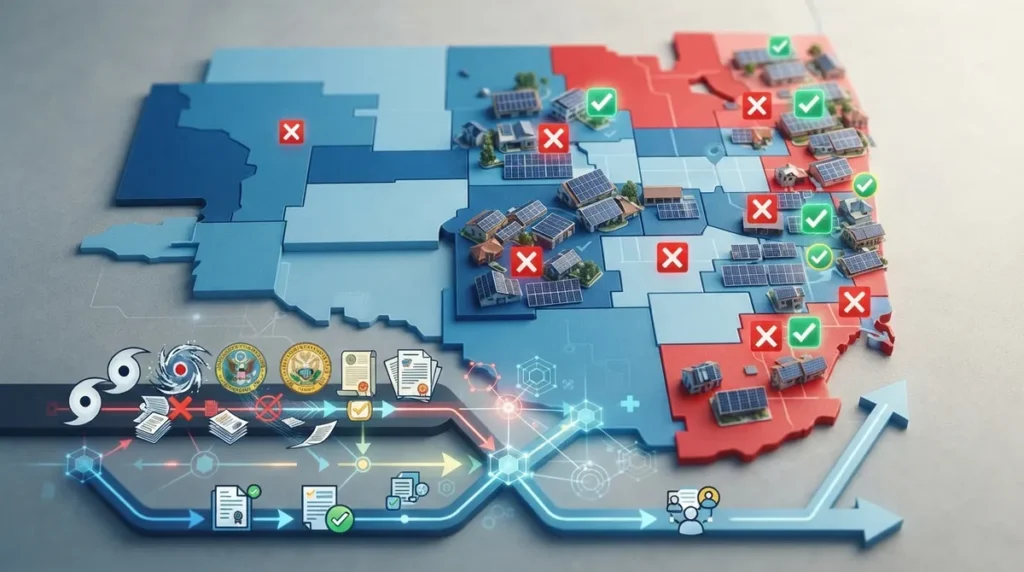
Key Takeaways
-
Broward County has nearly 30 different municipalities, each with its own building department and permit requirements—submitting to the wrong Authority Having Jurisdiction (AHJ) causes rejected batches and weeks of delays.
-
Missing hurricane-zone documentation (Florida Product Approval or Miami-Dade NOA) for racking and mounting hardware is the most common and avoidable reason solar permits stall in Broward's High-Velocity Hurricane Zone.
-
Utility interconnection approval runs on a completely separate track from building permits—running both in parallel instead of sequentially cuts wait time in half for high-volume pipelines.
-
Standardized plan templates that flex to each city's checklist, centralized project tracking, and same-day engineering revisions are what separate efficient high-volume operations from chaotic ones.
-
Verify the exact AHJ for every address using a building department lookup tool before batch-submitting, as copying one city's permit package to another jurisdiction's portal causes immediate rejections.
-
Broward municipalities use different permit structures: some require one combined master permit while others demand entirely separate structural/building and electrical applications with varying fees and notarization rules.
If you're a solar company trying to keep panels moving onto roofs across Broward County, you already know the feeling: one week Fort Lauderdale approves your submission in days, the next week Miramar sends back a correction for a detail that Hollywood never even asked about. High volume solar permitting Broward County isn't a special permit type — it's the art (and headache) of pushing dozens or hundreds of PV applications through dozens of different city rulebooks without losing your mind or your installation schedule.
We wrote this one for the solar installers, general contractors, and even the homeowners and realtors who keep bumping into confusing permit requirements every time a project crosses a city line. Grab a coffee, because we're going to walk through the three biggest mistakes that slow down high-volume solar permitting in Broward — and exactly how to avoid them.

Why Broward County Solar Permitting Gets Complicated Fast
Here's the thing that trips up even experienced crews: Broward County is not one permitting authority. It's more like a patchwork quilt of nearly 30 municipalities, each with its own building department, its own portal, and sometimes its own personality when it comes to reviewing plans. Unincorporated Broward is one thing. Fort Lauderdale, Hollywood, Miramar, Oakland Park, and Pompano Beach are each their own thing entirely.
So when someone asks "how do I submit a high volume of solar permits in Broward County," the honest answer is: you don't submit to "Broward County" — you submit to whichever authority having jurisdiction (AHJ) actually covers that specific address. Mixing that up, even once in a batch of 50 applications, can create a domino effect of rejected submittals and wasted weeks.
Mistake #1: Treating Every Broward Municipality the Same Way
This is the big one, and it's the mistake that costs solar companies the most time. Teams get comfortable with one city's checklist, then copy-paste that same package into a different jurisdiction's portal — and it bounces back immediately.
- Some cities require a combined master permit with structural and electrical trade reviews bundled together
- Others require entirely separate applications for structural/building review and electrical review
- Fee schedules, notarization rules, and owner-builder documentation vary from one city to the next
- Portal systems differ — some are fully electronic, others still expect physical or hybrid submissions
Before you ever batch-submit, confirm the exact AHJ for each address using a reliable building department lookup tool. It sounds like an extra step, but it saves you from the much bigger headache of a mass rejection.
Mistake #2: Skipping or Skimping on Hurricane-Zone Documentation
Broward sits squarely inside Florida's High-Velocity Hurricane Zone, which means your PV racking, mounting hardware, and roof attachments need to hold up to serious wind loads — and reviewers know it. If your structural attachment details are missing, or you don't include the applicable Florida Product Approval or Miami-Dade County Notice of Acceptance (NOA) documentation, expect a correction letter waiting for you.
This is honestly one of the most common — and most avoidable — reasons solar permits stall out in Broward. A missing NOA reference on one project is annoying. A missing NOA reference across forty projects in your pipeline is a genuine crisis. If you're unsure which document applies to your hardware, our guide on Miami-Dade NOA vs Florida Product Approval breaks down the difference in plain English.
Mistake #3: Forgetting That Utility Interconnection Is a Separate Track
Here's a mix-up we see constantly: teams treat utility approval as if it's the same thing as building permit approval. It isn't. Your local building department handles the structural and electrical permit review and inspections. The utility company handles interconnection separately, on its own timeline, with its own paperwork.
Running both tracks in parallel — rather than waiting on one before starting the other — is what keeps a high-volume pipeline actually moving. If you let utility paperwork sit until the permit clears, you've just doubled your wait time for no good reason.
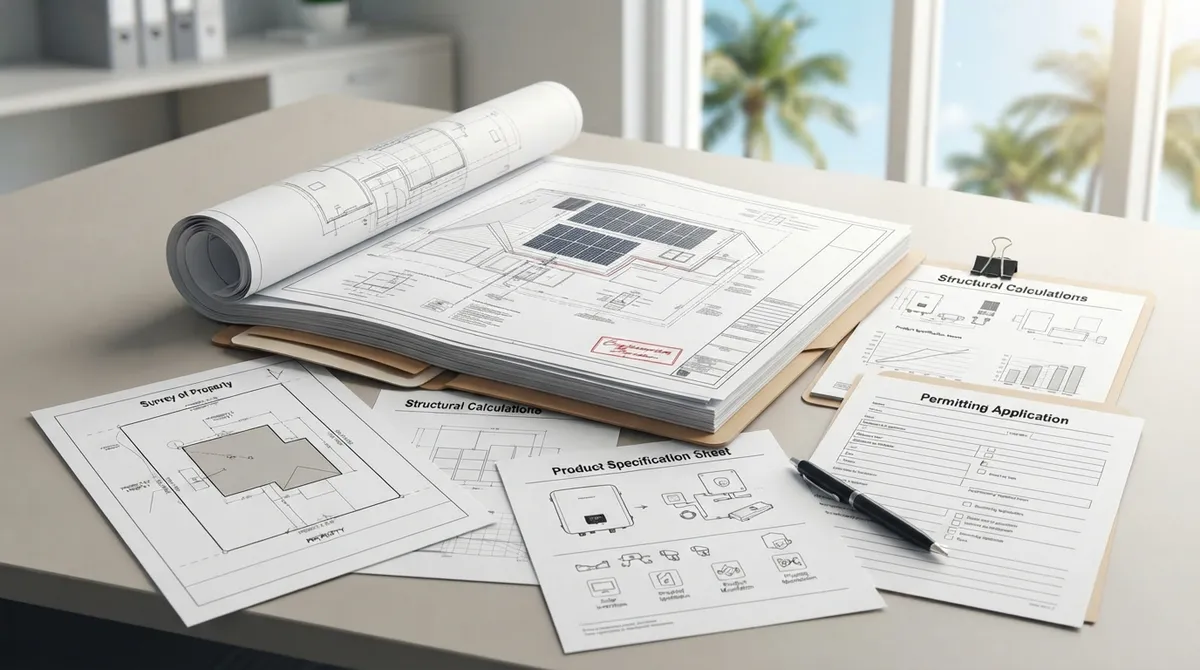
What a Typical Broward Solar Permit Package Actually Needs
Regardless of which city you're filing in, most Broward jurisdictions want to see a fairly consistent set of documents. Having these standardized and ready to configure per project is what separates a smooth high-volume operation from a chaotic one.
- Broward County Uniform Building Permit Application (or the municipality's equivalent form)
- Site or roof plan showing the property and structure
- PV array layout drawing
- Structural attachment and roof-penetration details
- Electrical one-line diagram
- Equipment specification sheets (panels, inverters, disconnects)
- Grounding and rapid-shutdown documentation
- Contractor license and registration documentation
Getting these details right the first time, every time, is exactly why in-house drafting and engineering matter so much. When your structural engineering and MEP engineering documents are prepared under one roof, corrections get resolved same-day instead of bouncing between three different consultants who all need a callback.
Comparing Common Broward Solar Permit Review Paths
| Review Type | Applies To | Typical Components Reviewed |
|---|---|---|
| Combined Master Permit | Municipalities that bundle trades together | Structural and electrical reviewed under one application |
| Separate Trade Permits | Municipalities requiring distinct applications | Structural/building permit and electrical permit filed independently |
| Solar Thermal Systems | Water-heating solar installations | Structural/building review plus plumbing review |
| Solar PV Systems | Standard rooftop photovoltaic installs | Structural/building review plus electrical review |
Notice that solar thermal and solar PV aren't reviewed the same way. Oakland Park's published solar checklist, for example, spells out separate structural, electrical, and plumbing review stops depending on system type — which is exactly the kind of detail that trips up a batch-processing workflow if nobody's paying close attention.
What Fees and Timelines Can Look Like
Fee schedules absolutely vary by jurisdiction and change over time, so nothing here should be treated as a guaranteed current number — but it helps to understand the shape of typical solar permit costs in Broward.
| Fee Type | Historical Example (Go SOLAR Agreement) |
|---|---|
| Basic solar permit fee | $500 |
| Listed surcharges and convenience fees | $52 |
| Stated online total | $552 |
| Reinspection fee | $50 |
| Credit card convenience fee | $2 |
These figures come from a Broward County Go SOLAR interlocal-agreement document and are historical, jurisdiction-specific examples — not a universal current fee. Always confirm current fees with the actual AHJ before quoting a client or budgeting a large batch of applications.
Building a Repeatable High-Volume Workflow
So how do the most efficient teams actually pull off dozens of solar permits a month without constant fire drills? It usually comes down to a handful of habits.
- Standardized plan templates that flex to each jurisdiction's checklist
- A centralized tracker showing every project's status, correction history, and inspection stage
- Quality control review before submittal, not after a rejection
- Fast turnaround on correction responses so applications don't sit idle
- Clear separation between permit tracking and utility interconnection tracking
This is really where working with an experienced solar contractors permitting partner pays for itself. When 1 Contractor Solutions handles permit facilitation and filing for a solar company's whole Broward pipeline, every project gets mapped to its correct jurisdiction upfront, plans get built around that city's exact checklist, and someone is actively working every reviewer comment instead of letting it sit in an inbox.
Why In-House Engineering Changes the Game
Picture this: a reviewer in Hollywood flags your roof attachment detail on a Tuesday. If your engineer is an outside consultant juggling five other clients, that correction might not get addressed until next week. If your engineering team is in-house and the same firm that drafted the original plans, that correction can often be turned around the same day.
That speed matters even more at high volume, because one slow correction can hold up your entire crew scheduling for that week. Same-day revisions and resubmittals aren't a luxury in solar permitting — they're the difference between a profitable month and a frustrating one.
A Note for General Contractors, Realtors, and Homeowners
Solar companies aren't the only ones who bump into this maze. General contractors managing a renovation that includes rooftop solar need accurate, jurisdiction-specific plans and engineering just as much as a dedicated installer does. Realtors closing on a home with an existing solar system sometimes discover an open or expired solar permit during due diligence — which is its own can of worms, and one we cover in our piece on what to do when an open permit is found at closing.
And if you're a homeowner in Fort Lauderdale or elsewhere in Broward County simply trying to figure out whether your installer actually pulled the right permit, it's worth reading up on Florida solar permit timelines so you know what to expect before panels ever hit the roof.
Keeping Your Pipeline Moving Without the Guesswork
At the end of the day, high volume solar permitting in Broward County comes down to respecting how genuinely different each city's process can be, while still running a consistent, repeatable system behind the scenes. Skip the shortcuts, verify the jurisdiction every single time, keep your structural documentation airtight, and treat utility interconnection as its own lane — and you'll avoid the three mistakes that trip up most teams.
We've spent years filing across all 67 Florida counties, and we genuinely enjoy untangling exactly this kind of multi-jurisdiction puzzle. You can visit us on Google — 1 Contractor Solutions to see how our clients talk about working with us, and we'd love to hear from your team too — follow us on LinkedIn or follow us on Facebook for regular permitting updates across Florida. For broader background on hurricane-zone construction standards, the Florida Building Commission is a solid resource worth bookmarking.
Ready to stop guessing which Broward city wants what? Let's talk about your pipeline — get a free quote and we'll map out exactly what your next batch of solar permits needs before you file a single application.
FAQs
How do I submit a high volume of solar permits in Broward County?
The secret is mapping every project to its correct jurisdiction first, since Broward has nearly 30 different municipal building departments alongside unincorporated county review. Once you know the right AHJ, you build a standardized-but-flexible plan package for that city's specific checklist, then track everything centrally so nothing slips through the cracks.
Which Broward County cities allow online or expedited solar permitting?
Several Broward municipalities offer electronic submission portals, though the exact process, forms, and fees vary from city to city. We always recommend confirming the current online submission option directly with the applicable building department before you build your batch workflow around it.
Do Broward County solar panels require Miami-Dade NOA or Florida Product Approval?
In most cases, yes — because Broward sits within Florida's High-Velocity Hurricane Zone, your racking and mounting hardware typically need supporting product approval documentation. Which specific document applies depends on the AHJ and the exact hardware you're using, so it's worth double-checking before every submittal.
Does a rooftop solar project need separate building and electrical permits?
It depends on the city! Some Broward municipalities bundle everything into one master permit with separate structural and electrical trade reviews underneath it, while others require you to file two completely separate applications. This is exactly the kind of detail that catches high-volume teams off guard when they assume one city's process applies everywhere.
What causes Broward County solar permit applications to be rejected or delayed?
The most common culprits are missing structural attachment details, absent product approval or NOA documentation, mismatched contractor information, and simply applying to the wrong jurisdiction's checklist. The good news is all of these are entirely preventable with a solid quality-control step before you hit submit.
We do this work every day across all 67 Florida counties. Call (866) 314-6931 and we will tell you what your situation actually requires — including when you do not need us.
Related services
Permit Facilitation & Filing
You have a crew scheduled, a client asking for dates, and a permit sitting somewhere in a queue you cannot see. We file it, w…
See the servicePlan Review Coordination
A permit in plan review is not one queue. On a commercial project it can be six queues, each with its own reviewer, its own c…
See the serviceReady to get your permit moving?
One call tells you which jurisdiction controls your project, what it will take, and what it will cost. Most of the time we can scope it on the phone.