
Blog
12 Traits of the Best Solar Permitting Partner in Miami
Discover 12 traits of the best solar permitting partner for installers in Miami, from jurisdiction know-how to in-house engineering and fast corrections.
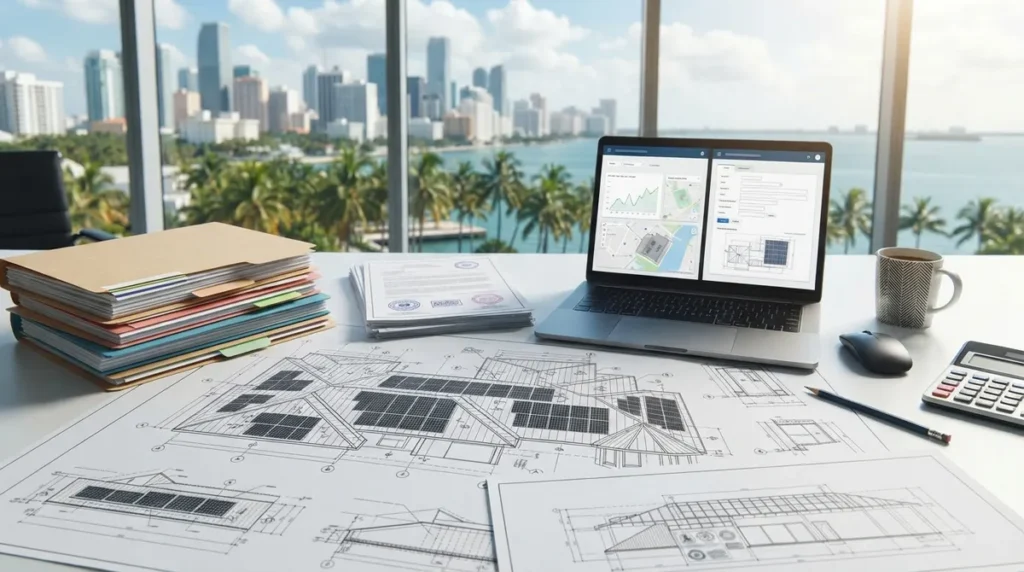
Key Takeaways
-
Confirm jurisdiction first—Miami is not one office. The City of Miami uses iBuild while Miami-Dade County runs its own portal, and residential roofing permit rules differ between them.
-
Choose a partner with in-house engineering and sealed drawings who fixes reviewer comments the same day, not after consulting outside engineers who may delay responses.
-
Build complete plan packages upfront including roof layouts, structural calculations, wind-load analysis, electrical diagrams, and equipment specs to avoid missing documents during review.
-
Miami-Dade requires detailed structural and wind-load documentation due to high-wind environment; a strong partner understands these requirements and can resolve roof capacity questions with engineer letters.
-
Track status transparently at every stage and respond to reviewer comments same-day when possible. Most permit delays come from wrong portals, incomplete structural data, or slow responses to corrections.
-
Verify current rules directly with each jurisdiction rather than assuming—threshold limits, expedited eligibility, and requirements change regularly, so a partner must confirm applicability before building estimates.
If you install solar in South Florida, you already know the feeling. The crew is scheduled, the panels are on the truck, and the job is sitting in a portal waiting on a reviewer comment you did not see coming. That is why choosing the best solar permitting partner for installers in Miami is one of the smartest business moves you can make in 2026.
Here is the friendly truth: a good permitting partner is not just someone who uploads your plans. It is a team that knows which jurisdiction actually controls the address, builds a complete package the first time, answers reviewer comments fast, and keeps your install calendar moving.
Below are 12 traits to look for. Use them as a checklist when you compare options. We will also cover how Miami's requirements really work, what documents you will need, and where installers most often lose time. Grab a coffee, and let's make your next permit submission a smooth one.

Why Miami Solar Permitting Is Different
Miami is not one permitting office. The word "Miami" can mean the City of Miami or any of the many other municipalities inside Miami-Dade County. The City of Miami uses its iBuild portal and electronic plan-review process, while Miami-Dade County runs its own permit portal and procedures.
Picking the wrong portal or checklist is a classic early mistake. Our guide to which Florida jurisdiction reviews your project walks through how to confirm this before you file.
On top of that, Miami-Dade projects often require detailed electrical, structural, and wind-load documentation. That is a lot of moving parts for a busy installer to juggle alone. You can also look at our Miami-Dade County permitting resources for local context.
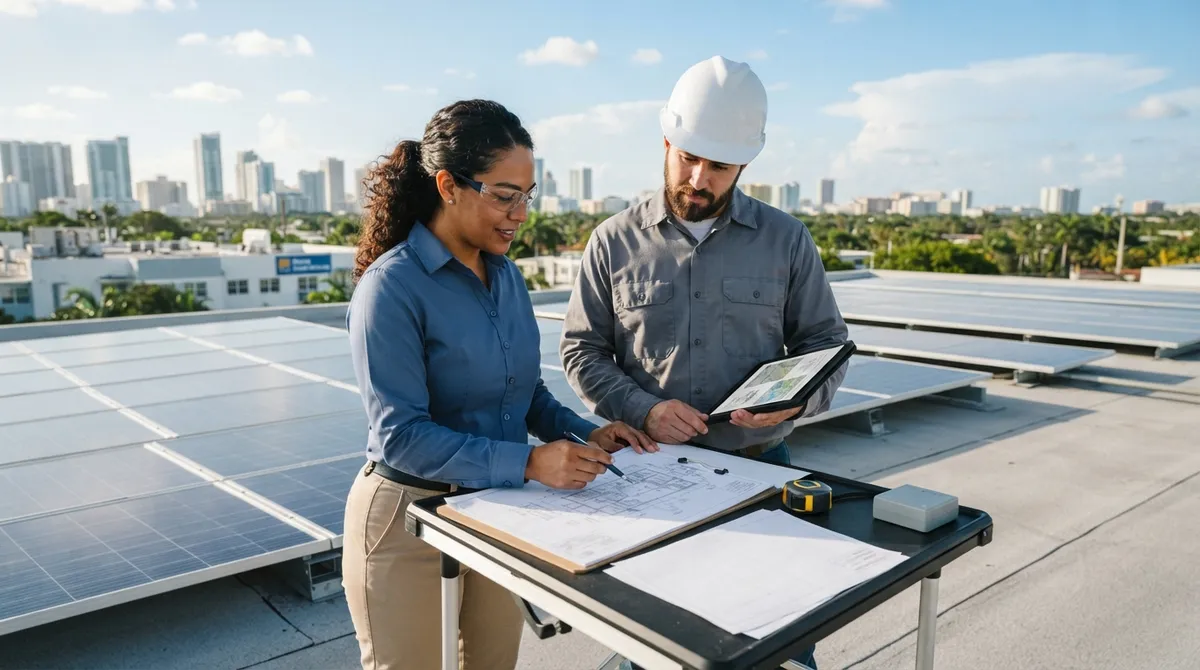
12 Traits of the Best Solar Permitting Partner for Installers in Miami
1. They Confirm the Jurisdiction First
Before anything is drawn, a strong partner verifies whether the property sits in the City of Miami, another municipality, or unincorporated Miami-Dade. This matters because each has its own portal, checklist, and quirks. Near city lines, the answer is not always obvious.
2. They Know Miami-Dade's Solar PV Checklist Cold
Miami-Dade County requires permits for solar photovoltaic systems. Its published checklist includes a completed building permit application, an electrical fee sheet, and electronically submitted plans and supporting documents. Plans submitted electronically must be digitally signed and sealed where required.
A partner who lives in this checklist every day will not send you back for missing pieces.
3. They Understand City of Miami Rules Separately
The City of Miami publishes its own guidance for solar. For example, it states that residential solar projects do not require a separate roofing permit, while commercial projects need a separate stand-alone roofing permit in addition to the solar permit. That should not be generalized to all of Miami-Dade, so your partner must keep the two straight.
4. They Build Complete Plan Packages
Solar plan sets commonly need several core documents. A good partner assembles all of them up front:
- Roof and array layouts
- Structural and wind-load calculations
- Attachment and racking details
- Equipment specifications and cut sheets
- Electrical single-line diagrams and calculations
Miami-Dade's checklist references NEC Article 690 and applicable Florida Building Code requirements, so accuracy against those codes is non-negotiable.
5. They Have In-House Engineering
This is a big one. When a reviewer flags a structural or electrical issue, you want the fix made the same day, not after an outside consultant returns a call. Partners with in-house drafting and sealed engineering can respond quickly. Learn more about engineering support for permits and structural engineering if your roof needs a closer look.
6. They Handle Wind-Load and Structural Requirements
South Florida's high-wind environment shapes solar submittals. Your partner should be comfortable with wind-load calculations, attachment spacing, and roof structural capacity. When a reviewer questions the roof, an engineer letter can often resolve it without a full redesign.
7. They Use the Right Fast-Track Pathways
Miami-Dade County says small PV projects can use Concurrent Plans and Processing, which routes a submission to multiple departments at the same time. It also says renewable-energy projects are eligible for Green Building expedited review. The county does not publish a guaranteed review duration, so a trustworthy partner will never promise you a fixed number of days.
The City of Miami states that qualifying solar permits are expedited and free. Always confirm current eligibility, scope, and fees directly with the City before building an estimate around that.
8. They Manage Corrections, Not Just Submissions
Filing is the easy part. The real value is in working every reviewer comment, preparing revisions, and resubmitting quickly. Ask any candidate how they handle rejections. A solid answer should mention revisions and resubmittals and plan review coordination.
9. They Give Transparent Fees and Status Updates
You should never have to guess where a permit stands. Look for clear pricing, a defined scope, and regular status reporting through filing, review, corrections, and approval. If you are curious about typical pricing structures, see our breakdown of permit expediter costs in Florida.
10. They Coordinate With Everyone Involved
Solar projects touch the installer, engineer, utility, and inspector. The best partner keeps all of those threads connected so nothing falls through the cracks between approval and interconnection. That includes scheduling and supporting inspections.
11. They Verify Licensing and Eligibility Rules
The City of Miami's published guidance uses a $50,000 project-value threshold when describing when plans may be prepared by a qualifying EC- or CVC-licensed contractor rather than requiring plans signed and sealed by a Florida-licensed engineer. A careful partner confirms current applicability with the City rather than assuming. Rules change, so verification matters.
12. They Respond Fast and Scale With You
Solar is a volume business. Your partner should keep pace when you go from five jobs a month to fifty, and they should answer the phone when a crew is waiting. Fast response is often the difference between a lost day and a saved one.
Quick Comparison: What to Ask Every Candidate
| Question to Ask | What a Strong Answer Sounds Like | Red Flag |
|---|---|---|
| How do you confirm jurisdiction? | We verify the property's municipality before choosing a portal and checklist. | "We just file in Miami-Dade." |
| Who seals the drawings? | Our in-house engineer signs and seals where required. | "We will find someone if needed." |
| What is your turnaround? | It depends on the jurisdiction; here is how we speed it up. | A guaranteed fixed number of days. |
| How do you handle rejections? | We work each comment and resubmit quickly. | "That is on the installer." |
| How do you report status? | Regular updates at every stage. | No clear reporting. |
City of Miami vs. Miami-Dade County at a Glance
Because the two are so easy to mix up, here is a simple side-by-side. Always confirm the latest details with the relevant office before filing.
| Topic | City of Miami | Miami-Dade County |
|---|---|---|
| Portal | iBuild and electronic plan review | County permit portal |
| Residential roofing permit with solar | Published guidance says not required | Confirm with the county |
| Commercial roofing permit with solar | Separate stand-alone roofing permit required | Confirm with the county |
| Expedited options | Qualifying solar permits described as expedited and free | Concurrent Plans and Processing; Green Building expedited review |
| Guaranteed timeline | Not established in sources | Not established in sources |
A Simple Process for a Cleaner Miami Solar Submission
Whether you handle permitting yourself or hand it off, this sequence keeps projects moving:
- Confirm the jurisdiction. Identify the city or county that controls the address.
- Gather site data. Collect roof details, equipment specs, and the electrical service information.
- Draft the plan set. Prepare layouts, single-line diagrams, and attachment details.
- Run structural and wind-load checks. Have an engineer seal the documents where required.
- File electronically. Submit through the correct portal with all required forms.
- Track and respond. Answer reviewer comments the same day whenever possible.
- Close out inspections. Coordinate final inspection and utility steps.
Common Reasons Miami Solar Permits Stall
Most delays are avoidable. Here are the usual suspects:
- Filing in the wrong portal or under the wrong jurisdiction
- Missing signed and sealed documents where they are required
- Incomplete structural or wind-load information
- Electrical diagrams that do not match equipment specifications
- Slow responses to reviewer comments
- Assuming City of Miami rules apply everywhere in the county
If you have already been rejected, do not panic. Our article on why building permits get rejected covers the fixes, and our urgent permit rescue team can step in when a job is stuck.
Should You Outsource or Keep Permitting In-House?
Keeping permitting in-house works when you have a dedicated coordinator, a reliable engineer, and steady volume in one jurisdiction. Outsourcing shines when you work across multiple cities, growth is uneven, or you want your team focused on installs.
Think of it as adding a permitting department without the payroll. A partner absorbs the portal learning curve, the checklist changes, and the back-and-forth with reviewers.
For a deeper look at timing expectations across the state, see our Florida solar permit timelines guide. And if you run high volumes, our article on high-volume solar permitting in Florida is worth a read.
Where 1 Contractor Solutions Fits In
1 Contractor Solutions acts as Florida's outsourced permitting department. We work across all 67 Florida counties, and our drafting and engineering are done in house, with our own engineer signing and sealing the work. That means when a reviewer flags something, we fix it directly rather than waiting on an outside consultant.
We also respond within 30 minutes day or night, and se habla español. If you are a solar company looking for dependable support, visit our page for solar contractors or explore our full permit facilitation and filing service. You can also see what customers say by reading our 1 Contractor Solutions reviews on Google.
A quick note on honesty: there is no independently verified ranking of permitting providers, so "best" really comes down to how well a partner matches the traits above. Use the checklist and judge for yourself. You can follow us on LinkedIn or follow us on Facebook to see how we work.
For official requirements, always double-check the source. The Miami-Dade County solar PV permit page and the City of Miami solar guidance are the best places to confirm current rules.
Ready to Get Your Miami Solar Permits Moving?
The best solar permitting partner for installers in Miami is the one that shows up with jurisdiction knowledge, complete plan packages, in-house engineering, and quick responses when reviewers ask questions. Use the 12 traits above as your yardstick, and do not settle for a partner who only uploads files.
If you want a team that treats your permits like its own deadline, get a free quote and tell us about your next Miami project. We will tell you which jurisdiction controls it, what it will take, and then go do it. Permits approved. Projects moving.
FAQs
What permits are required to install solar panels in Miami-Dade County?
Miami-Dade County requires a permit for solar photovoltaic systems. The published checklist includes a building permit application, an electrical fee sheet, and electronically submitted plans and supporting documents, digitally signed and sealed where required. Always confirm the latest checklist with the county before you file.
How do I know if my project falls under the City of Miami or Miami-Dade County?
"Miami" can mean the City of Miami or another municipality inside Miami-Dade County, so it pays to check the property's jurisdiction first. The City of Miami uses iBuild, while the county has its own portal and processes. A permitting partner can verify this for you before anything is filed.
How long does solar permitting take in Miami, and is expedited review available?
There is no reliable universal timeline, so be wary of anyone promising a fixed number of days. Miami-Dade offers Concurrent Plans and Processing for small PV projects and Green Building expedited review for renewable energy, while the City of Miami describes qualifying solar permits as expedited. Confirm current eligibility with each office.
Does a residential solar installation in Miami need a separate roofing permit?
The City of Miami's published guidance says residential solar projects do not require a separate roofing permit, while commercial projects need a separate stand-alone roofing permit. This is specific to the City, so do not assume it applies across all of Miami-Dade. Check with the local jurisdiction for your address.
What should solar installers look for in a Miami permitting partner?
Look for jurisdiction-specific experience, complete plan packages, in-house sealed engineering, and strong correction management. Transparent fees, regular status updates, and quick response times matter too. Since no independent ranking exists, judge candidates against these criteria.
We do this work every day across all 67 Florida counties. Call (866) 314-6931 and we will tell you what your situation actually requires — including when you do not need us.
Related services
Permit Facilitation & Filing
You have a crew scheduled, a client asking for dates, and a permit sitting somewhere in a queue you cannot see. We file it, w…
See the servicePlan Review Coordination
A permit in plan review is not one queue. On a commercial project it can be six queues, each with its own reviewer, its own c…
See the serviceReady to get your permit moving?
One call tells you which jurisdiction controls your project, what it will take, and what it will cost. Most of the time we can scope it on the phone.