
Blog
10 Permit Hold Mistakes Miami Agents Should Avoid
Learn who really helps Miami real estate agents resolve permit holds—from building departments to permitting experts—before your closing stalls.
Key Takeaways
-
Miami-Dade County has 35 separate municipalities, each with its own building department; confirm the correct jurisdiction (City of Miami, unincorporated Miami-Dade, or another municipality) before taking action on any permit hold.
-
Permit holds have different causes—missing documents, failed inspections, unpaid fees, unpermitted work, code violations—and each requires a completely different solution; identify the exact reason before coordinating next steps.
-
Only the building department can officially clear a hold; a permitting expediter researches records, coordinates contractors/engineers, and pushes paperwork through, but cannot unilaterally waive government holds.
-
Start permit research immediately when issues are discovered during listing or showing, not the week before closing; Miami-Dade estimates 14-40 business days for initial reviews, and holds require additional time to correct.
-
Distinguish between permit approval and closure—a permit can be approved and inspected but still not officially closed; pull full documentation including final inspection results and certificate of occupancy before confirming a permit is resolved.
-
Establish a relationship with a reliable permitting company before facing a closing crisis; having a go-to partner allows for same-day assessments instead of scrambling under pressure during deal closings.
If you sell real estate in Miami long enough, you'll eventually run into it: a title search comes back, and there it is—an open permit, an inspection hold, or a code case nobody mentioned during listing intake. Your closing date suddenly feels a lot less certain, and the buyer's lender is asking questions you can't answer yet. Take a breath. This happens more often than you'd think, and there's a whole process (and a whole team of people) built to sort it out.
So who actually helps real estate agents with permit holds in Miami? The honest answer is: it's a team effort. The property owner, a licensed contractor, sometimes an architect or engineer, the applicable building department, and a Florida permitting-services company all play a role. A permitting company or expediter can't wave a magic wand and erase a hold, but they can research the record, figure out exactly what's wrong, coordinate the right professionals, and push the case forward while you focus on your buyers and sellers. Let's walk through exactly how this works, who does what, and the mistakes to avoid along the way.
Mistake 1: Assuming Every Miami Property Falls Under the Same Building Department
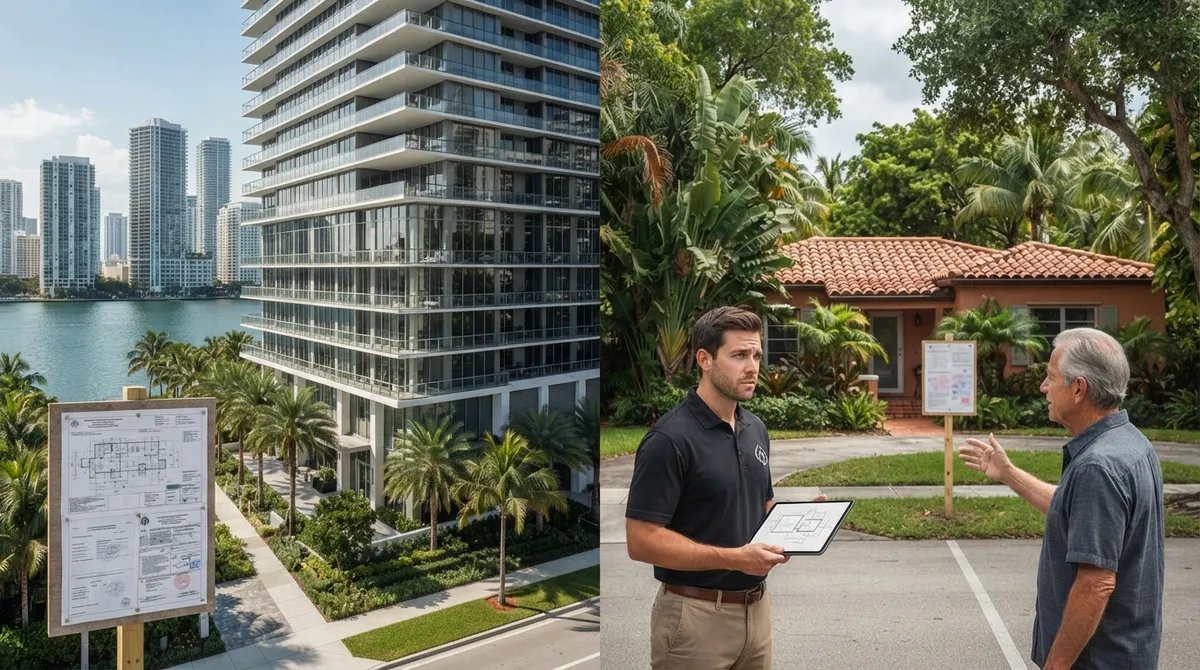
This is the single most common misstep agents make. Miami-Dade County has 35 separate municipalities, and each one has its own building official handling permits and inspections within its borders. That means a property in the City of Miami is handled by the City of Miami Building Department, while a home in unincorporated Miami-Dade falls under the county's jurisdiction—and a property in Miami Beach, Coral Gables, or Hialeah answers to yet another local building department entirely.
Before you tell a buyer or seller anything about a permit status, confirm exactly which jurisdiction controls that address. Guessing wrong wastes days, and in a tight closing window, days matter. Our Building Department Lookup tool is built exactly for this—plug in an address and get the right authority immediately.
| Jurisdiction | Handles Permits For | Main Contact |
|---|---|---|
| City of Miami Building Department | Properties inside Miami city limits | 305-416-1100 |
| Miami-Dade County Permitting & Inspection Center | Unincorporated Miami-Dade areas | 786-315-2000 |
| Miami-Dade Board and Code Administration | Code enforcement cases countywide | 786-315-2509 |
| Individual municipal building departments | Miami Beach, Coral Gables, Hialeah, and 32 other municipalities | Varies by city |
Mistake 2: Not Identifying the Exact Reason for the Hold
"There's a permit hold" isn't specific enough to act on. Holds can stem from missing documents, unpaid fees, a failed or incomplete inspection, an expired permit, an open code-enforcement case, unpermitted work, missing zoning or planning sign-off, unresolved utility requirements, or fire/life-safety issues. Each of these has a completely different fix, and some require entirely different professionals.
Miami-Dade's official permit-search tools let you review inspection holds and outstanding requirements directly, and the county's Building Support Case Search can surface code-enforcement cases tied to expired permits or unpermitted work. Our own Open Permit Search tool is a fast way to pull this information before you make any promises to a buyer.
Mistake 3: Thinking a Permit Expediter Can Override the Building Department
A Florida permitting-services company is incredibly valuable, but it's important to set realistic expectations. An expediter can research the record, prepare corrective documents, coordinate with the licensed contractor or engineer, schedule inspections, and follow the case through the system. What an expediter cannot do is unilaterally waive a government hold—only the building department has that authority.
Think of it like hiring a great project manager: they keep everything moving, chase down the right people, and make sure nothing falls through the cracks, but the final approval still comes from the agency itself. This is exactly the role 1 Contractor Solutions plays across Florida, including throughout Miami-Dade County and neighboring Broward County.
Mistake 4: Skipping the Licensed Contractor or Engineer When Structural Work Is Involved
If the permit hold involves structural changes, electrical work, or anything touching the building's bones, you'll need more than paperwork coordination. A licensed contractor typically has to pull or re-activate the permit, and an architect or structural engineer may need to certify the work meets current code. This is where in-house sealed engineering becomes a real time-saver.
Our Structural Engineering and Engineer Letters teams work directly with the permitting side of our business, so when a reviewer flags a structural concern, we don't have to wait on an outside consultant to call back. That in-house connection between drafting, engineering, and permit filing is a huge part of why cases move faster.
Mistake 5: Waiting Until the Week of Closing to Start
The City of Miami estimates roughly 14 business days for a first review cycle on building permits, about 35 business days for special permits, and around 40 business days for utility-excavation or non-construction permits. Those are just review estimates, not guarantees, and they don't account for a hold that needs correcting first.
If you spot a permit issue during the listing appointment or the first showing, start the research immediately. The earlier a permitting company can identify the hold reason, the more realistically you can set expectations for buyers, sellers, and lenders.
A Practical Workflow Agents Can Follow
- Confirm the correct jurisdiction—City of Miami, unincorporated Miami-Dade, or another municipality.
- Gather the permit or process number, property address, and folio number.
- Search permits, inspections, and code-enforcement records for every open item.
- Identify who is legally authorized to act—owner, contractor, or licensed professional.
- Correct or supply whatever documentation is missing.
- Schedule required inspections (Miami-Dade generally requires one business day advance notice, before 4 p.m.).
- Pay any legitimate outstanding fees.
- Obtain written confirmation the hold is cleared or the permit is officially closed.
Mistake 6: Confusing an Approved Permit With a Closed One
This trips up more agents than you'd expect. A permit can be approved, pulled, inspected, and finaled—and each stage means something different. The City of Miami is clear that completed permitted work must pass final inspections before the permit closes. A permit appearing in an online search doesn't automatically mean it's active, properly inspected, or closed with a certificate of occupancy or certificate of use.
Before you tell a buyer "the permit is fine," pull the full history: application, inspection results, any open requirements, code cases, and final closure documentation. Our Certificate of Occupancy and Certificate of Use teams handle exactly this kind of closeout confirmation daily.
Mistake 7: Not Knowing When to Bring in Additional Professionals
A permitting company handles a lot, but certain situations call for backup. Structural work, unpermitted construction with liens attached, active violations, or a formal appeal may require an attorney, a title company representative, or direct involvement from a licensed contractor.
- Structural or safety concerns → licensed contractor and structural engineer
- Liens or legal disputes → real estate attorney
- Financing complications → title company and lender coordination
- Unpermitted work discovered late → After the Fact Expired Permits specialists
- Ongoing code violations → Code Compliance Violations team
Mistake 8: Overlooking Miami-Dade's Countywide Case Search Tools
Miami-Dade County's official permit-search platform and its Building Support Case Search are two of the most useful tools available for verifying a property's status before you write it into a listing description. They cover inspection holds, code-enforcement cases, and outstanding items tied to the address and folio number.
Combine that with the City of Miami's iBuild portal for properties inside city limits, and you have a fairly complete picture—provided you know which system applies. If you'd rather skip the back-and-forth between portals, our team pulls this research directly and turns it into a plain-language summary for you and your client.
Mistake 9: Not Having a Go-To Permitting Partner Before You Need One
The best time to find a reliable Florida permitting-services partner is before a deal is on the line, not during a closing crisis. Agents who already have a relationship with a permitting company can call, describe the property, and get a same-day read on next steps instead of scrambling to find someone qualified under pressure.
1 Contractor Solutions has spent more than 15 years handling permitting across all 67 Florida counties, including deep experience with Realtors and Title Companies throughout Miami and greater South Florida. Our Realtor Closing Support service exists specifically for moments like this—when a hold shows up and you need an answer fast, not a runaround.
You can also check out what other agents and homeowners are saying by following follow us on LinkedIn or by taking a look at follow us on Facebook for real examples of cases resolved. And if you'd like to see what local clients say directly, Visit us on Google — 1 Contractor Solutions for firsthand reviews.
Mistake 10: Treating Every Permit Hold as Identical to the Last One
Every property has its own permit history, and no two holds are exactly alike. A 1980s single-family home with an expired reroof permit is a very different case than a commercial building with an open code violation and a lapsed certificate of use. Cookie-cutter advice—or worse, guessing based on a similar deal you handled last year—can lead you astray.
| Hold Type | Typical Cause | Who Usually Resolves It |
|---|---|---|
| Expired permit | Work never finaled or inspected | Contractor + permitting service |
| Failed inspection | Incomplete or non-compliant work | Contractor + building department |
| Unpermitted work | Prior owner skipped the permit process | After-the-fact permitting specialist |
| Code violation | Ongoing non-compliance notice | Code compliance team + owner |
| Unpaid fees | Outstanding balance with jurisdiction | Owner, sometimes coordinated by expediter |
Every case deserves its own honest assessment. That's why we always start with jurisdiction confirmation and a full record pull before recommending next steps—whether the property sits near Fort Lauderdale, in Miami-Dade County, or anywhere else across the state.
Bringing It All Together
Permit holds can feel like a wrench thrown into an otherwise smooth deal, but they're rarely unsolvable. With the right combination of the property owner, a licensed contractor, an engineer when needed, the correct building department, and a permitting company that knows how to navigate all of it, most holds clear up faster than agents expect. The key is knowing the jurisdiction, identifying the exact hold reason, and bringing in the right help early rather than late.
If you're staring down a permit hold on a Miami listing right now, you don't have to untangle it alone. Our team at 1 Contractor Solutions has helped countless agents, buyers, and sellers move past exactly this kind of roadblock, with same-day responses and in-house sealed drawings when engineering is part of the fix. Ready to get your deal back on track? Request Your Free Quote today and let's find out exactly what your property needs to close clean.
FAQs
Who can actually remove a permit hold on a Miami property?
At the end of the day, only the building department with jurisdiction over the property can officially clear a hold. That said, a permitting company or expediter does the heavy lifting—researching the record, coordinating the contractor or engineer, and pushing the paperwork through so the agency can sign off faster.
Should a real estate agent hire a permit expediter for an open permit in Miami?
If you want the case moving quickly and correctly, yes—it's usually worth it. A good permitting partner knows exactly which forms, inspections, or documents are missing, which saves you from guessing and losing precious days before closing.
How do I check whether a Miami building permit has an inspection hold?
You can search Miami-Dade County's official permit-search tools or the City of Miami's iBuild system, depending on the property's jurisdiction. If that feels overwhelming, our Open Permit Search tool pulls this information for you in plain language.
What's the difference between City of Miami and Miami-Dade County permitting?
The City of Miami Building Department handles properties inside city limits, while Miami-Dade County handles unincorporated areas. To make things a bit more layered, each of the county's 35 municipalities—like Miami Beach or Coral Gables—has its own building official too, so confirming the right jurisdiction first saves a lot of headaches.
Can unpermitted work actually stop a Miami real estate closing?
It absolutely can, especially if a lender, title company, or buyer's inspector flags it. The good news is that after-the-fact permitting is a well-established process, and with the right documentation and engineering support, most unpermitted work can be legalized without derailing the sale entirely.
We do this work every day across all 67 Florida counties. Call (866) 314-6931 and we will tell you what your situation actually requires — including when you do not need us.
Related services
Permit Facilitation & Filing
You have a crew scheduled, a client asking for dates, and a permit sitting somewhere in a queue you cannot see. We file it, w…
See the servicePlan Review Coordination
A permit in plan review is not one queue. On a commercial project it can be six queues, each with its own reviewer, its own c…
See the serviceReady to get your permit moving?
One call tells you which jurisdiction controls your project, what it will take, and what it will cost. Most of the time we can scope it on the phone.