
Blog
10 Facts About Sealed Drawings for Permit Tampa
Learn exactly when Tampa permits require sealed drawings, who can seal them, and how to avoid costly delays on your next project.
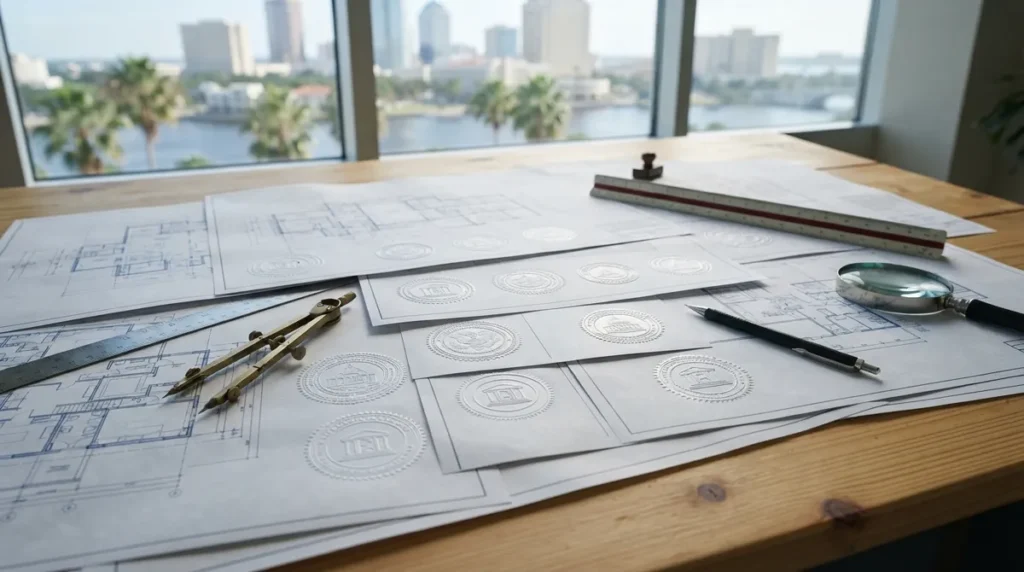
Key Takeaways
-
Tampa requires sealed drawings for commercial construction valued above $25,000 and all residential new construction, signed by Florida-licensed architects or engineers responsible for the work.
-
Discipline-specific thresholds trigger sealing requirements: electrical systems over 400 amperes or $5,000 value, plumbing over 250 fixture units or $50,000 value, and mechanical systems over 15 tons or $50,000 value.
-
Only wet seals (physical embossed stamps) and compliant digital signatures are valid for Tampa permits; scanned images of seals pasted onto PDFs will result in rejected submissions.
-
Survey documents must be sealed separately by a Florida-licensed surveyor even when survey data is incorporated into site plans, requiring multiple professional seals on complete permit packages.
-
Sealed drawings alone don't guarantee permit approval; projects typically also require site plans, drainage documentation, structural calculations, energy compliance, and flood-zone documents to avoid review delays.
-
Jurisdiction matters significantly—City of Tampa, unincorporated Hillsborough County, and neighboring jurisdictions have different requirements, so confirming your exact building department before preparing plans prevents costly revisions.
If you have ever stared at a Tampa permit application wondering why your plans keep bouncing back, you are definitely not alone. One of the most common holdups we see involves sealed drawings — who needs them, when they are required, and what actually counts as a valid seal. Whether you are a general contractor juggling five jobsites, a solar installer racing to hit an interconnection deadline, a realtor trying to close on a property with permit questions, or a homeowner dreaming up that dream addition, understanding sealed drawings can save you weeks of frustration.
The good news? Once you know the rules, this stuff is actually pretty manageable. Tampa has published thresholds for when a Florida-licensed architect or engineer needs to sign, date, and seal your plans, and we're going to walk through all of it together in plain, friendly language. Think of this as your coffee-chat guide to sealed drawings — no jargon overload, just the facts you need. Let's dig in.

1. What Sealed Drawings Actually Mean in Tampa
Sealed drawings are construction documents that have been signed, dated, and sealed by the Florida-licensed professional responsible for that portion of the work — usually an architect, engineer, or surveyor. This isn't just a formality; Florida Statutes Chapters 471 and 481 require it for documents submitted to the public record. The seal is essentially that professional putting their license on the line, confirming the design meets code and is safe to build.
In Tampa specifically, whether you need a seal depends on a mix of factors: the jurisdiction, the construction value, the occupancy type, the size of the project, and which discipline (structural, electrical, plumbing, mechanical) is involved. It's not one-size-fits-all, which is exactly why so many people get tripped up. If you're unsure where your project falls, our plans and engineering team can walk through the specifics with you.

2. When Commercial Projects Require a Seal
The City of Tampa generally requires architect- or engineer-prepared plans for commercial construction valued above $25,000. That threshold catches a lot of mid-size renovations and buildouts that people assume are simple.
Public-use buildings in Occupancy Groups A (assembly), E (educational), and I (institutional) also require professional preparation, regardless of cost, subject to applicable Florida exemptions. If you're a general contractor bidding commercial work in Tampa, it pays to check this early rather than after the drawings are already drafted.
3. Discipline-Specific Thresholds You Should Know
Tampa breaks down sealed-plan requirements by trade, and the numbers matter. Here's a quick snapshot to keep handy:
| Discipline | Threshold Triggering Sealed Plans |
|---|---|
| Electrical | Public assembly over 5,000 sq ft, systems above 400 amperes, or work valued above $5,000 |
| Plumbing | Public assembly over 5,000 sq ft, more than 250 fixture units, or work valued above $50,000 |
| Mechanical | Public assembly over 5,000 sq ft, above 15 tons per system, serving 100+ people, or work valued above $50,000 |
| Site Plans | Construction area on site exceeding 10,000 sq ft |
These thresholds are exactly why coordinated MEP engineering matters — a project can trip multiple discipline requirements at once, and missing one means a rejected application.
4. Residential New Construction Has Its Own Rules
Building plans for residential new construction in Tampa must be signed and sealed by a Florida-licensed architect or engineer, according to the city's current Residential New Construction Permit Application Guide. That applies even if the site plan itself doesn't carry a general signature requirement.
Required plan content typically includes:
- The project address or legal description
- Applicable Florida Building Code reference
- Scope of work description
- Scaled floor plans with room labels and dimensions
- Structural and construction details specific to the design
Homeowners tackling new construction should lean on professionals who understand these specifics. Our residential plans service is built exactly for this kind of project.
5. Surveys Need Their Own Seal Too
Here's something people often miss: a survey submitted with a Tampa permit application must be signed and sealed by a Florida-licensed surveyor — even when topographic information from that survey gets folded into a site plan. The survey data itself still carries the surveyor's seal requirement, separate from the architect or engineer's seal on the building plans.
This is a good reminder that a "complete" permit package for Tampa can require multiple professional seals working together, not just one.
6. Wet Seal vs. Digital Seal vs. Scanned Seal
This trips up more people than you'd think, so let's clear it up. There are three terms floating around, and only two of them are actually valid for Tampa permitting:
- Wet seal: A physical, embossed or ink stamp applied directly to a printed drawing, signed and dated by hand.
- Digital/electronic seal: A compliant, verifiable digital signature method that meets Florida Board rules and preserves validation information within the PDF.
- Scanned seal: A picture or scan of a physical seal pasted onto a PDF — this is NOT considered valid and can get your submission rejected outright.
Electronic submission is generally practical and encouraged for Tampa permitting, but design professionals need to use a genuinely compliant digital-signature method — not a shortcut. If your permitting partner isn't clear on this distinction, that's a red flag.
7. A Seal Doesn't Mean the Package Is Complete
One of the biggest misconceptions we run into: people think that once the drawings are sealed, they're done. Not quite. Depending on your project, Tampa may also require:
- Site plans and drainage or stormwater information
- Structural calculations and soil reports
- Energy-code compliance documentation
- Product approvals for windows, doors, or roofing materials
- Flood-zone related documents
- Owner or contractor signatures on the application itself
This is where a lot of projects stall — not because the seal was wrong, but because supporting documents were missing. Coordinating all of it through plan review coordination can prevent that back-and-forth entirely.
8. Who Can Legally Apply a Seal
Only a Florida-licensed architect, professional engineer, or surveyor can sign and seal drawings for their respective discipline. A permitting service can coordinate the drawings, manage the application, handle revisions, and track the submission — but it absolutely should not apply another professional's seal or misrepresent unlicensed work as sealed design.
This is exactly why having in-house licensed engineers matters. When our own engineer seals a set, and a reviewer flags a comment, we can fix it directly rather than waiting on a third-party consultant to return a call. Our engineering team handles structural and MEP work in-house across all 67 Florida counties, which keeps revisions moving instead of stalling.
9. What Sealed Drawings Typically Cost in Tampa
Costs vary quite a bit depending on project complexity, scope, and how many disciplines are involved. Here's a general sense of what factors into pricing:
| Project Type | Typical Complexity Factors |
|---|---|
| Residential addition or remodel | Structural scope, square footage, existing conditions |
| New residential construction | Full architectural set, structural engineering, energy compliance |
| Solar installation | Structural load analysis, electrical one-lines, interconnection docs |
| Commercial buildout | MEP coordination, occupancy classification, site plan requirements |
Rather than guessing, it's worth reaching out for project-specific numbers. You can always get a free quote to see exactly what your project needs before committing to a scope.
10. How Long Tampa Permit Review Takes After Submission
Once sealed plans go in, review timelines depend on project type, current department workload, and how clean the submission is. Straightforward residential permits often move faster than commercial projects requiring multiple discipline reviews. Projects with complete, well-organized sealed packages — including all supporting documentation — almost always move through review faster than incomplete ones.
If you're managing multiple properties across Tampa Bay, tracking review status for each one can become a full-time job on its own. That's a big part of why contractors and developers turn to permit facilitation and filing support — someone needs to be watching the queue and responding to reviewer comments the moment they land.
Jurisdiction Matters More Than You'd Think
Requirements can vary between the City of Tampa, unincorporated Hillsborough County, and neighboring jurisdictions across the Tampa Bay area. Before you prepare a package, confirm the exact jurisdiction, project scope, valuation, occupancy classification, and flood-zone status. A project just a few blocks away might fall under different rules entirely.
We work extensively throughout Tampa and greater Hillsborough County, as well as neighboring Pinellas County and Manatee County. Knowing exactly which building department reviews your project is half the battle — our building department lookup tool makes that part easy.
Who Benefits Most From Getting Sealed Drawings Right the First Time
Different readers come to this topic with different goals, so let's break it down by who you are:
- General contractors: Accurate sealed plans and organized revisions and resubmittals keep crews scheduled and clients happy.
- Solar companies: Code-compliant structural and electrical documentation speeds up interconnection approvals — check our guide on Florida solar permit timelines for more detail.
- Realtors and investors: Verifying sealed drawings exist for prior work can prevent nasty surprises at closing — our realtor closing support service helps here.
- Homeowners: Getting the right professional seal from the start avoids costly redesign later, especially for additions or structural changes.
- Design trade professionals: Outsourcing drafting only services lets architects focus on design while we handle technical documentation.
No matter which category you fall into, the underlying goal is the same: get it right the first time so your project doesn't sit in limbo.
A Few Honest Words on Working With a Permitting Partner
We've been doing Florida permitting for over 15 years, and if there's one thing we've learned, it's that sealed drawings are only as good as the process supporting them. A rushed submission with an unclear seal or a missing calculation package can cost you months, not days.
That's why we built our team around in-house drafting and engineering — it's actually our largest department, and our own engineer signs and seals the work we produce. When a reviewer flags something, we fix it ourselves instead of waiting on an outside consultant. We're also a licensed private provider, meaning we can perform plan review directly instead of leaving you stuck in the county queue. You can read more about how that works through our private provider plan review and inspections page.
If you'd like to see how other Tampa-area clients have experienced working with us, feel free to visit us on Google — 1 Contractor Solutions and read through real reviews. We're also active on LinkedIn and Facebook, where we regularly share permitting updates relevant to Tampa Bay and beyond.
Final Thoughts on Sealed Drawings for Tampa Permits
Sealed drawings aren't just red tape — they're the backbone of a safe, code-compliant building process, and understanding when they're required puts you miles ahead of the frustration most people experience. Whether you're pulling a permit for a small addition, a solar array, or a full commercial buildout, knowing Tampa's thresholds for architects, engineers, and surveyors means fewer surprises and faster approvals.
We genuinely enjoy helping people navigate this stuff — it's what we do every single day across all 67 Florida counties. If you're ready to move your Tampa project forward with sealed drawings that are done right the first time, get a free quote from our team today. We answer 24/7, respond within 30 minutes, and se habla español — so there's really no reason to keep guessing.
FAQs
When are sealed drawings required for a permit in Tampa?
It really depends on your project! Generally, Tampa requires sealed drawings for commercial work valued above $25,000, public-use buildings in certain occupancy groups, and any project crossing specific electrical, plumbing, mechanical, or site-plan thresholds. Residential new construction also needs sealed building plans, so it's always worth checking early rather than guessing.
Can a homeowner submit unsealed drawings for a Tampa residential permit?
For many smaller residential projects, homeowners can sometimes submit their own drawings, but new construction and anything involving structural changes typically requires a Florida-licensed architect or engineer's seal. When in doubt, it's much easier to check upfront than to get bounced back after submission — we're happy to help you figure out which category your project falls into.
What is the difference between a wet seal, digital seal, and scanned seal?
A wet seal is a physical stamp signed by hand, a digital seal is a verifiable electronic signature that meets Florida Board requirements, and a scanned seal is just a picture of a seal pasted onto a PDF — which unfortunately isn't valid. Tampa accepts wet seals and true digital seals, but scanned images will get your submission rejected.
How much do sealed drawings cost in Tampa?
Costs vary based on project type, complexity, and how many disciplines are involved — a simple residential remodel costs quite a bit less than a full commercial buildout requiring MEP coordination. The best way to get an accurate number is to reach out directly so we can look at your specific scope and give you a real quote, not a guess.
How long does Tampa permit review take after sealed plans are submitted?
Timelines vary depending on project type and current department workload, but clean, complete submissions with all supporting documents almost always move faster than incomplete ones. If you want to avoid the back-and-forth of missing paperwork, having an experienced team track your submission can genuinely save weeks.
We do this work every day across all 67 Florida counties. Call (866) 314-6931 and we will tell you what your situation actually requires — including when you do not need us.
Related services
Permit Facilitation & Filing
You have a crew scheduled, a client asking for dates, and a permit sitting somewhere in a queue you cannot see. We file it, w…
See the servicePlan Review Coordination
A permit in plan review is not one queue. On a commercial project it can be six queues, each with its own reviewer, its own c…
See the serviceReady to get your permit moving?
One call tells you which jurisdiction controls your project, what it will take, and what it will cost. Most of the time we can scope it on the phone.