
Blog
How to Use Private Provider Plan Review in Tampa
Learn how private provider plan review works in Tampa, from election deadlines and required forms to fees, audits, and choosing the right provider.

Key Takeaways
-
You must elect private provider plan review when filing the permit application—there is no option to choose this path later, or the project becomes disqualified from the program.
-
Tampa offers a 30% reduction in standard building permit fees for qualifying private provider projects, but you still pay the provider directly, so calculate total cost against time savings.
-
The Plan Compliance Affidavit must be submitted for every submittal, resubmittal, and revision; missing it on any submission is a common mistake that stalls permits.
-
The city building official retains audit authority and can require corrections even after private provider approval, so choose a provider experienced with Tampa's audit expectations.
-
Private provider review covers only Florida Building Code compliance; zoning, fire-safety, site-development, and other approvals remain separate city requirements.
-
Tampa and Hillsborough County are separate jurisdictions with different forms, fees, and procedures—always verify rules for your specific property location before filing.
If you have ever stared at a permit portal in Tampa wondering when a reviewer will finally open your file, you are in good company. Waiting in the queue is one of the most common frustrations for contractors, homeowners, and investors alike. The good news? Florida law gives you another road to take.
Private provider plan review in Tampa lets an owner, or a contractor with the owner's written authorization, hire a qualified professional to check plans for Florida Building Code compliance instead of relying only on the city's review. It sounds simple, and it can be, but the details matter. Miss one deadline or one form, and you may lose the option entirely.
In this friendly, step-by-step guide, we will walk you through what the program is, who can use it, what paperwork Tampa expects, how fees work, and how to avoid the mistakes that trip people up. Whether you are a general contractor with a crew waiting, a solar company chasing faster approvals, or a homeowner planning an addition, you will leave with a clear game plan for 2026.

What Private Provider Plan Review Means in Tampa
Private provider plan review comes from Florida Statute §553.791. Under that law, a building owner, or a contractor with the owner's written authorization, may hire a qualified private provider to review plans for building code compliance. The provider is paid directly by the owner or contractor, not by the city.
Think of it as hiring your own expert reviewer to do the same compliance check the building department would do, only on your schedule. The statute's scope is the Florida Building Code and applicable local technical amendments.
Here is what it does not do:
- It does not replace fire-prevention and fire-safety code review.
- It does not eliminate zoning, site-development, or other required approvals.
- It does not guarantee permit issuance, since the local building official keeps audit and enforcement authority.
- It does not apply automatically to every Hillsborough County project.
For a deeper look at how this compares statewide, see our breakdown of private provider vs. building department in Florida.
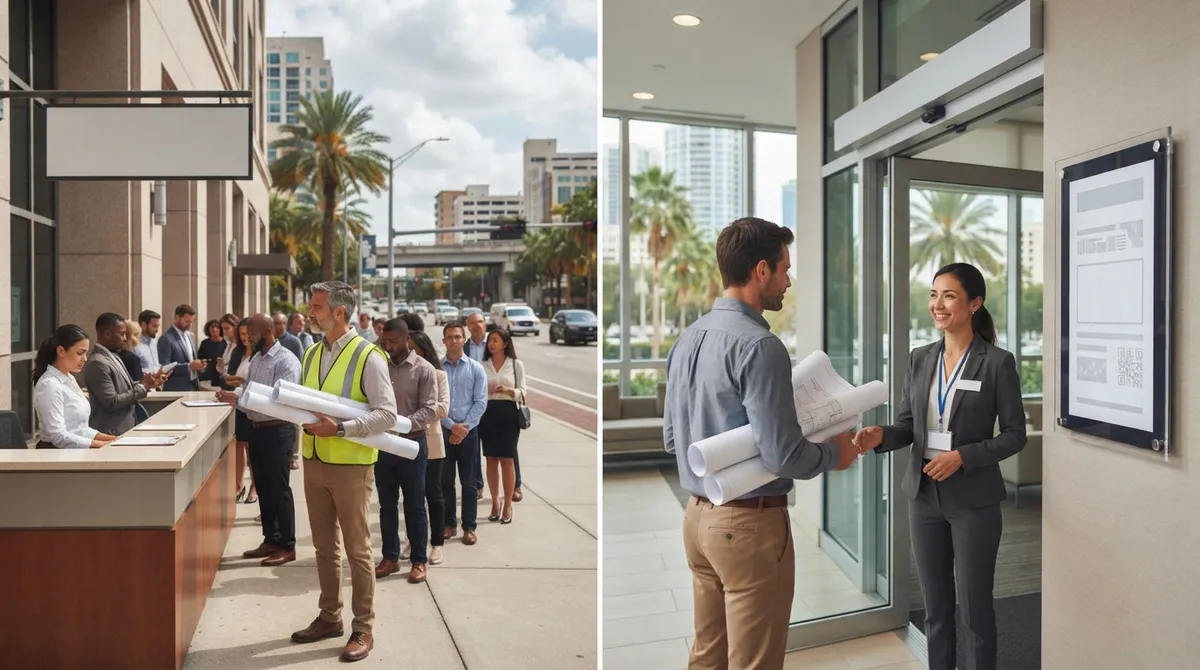
City Review vs. Private Provider Review: A Quick Comparison
Before you decide, it helps to see the two paths side by side.
| Factor | City of Tampa Plan Review | Private Provider Plan Review |
|---|---|---|
| Who reviews plans | City building department staff | Qualified private provider you hire |
| Who pays the reviewer | Covered by permit fees | Owner or authorized contractor pays provider directly |
| Election timing | Default path | Must be elected at permit application filing |
| Extra paperwork | Standard application | Notice to Building Official, DAR info, Plan Compliance Affidavit |
| City audit authority | Full review | City may audit and require corrections |
| Fee treatment | Standard permit fee | Tampa publishes a 30% reduction for qualifying projects |
The biggest takeaway is control. With private provider review, you choose the reviewer and gain more predictability, while the city still holds the final say.
Who Benefits Most From Using a Private Provider
Different readers get different wins from this option, so let's be specific.
- General contractors: When crews and subs are scheduled, every idle week costs money. A private reviewer can help keep momentum.
- Solar companies: Repeatable, code-compliant documentation is the heart of distributed energy work. Our guide on whether solar companies can use a private provider covers this in detail.
- Real estate professionals: Investors and agents often face closing deadlines that do not wait for a review queue.
- Homeowners and residential property owners: Additions, remodels, and structural changes can move faster with a professional guiding the paperwork.
- Architects, designers, and specialty trades: You get a dependable reviewer who speaks fluent plan set.
If you are a contractor, our page for general contractors explains how we support busy jobsites across Florida.
How to Use Private Provider Plan Review in Tampa: Step by Step
Ready to get moving? Follow these steps in order. The sequence matters more than you might think.
- Confirm your jurisdiction. Tampa and Hillsborough County are separate permitting jurisdictions. Your property address determines which rules and forms apply. Our building department lookup tool can help you verify this quickly.
- Decide before you file. Tampa warns that if you do not elect private provider plan review when the permit application is filed, the project is disqualified from using the program for that plan review.
- Hire a qualified private provider. Confirm licensing, statutory qualifications, and Tampa registration.
- Get written owner authorization. If a contractor is making the election, the owner's written authorization is required.
- Prepare the required documents. More on this in the next section.
- File the application with the election notice. Submit the signed, notarized Notice to Building Official at application.
- Submit the Plan Compliance Affidavit. This is required for each applicable submittal, resubmittal, and revision.
- Respond to any city audit findings. If the city identifies deficiencies, your provider may need to correct and recertify the plans.
Notice how much of this happens before the review even begins. Preparation is the secret ingredient.
The Documents Tampa Expects
Tampa's application materials call for several specific items. Having them ready prevents the dreaded "incomplete application" bounce-back.
| Document | Purpose | Notes |
|---|---|---|
| Notice to Building Official | Formally elects private provider plan review | Signed and notarized; filed with the application |
| Provider identification (DAR) | Identifies the Duly Authorized Representative | Required for the provider's firm |
| Plan Compliance Affidavit | Certifies the plans comply with the code | Needed for each submittal, resubmittal, and revision |
| Firm registration with the City | Registers the provider firm in Tampa | Includes registration form and DAR employment affidavit |
| Professional licenses | Verifies credentials of regulated personnel | Applicable to licensed staff |
Forms and procedures can change, so always confirm the current versions directly with the City of Tampa before you file. The city's private provider page is the best place to check.
Understanding Fees and Savings
Let's talk money, because that is usually the next question.
Tampa's published guidance describes a 30% reduction from the standard building permit fee for qualifying private provider projects. According to the city, the plan review reduction is processed when the application is accepted, and the inspection reduction is handled before permit issuance.
Remember, though, that you are also paying your private provider directly. So the true cost comparison is your provider's fee minus the permit fee reduction, weighed against the value of time saved.
Hillsborough County handles this differently. Its published fee schedule lists administrative fees for private provider projects at:
- 75% of the total permit fee when only plan review is private
- 50% when only inspections are private
- 25% when both plan review and inspections are private
Those county figures are not City of Tampa figures. If your property sits in unincorporated Hillsborough County, check our Hillsborough County page and the county's current schedule rather than assuming Tampa's numbers apply. Fee schedules change, so verify before budgeting.
Timing Rules You Cannot Afford to Miss
Deadlines are where good projects get derailed. Keep these front and center.
Plan review election
The owner or authorized contractor must notify the local building official in writing when the permit application is filed. There is no do-over later for that plan review.
Inspection notice
Florida Statute §553.791(4) requires written notice for private provider inspections at permit application or by 2 p.m. local time two business days before the first scheduled inspection. Tampa's page describes inspection notice more generally as needed before the first scheduled inspection, so follow both the statute and the current local instructions.
If you want inspections handled by the same team, explore our private provider plan review and inspections service.
What Happens After Your Provider Approves the Plans
Here is a point that surprises many first-timers: a private provider's approval does not automatically mean a permit lands in your inbox.
The local building official retains authority to audit the review and address code deficiencies. Tampa publishes a plan review audit process. If the audit finds problems, the provider may need to correct and recertify the plans before you resubmit.
This is why quality matters more than speed alone. A rushed review that fails audit can cost you more time than a careful one that sails through. Choose a provider who knows Tampa's expectations and treats the audit as a standard part of the process, not an unpleasant surprise.
If comments do come back, our revisions and resubmittals team works every reviewer comment until it is resolved.
Common Mistakes to Avoid
After years of watching permit files move through Florida jurisdictions, certain patterns pop up again and again. Steer clear of these.
- Filing first, deciding later. The election must happen at application. This is the number one dealbreaker.
- Skipping the affidavit on revisions. The Plan Compliance Affidavit is needed for every submittal, resubmittal, and revision.
- Using county forms for a city project. Tampa and Hillsborough County have separate procedures.
- Assuming private review covers everything. Zoning, fire, and site-related reviews still apply.
- Hiring an unregistered firm. Tampa requires provider registration and supporting documents.
- Ignoring audit feedback. Unresolved deficiencies stall permits.
If your permit has already hit a wall, our guide on why building permits get rejected can help you diagnose the problem, and our urgent permit rescue service exists for exactly those stressful moments.
How to Choose the Right Private Provider
Not all providers are created equal, so ask smart questions before signing anything.
- Are you registered with the City of Tampa, and can you show your DAR documentation?
- Do your reviewers hold the required professional licenses?
- How many Tampa plan sets have you taken through city audit?
- Can you produce sealed drawings and correct deficiencies in-house?
- How quickly do you respond when the city flags an issue?
That fourth question is a big one. When drafting, engineering, and review live under one roof, corrections happen faster because no one is waiting on an outside consultant to call back. That is exactly how we operate at 1 Contractor Solutions. Our in-house drafting and engineering team, with our own engineer sealing the work, means reviewer comments turn into fixes, not delays. We are also a licensed private provider, so we can perform your plan review ourselves.
For more on what separates strong providers from the pack, read 10 signs you found the best private provider.
Tampa vs. Other Florida Jurisdictions
Florida has 67 counties and hundreds of municipalities, and each one puts its own spin on private provider procedures. Tampa's forms and fee treatment will not match, say, Miami-Dade or Palm Beach County. If you work across regions, see how it plays out in Miami-Dade and Palm Beach.
The lesson: always work from the rules of the jurisdiction where the property sits. Our Tampa page gives local context, and our broader guide on which Florida jurisdiction reviews your project helps when city lines get blurry.
A Quick Pre-Filing Checklist
Before you hit submit on that Tampa application, run through this list one more time:
- Property address confirmed as inside City of Tampa limits
- Private provider hired, registered, and credentialed
- Owner's written authorization in hand, if a contractor is filing
- Notice to Building Official signed and notarized
- DAR information and provider documents ready
- Plan Compliance Affidavit prepared for the initial submittal
- Zoning, fire, and site reviews mapped out separately
- Current fees and forms verified with the City of Tampa
Checking every box takes a little effort upfront, but it is far easier than untangling a disqualified application later.
Ready to Move Your Tampa Permit Forward?
Private provider plan review can be a real game changer in Tampa, offering more control, a published fee reduction, and a smoother path when handled correctly. The key is planning early, filing the election at the right moment, and working with a team that knows how the city audits.
At 1 Contractor Solutions, we act as Florida's outsourced permitting department. We answer 24/7, respond within 30 minutes, and handle everything from plans and engineering to filing, tracking, and closeout. Want to see what customers say? Read reviews and visit us on Google — 1 Contractor Solutions, and feel free to follow us on LinkedIn or follow us on Facebook for Florida permitting tips.
Have a Tampa project waiting on plan review? Get a free quote today and let us help you keep your project moving.
FAQs
What is a private provider plan review in Tampa?
It is an option under Florida Statute §553.791 that lets an owner, or a contractor with written owner authorization, hire a qualified professional to review plans for Florida Building Code compliance. The city still audits the work and keeps enforcement authority, so it supplements the process rather than replacing every approval.
When do I need to notify Tampa that I am using a private provider?
You must give written notice to the building official when the permit application is filed. Tampa warns that missing this step disqualifies the project from using private provider plan review, so decide before you submit.
Does using a private provider reduce Tampa building permit fees?
Tampa's published guidance describes a 30% reduction from the standard building permit fee for qualifying projects. You still pay your provider directly, and fee schedules can change, so confirm current numbers with the City of Tampa.
Does a private provider plan review guarantee Tampa will issue my permit?
Not automatically. The local building official can audit the review and flag code deficiencies, and your provider may need to correct and recertify the plans. Zoning, fire, and site-related approvals also remain separate requirements.
Do Tampa's private provider rules also apply in Hillsborough County?
No, they are separate jurisdictions with their own instructions, forms, and fee schedules. Always use the rules for the jurisdiction where your property is located, and verify details directly with that office.
We do this work every day across all 67 Florida counties. Call (866) 314-6931 and we will tell you what your situation actually requires — including when you do not need us.
Related services
Permit Facilitation & Filing
You have a crew scheduled, a client asking for dates, and a permit sitting somewhere in a queue you cannot see. We file it, w…
See the servicePlan Review Coordination
A permit in plan review is not one queue. On a commercial project it can be six queues, each with its own reviewer, its own c…
See the serviceReady to get your permit moving?
One call tells you which jurisdiction controls your project, what it will take, and what it will cost. Most of the time we can scope it on the phone.