
Blog
How Can Roofing Companies Scale Permit Volume in South Florida?
Discover practical, jurisdiction-specific strategies roofing companies use to scale permit volume across Miami-Dade, Broward, and Palm Beach counties.

Key Takeaways
-
Build jurisdiction-specific permit playbooks for each city/county rather than forcing one standard process, since Miami-Dade, Broward, and Palm Beach counties each have different portals, forms, and fee schedules that vary even within municipalities.
-
Create standardized, roof-system-specific application templates (tile reroof, shingle reroof, flat roof) with pre-filled boilerplate information and require a second-set-of-eyes review before submission to eliminate the correction cycle that delays permits during high-volume periods.
-
Centralize permit intake with dedicated staff monitoring portal status across all jurisdictions using a shared tracking system, rather than letting individual crews submit independently, to prevent jobs from slipping through during busy storm-recovery months.
-
Use online e-permitting portals where available (Miami-Dade offers 2 a.m.–5 p.m. daily access) but verify the correct submission channel for each property address first, since submitting to the wrong portal causes days of delays waiting for rejection notices.
-
Verify current Florida Building Code editions (8th Edition as of Dec 31, 2023) and confirm local form versions before submitting permit batches, since code requirements and HVHZ-related documentation overlap and jurisdictions sometimes reference older editions.
-
Consider partnering with a dedicated Florida permitting services provider once internal scaling becomes inefficient, since they handle jurisdiction research, application prep, corrections, and fee tracking while you focus on crews and closing jobs.
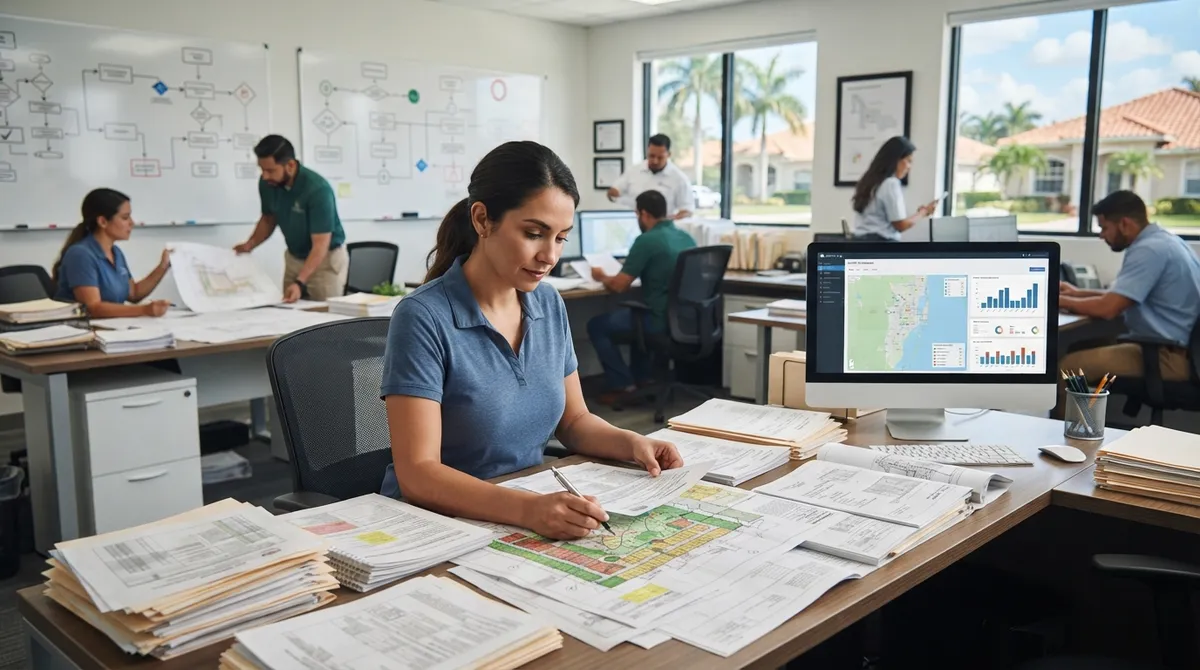
If you run a roofing company anywhere from Miami to West Palm Beach, you already know the drill. Storm season rolls through, insurance claims pile up, and suddenly you have thirty roofs to permit instead of three. The tools are there — good crews, good materials, happy homeowners — but the permit process can turn a great month into a bottleneck month if you are not set up to handle the volume. The good news? Scaling permit volume in South Florida is absolutely doable once you treat it like the operational challenge it really is, not an afterthought tacked onto the end of a sales cycle.
We work with roofing contractors across Miami-Dade County, Broward County, and Palm Beach County every single week, and we have seen firsthand what separates the crews who scale smoothly from the ones stuck refreshing a portal at midnight. This article walks through exactly how to build a permit process that grows with your business, without losing sleep over rejected applications or missed inspections.
Why South Florida Permit Volume Is Its Own Kind of Puzzle
South Florida is not one market — it is dozens of them stitched together. Miami-Dade County, Broward County, and Palm Beach County each run their own systems, and inside those counties, individual cities often have their own portals, forms, and fee schedules layered on top. A roof replacement two blocks apart can fall under completely different rules depending on which side of a municipal line the house sits on.
That is the real challenge behind scaling permit volume: it is not about doing more of the same thing faster. It is about managing dozens of slightly different workflows at once, without letting any single one slip through the cracks. Contractors who try to force one standard process across every jurisdiction usually end up with a stack of rejected applications and frustrated crews sitting idle waiting on paperwork.
Jurisdiction-by-Jurisdiction Thinking Beats One-Size-Fits-All
Instead of assuming a single regional permit process, successful roofing companies build a jurisdiction-specific playbook. That means knowing, before the crew even shows up to quote the job, which city or county authority controls the property, what their roofing permit application looks like, and what documentation they typically expect.
- Confirm the authority having jurisdiction using an address-based lookup rather than assuming based on mailing address or zip code
- Keep a running reference sheet of which municipalities use their own e-permitting portal versus routing through the county
- Track fee schedules separately, since they vary widely between cities like Fort Lauderdale, Boca Raton, and unincorporated Miami-Dade
- Note which jurisdictions require notarized documents, homeowner signatures, or additional hurricane-mitigation paperwork
A building department lookup tool can save your permit staff hours every week by removing the guesswork about which office actually reviews a given address.

Start With Standardized, Complete Application Packages
The single biggest driver of permit delays is incomplete or inconsistent applications. When you are filing three or four permits a month, a little inconsistency is annoying. When you are filing thirty or forty, it becomes a full-blown operational drag, with reviewers sending back corrections faster than your team can process them.
Miami-Dade County's roofing guidance calls for a Uniform Roofing Permit Application along with project-specific details like roof type, roof system, and roof plan. Some submissions also need ventilation calculations and hurricane-mitigation details. Building a standardized, roof-system-specific template for each common scenario — tile reroof, shingle reroof, flat roof recover — means your team is not reinventing the wheel on every job.
Build Templates by Roof System, Not Just by City
- Create a master checklist for each roof system type you commonly install
- Pre-fill as much boilerplate contractor and license information as portals allow
- Attach current Notice of Acceptance (NOA) or product approval documentation matched to the specific product being installed
- Double-check ventilation and attachment calculations before submission, since these are common rejection points
- Have a second set of eyes review the package before it goes into any portal
This kind of internal quality control step feels like it slows things down at first, but it actually speeds up your overall throughput because you avoid the back-and-forth cycle of corrections that can stretch a routine reroof permit into a multi-week ordeal.
Use Online Permitting Where It Is Available — Carefully
Miami-Dade County offers qualified contractors online e-permitting for roofing permits, covering application submission, fee payment, and permit-card printing. The service runs seven days a week, generally from 2 a.m. to 5 p.m., which gives permit coordinators a wide window to submit and check status without needing to visit a building department in person.
The City of Miami takes a similar approach but requires new permit applications to be started electronically through either iBuild or ePlan. Meanwhile, some municipalities inside Miami-Dade run their own separate e-municipal systems entirely, while others route submissions through the county's portal. This patchwork is exactly why verifying the correct submission channel for each property matters so much before you scale volume.
| Jurisdiction Type | Typical Submission Method | Key Consideration |
|---|---|---|
| Unincorporated Miami-Dade County | County online e-permitting portal | Available 2 a.m.–5 p.m. daily; some roofing work with plans requires separate electronic submission |
| City of Miami | iBuild or ePlan (required starting point) | All new applications must begin electronically |
| Select municipalities | Independent e-municipal systems | Requirements and portals vary by city; always verify before submitting |
| Other Miami-Dade municipalities | Routed through county portal | Confirm which authority actually reviews the specific address |
Online submission reduces in-person handling, which is a real time-saver as volume grows. But it only helps if your team knows exactly which portal applies to which address — otherwise you risk submitting into the wrong queue and losing days waiting for a rejection notice.
Code Requirements You Cannot Afford to Miss
The Florida Building Code, 8th Edition (2023), has been in effect since December 31, 2023, and it governs the baseline requirements for roofing work statewide. However, Miami-Dade's roofing guidance also references a High Velocity Hurricane Zone uniform application still tied to the 7th Edition (2020) in certain contexts. That kind of overlap is exactly why contractors scaling their permit volume should never assume last year's packet or reference sheet is still accurate.
Before submitting a batch of permits, it is worth confirming current code editions and local form versions directly through the Florida Building Commission's official code resources, since local jurisdictions sometimes lag or reference specific editions for HVHZ-related work. A quick verification step here can prevent an entire batch of applications from bouncing back for the same avoidable reason.
Practical Steps to Increase Permit Throughput
Once your documentation and jurisdiction knowledge are solid, the next lever is process design. Here is how roofing companies that successfully scale their permit volume typically structure their internal operations:
- Centralize permit intake with one team or point person, rather than letting individual crews or sales reps submit applications independently
- Maintain current license, insurance, and workers' comp documentation on file so it never holds up a submission
- Assign dedicated staff to monitor portal status, review comments, and inspection scheduling across all active jobs
- Track every open permit in a shared system so nothing falls through the cracks during busy storm-recovery months
- Build relationships with plan reviewers and building department staff in your highest-volume jurisdictions
- Set internal deadlines for responding to correction comments, since slow responses compound delays across your entire pipeline
A private compilation of city permit records reported 6,737 roofing permits issued in 2025 across five Palm Beach County cities — Boca Raton, West Palm Beach, Delray Beach, Wellington, and Palm Beach Gardens — down from 7,572 in 2024 but up from 6,277 in 2023. The same source noted that March through May accounted for roughly 28.1% of permits issued across that three-year span. While these figures are directional rather than official countywide totals, they underscore just how seasonal and volume-heavy South Florida roofing permitting can get, especially right after hurricane season.
When It Makes Sense to Bring in a Permitting Partner
At a certain point, most roofing companies hit a ceiling where adding more internal staff to chase permits stops being efficient. That is usually the moment to consider partnering with a dedicated Florida permitting services provider who already understands the jurisdictional quirks across Miami-Dade, Broward, and Palm Beach counties.
This is exactly the gap 1 Contractor Solutions fills for roofing contractors scaling their volume. Our team handles jurisdiction research, application preparation, submission, correction follow-up, fee tracking, and permit-card delivery — while you stay focused on running crews and closing jobs. We even run a dedicated Roof Permit Partnership Program built specifically for roofing companies that need consistent, high-volume permit support without hiring an entire in-house department.
Because our drafting and engineering work is done in-house, with our own engineer sealing documentation, we can respond to reviewer comments quickly instead of waiting on an outside consultant to call back. That matters enormously when you are managing dozens of open permits simultaneously across multiple counties. You can browse our full roof permit services or check out support built specifically for roofing contractors to see how the process fits into your existing operation.
What a Permitting Partner Actually Takes Off Your Plate
- Researching which authority governs each property before the crew is even scheduled
- Preparing standardized, roof-system-specific application packages
- Submitting through the correct portal or in-person channel for each jurisdiction
- Tracking review comments, deadlines, and inspection scheduling across every open file
- Following up on corrections quickly so jobs do not sit idle
- Delivering the final permit card and closing out the file properly
The contractor still remains responsible for accurate project information, proper licensing, and overall compliance with the authority having jurisdiction — a good permitting partner supports that responsibility rather than replacing it. If you want to see how this looks in practice for a business your size, it is worth reaching out to get a free quote and walk through your current permit volume together.
Keeping Track of It All: Tools That Help
Even with a great process, scaling permit volume without good tracking tools is like driving with your eyes closed. A few resources worth building into your workflow:
| Tool or Resource | Purpose |
|---|---|
| Open permit search | Check for existing open permits on a property before submitting new work |
| Building department lookup | Confirm the correct authority having jurisdiction for any address |
| Contractor registration checklist | Verify municipality registration is current before submitting in a new city |
| Miami-Dade County permit search | Track official status of Miami-Dade filings directly |
Setting aside even fifteen minutes a day for a dedicated team member to run through these tools across your active job list can catch small issues — an expired registration, a missed inspection window — before they turn into scheduling headaches for your crews.
Bringing It All Together
Scaling permit volume in South Florida really comes down to three things: knowing exactly which jurisdiction governs each job, submitting complete and standardized application packages every time, and staying on top of every open file until it closes. None of that requires reinventing your business — it requires building repeatable systems, and knowing when it makes sense to lean on outside support.
We have spent more than fifteen years helping roofing companies, general contractors, and property owners navigate exactly this kind of growth across all 67 Florida counties. If you would like to see what other roofing contractors and clients say about working with us, feel free to visit us on Google — 1 Contractor Solutions, or connect with us on social through LinkedIn and Facebook for regular updates on Florida permitting trends.
Whether you are filing five roofing permits a month or fifty, the goal is the same: happy homeowners, moving crews, and a permit desk that never becomes the bottleneck. If your current process is starting to creak under growing volume, we would love to talk through what scaling could look like for your team — reach out today to get a free quote and let's build a permit process that actually keeps up with your business.
FAQs
How do roofing contractors get more roofing permits approved in South Florida?
The trick is building complete, standardized application packages tailored to each roof system, and double-checking them before submission. When your paperwork matches exactly what a jurisdiction expects the first time, you avoid the correction cycle that eats up so much time as volume grows.
Can roofing contractors apply for Miami-Dade roofing permits online?
Yes! Miami-Dade County offers qualified contractors online e-permitting for roofing permits, including application submission, fee payment, and permit-card printing, available seven days a week from 2 a.m. to 5 p.m. Just note that some roofing work requiring plans follows a separate electronic submission process, so it pays to verify the correct route first.
Do roofing permit requirements differ between Miami-Dade, Broward, and Palm Beach counties?
They absolutely do, and honestly, that is the biggest hurdle for roofing companies trying to scale. Each county — and often individual cities within them — has its own forms, fee schedules, and submission portals, so a jurisdiction-specific process (or a knowledgeable permitting partner) makes a huge difference.
How can a roofing company reduce permit application rejections and delays?
Start with roof-system-specific templates, keep license and insurance documentation current, and have a second set of eyes review every package before submission. It also helps to track review comments closely so you can respond to corrections quickly instead of letting them sit.
Can a permit service submit roofing permits on behalf of a contractor in Florida?
Yes, a Florida permitting services partner can handle jurisdiction research, application prep, submission, correction follow-up, and status tracking on your behalf. The contractor still stays responsible for accurate project details and proper licensing, but a good partner takes the day-to-day permit chase off your plate entirely.
We do this work every day across all 67 Florida counties. Call (866) 314-6931 and we will tell you what your situation actually requires — including when you do not need us.
Related services
Permit Facilitation & Filing
You have a crew scheduled, a client asking for dates, and a permit sitting somewhere in a queue you cannot see. We file it, w…
See the servicePlan Review Coordination
A permit in plan review is not one queue. On a commercial project it can be six queues, each with its own reviewer, its own c…
See the serviceReady to get your permit moving?
One call tells you which jurisdiction controls your project, what it will take, and what it will cost. Most of the time we can scope it on the phone.